
Local Law G7
PRESCRIPTIVE ENERGY CONSERVATION MEASURES FOR CERTAIN COVERED BUILDINGS
Article 321 Filing Guide
Version 1.c, S/1S/2024
Background


Article 321 Filing Guide, rev.S/1S/2024
Page 1 of c1
I. Background
(#1) Temperature set points (#2) Repair leaks (#3) Heating system function (#4) Radiator temperature controls* (#5) Piping insulation (#6) Water tank insulation (#7) Indoor/outdoor temp. sensors* (#8) Steam traps* (#9) Master steam system venting* (#10) Lighting (#11) Building envelope (#12) Exhaust fan timers (#13) Radiant barriers
- Covered buildings
- Rent regulated accommodations and other affordable housing
- Houses of worship
- Definitions
Article 321 compliance pathways
- PECM verification procedures – General
- Clarification of the Article 321 PECMs (includes PECM verification procedures – Specific)
Penalty mitigation
- Unexpected or unforeseeable event
- Eligible energy conservation project
- Mediated resolution
NYC Accelerator service types
- Acknowledgements
I. Background
This Article 321 Filing Guide has been developed through collaboration between the Department of Buildings (“the
Department”) and members of the design, auditing, and energy services communities. Comments and questions related to the Guide may be sent to the Department at GHGEmissions@buildings.nyc.gov.
Greenhouse gas (“GHG”) emissions – which are not limited to carbon dioxide (CO2 or CO2) but are often collectively referred to as “carbon emissions” or simply “carbon” – greatly alter climate and weather patterns when concentrated in the Earth’s atmosphere. Therefore, to slow the increasing frequency of extreme weather events, it is imperative to reduce the production of GHG emissions through a strategy of decarbonization.
Local Law 97 of 2019 (“LL97”), as amended, is designed to greatly reduce building operational carbon emissions toward a goal of net zero by 2050. To understand LL97 as a whole, please see this presentation from the Department’s Office of Building Energy and Emissions Performance (“OBEEP”), this page on the Department’s website, and the citywide strategy outlined here by the New York City (“NYC”) Mayor's Office of Climate and Environmental Justice (“MOCEJ”). General questions about LL97 can go to CUNY’s Building Performance Lab (“BPL”), aka the NYC Sustainability Help Center, which also offers trainings.
LL97 was first enacted in 2019 as part of a package known as the Climate Mobilization Act. The original LL97 text was later modified by LL147 of 2019, LL95 of 2020, LL116 of 2020, LL117 of 2020, LL126 of 2021 and LL77 of 2023; the composite law is still referred to as LL97. It is made up of Articles, which are primary legislation enacted by the NY City Council, and supported by Rules, which are secondary legislation enacted by the Department. LL97’s Articles pertaining to privately-owned buildings are Article 320 and Article 321 of Chapter 3 of Title 28 of the NYC Administrative Code. Article 320’s corresponding Rule is 1 RCNY §103-14; Article 321’s corresponding rule is 1 RCNY §103-17. These Rules (and future Rules) were informed by the yearslong research and discussion of the LL97 Advisory Board and its eight Working Groups, as memorialized in the *LLS7 Advisory Board Report* (2022).
(#1) Temperature set points (#2) Repair leaks (#3) Heating system function (#4) Radiator temperature controls* (#5) Piping insulation (#6) Water tank insulation (#7) Indoor/outdoor temp. sensors* (#8) Steam traps* (#9) Master steam system venting* (#10) Lighting (#11) Building envelope (#12) Exhaust fan timers (#13) Radiant barriers
Articles 320 and 321 apply to certain structures categorized as covered buildings, as described in Section I(A) of this guide. Two types of covered building are allowed to follow Article 321: certain types of affordable housing and houses of worship. When Article 321 applies to a building, it applies to all portions of that building – even those that are neither certain types of affordable housing nor houses of worship. However, separate buildings on the same lot could be subject to Article 320 instead.
NOTE: Article 321 does not apply to covered buildings whose first occupancy is on or after January 1, 2025. For those buildings, compliance with the most recent NYC Energy Conservation Code (“NYC ECC”) is the way to address emissions reduction.
I(A). Covered buildings
The size threshold for LL97 is over 25,000 gross square feet (“GSF”) for a single building or over 50,000 GSF for multiple buildings that are either on a single lot or governed by the same board of managers; see chart on page 5 of this Guide.
Covered buildings lists (“CBLs”), compiled by the Department using Department of Finance (“DOF”) data, are downloadable here. The CBLs are intended as a preliminary reference only and are subject to change due to circumstances unknown to the Department. The absence of a lot from the list cannot be construed to mean relief from LL97 or any other applicable law; conversely, the presence of a lot on the list can be challenged, with DOF or the Department revising the list upon evidence of more accurate/current information.
Building owners should consult with legal representatives and registered design professionals (“RDPs”) if there are any perceived discrepancies with the CBLs. When a building is subject to more than one compliance path, the building may appear on more than one CBL; in this circumstance, the highest-numbered tier from the Department’s CBL Matrix applies. (For more context, a webinar describing CBL-related issues is available on the Department’s YouTube channel here.)
(#1) Temperature set points (#2) Repair leaks (#3) Heating system function (#4) Radiator temperature controls* (#5) Piping insulation (#6) Water tank insulation (#7) Indoor/outdoor temp. sensors* (#8) Steam traps* (#9) Master steam system venting* (#10) Lighting (#11) Building envelope (#12) Exhaust fan timers (#13) Radiant barriers
Because CBLs are compiled at lot level, the entire lot is flagged even if individual buildings on the lot may be excepted or follow alternative compliance pathways. And because each covered building must show compliance with its own specific pathway, the submission of reports – and issuance of associated penalties by the Department – takes place at the level of an individual building (as designated by a Building Information Number, “BIN”). Combined reports covering more than one building are possible in certain cases; see Section II of this Guide for more details. For the purposes of this Guide, the word “lot” shall be construed to mean BBL and the word “building” shall be construed to mean BIN unless otherwise indicated by the text.
Covered buildings that require upgrades to improve efficiency and reduce emissions may be eligible for various types of incentives, financing, and technical assistance. NYC Accelerator has a list of financing options here. The New York State Energy Research and Development Authority (“NYSERDA”) lists financial and technical support options here.
GSF vs. GFA:
- GSF = Gross Square Feet or Gross Square Footage, as defined in 1 RCNY §103-06, is the “total square footage as provided in Department of Finance records.” As noted above, it is GSF that determines whether or not a building is “covered” under LL97. Recorded GSF will not be revised simply because a different GFA number is submitted for LL97 reporting purposes; GSF can only be revised if a specific petition is made to DOF, as described here.
- GFA = Gross Floor Area, as defined in 1 RCNY §103-06, 1 RCNY §103-14(a), and Section 202 of the NYC Building Code (“BC”), includes “all floors and spaces in a covered building” and may be different than the building’s GSF as recorded by DOF. GFA should be verified by an RDP when an Article 321 building elects to use the Performance- based Pathway rather than the Prescriptive Pathway (as described in Section II of this Guide).
(#1) Temperature set points (#2) Repair leaks (#3) Heating system function (#4) Radiator temperature controls* (#5) Piping insulation (#6) Water tank insulation (#7) Indoor/outdoor temp. sensors* (#8) Steam traps* (#9) Master steam system venting* (#10) Lighting (#11) Building envelope (#12) Exhaust fan timers (#13) Radiant barriers
| Definitions of "covered building" | General exceptions (for more specific exceptions, see the law) |
|
| Article 320 / 1 RCNY §103-14, Building Energy and Emissions Limits (Local Law 97) |
• Single building > 25,000 GSF; • Multiple buildings, either on the same tax lot or governed by the same board of managers, which are in aggregate > 50,000 GSF (even if individual buildings are < 25,000 GSF).Not covered until CY202c: • Buildings with at least one, but no more than 35%, rent- regulated dwelling units.Not covered until CY2035: • Certain types of affordable housing not subject to Article 321, as per the rightmost (green) column in this flowchart.Annual CBLs here. |
• Certain utilities; • Certain garden-style apartments; • City buildings, except for the eleven CUNY senior (4-year) colleges; and • Buildings covered under Article 321. |
| Article 321 / 1 RCNY §103-17, Energy Conservation Measure Requirements for Certain Buildings (Local Law 97) |
Buildings meeting the same size thresholds as Article 320 that (as explained on the next few pages of this Guide): • Are certain types of affordable housing; or • Have verified more than 50% of the space is used for the purpose of worship.Annual CBL here. |
• Certain utilities; and • Certain garden-style apartments. |
(#1) Temperature set points (#2) Repair leaks (#3) Heating system function (#4) Radiator temperature controls* (#5) Piping insulation (#6) Water tank insulation (#7) Indoor/outdoor temp. sensors* (#8) Steam traps* (#9) Master steam system venting* (#10) Lighting (#11) Building envelope (#12) Exhaust fan timers (#13) Radiant barriers
I(B). Certain types of affordable housing
If a residential structure is a covered building, it is subject to Article 321 when it contains the specific type and amount of affordable housing prescribed in the definitions of covered building and rent regulated accommodation in §28-321.1; further details below. (Categories of affordable housing not listed below are subject to Article 320.)
- Buildings in which more than 35% of dwelling units are subject to rent regulation based upon:
- The Emergency Tenant Protection Act of 1974; or
- The Rent Stabilization Law of 1969; or
- The Local Emergency Housing Rent Control Act of 1962.
NOTE: If the percentage of rent regulated units is initially more than 35% but later falls to 35% or less, then the building will become subject to Article 320 starting January 1st of the year following the change.
- Housing Development Fund Company co-ops (HDFC co-ops, incorporated under the Business Corporation Law and Article XI of the Private Housing Finance Law)
- Buildings with 1 or more units participating in a project-based federal housing program, such as:
- Section 8 Project-Based Rental Assistance (“PBRA”); or
- NYCHA Permanent Affordability Commitment Together (“PACT”); or
- Section 202 financing (supportive housing for the elderly); or
- Section 811 financing (supportive housing for persons with disabilities); or
- Continuum of Care (“CoC”) leases serving formerly homeless individuals and families.
(#1) Temperature set points (#2) Repair leaks (#3) Heating system function (#4) Radiator temperature controls* (#5) Piping insulation (#6) Water tank insulation (#7) Indoor/outdoor temp. sensors* (#8) Steam traps* (#9) Master steam system venting* (#10) Lighting (#11) Building envelope (#12) Exhaust fan timers (#13) Radiant barriers
NOTE: Buildings with dwelling units rented using federal assistance that is not project-based but tenant-based, such as Section 8 Housing Choice Vouchers (“HCVs”), are not necessarily subject to Article 321. This is because tenant-based assistance is attached to the occupant and not to the building.
For more information on LL97 as it relates to rent regulated accommodation, see the Department of Housing Preservation and Development (“HPD”)’s webpage, flowchart, and FAQ. For instructions on how to obtain documentation/proof in support of a building’s specific rent regulated status, see the rightmost column of the CBL Matrix.
I(C). Houses of worship
While the text of Article 321 says that it applies to covered buildings “whose main use or dominant occupancy is classified as occupancy group A-3 religious house of worship”, many older buildings do not have Certificates of Occupancy (“COs”), Letters of No Objection (“LNOs”), or other official documentation of use.
DOB does not have complete data regarding whether a building meets the definition of a house of worship in the law. This means that Preliminary CBLs for Articles 320 and 321 may not accurately represent the correct compliance pathway for HOW buildings. These lists are compiled based upon the best information available, but certain building characteristics are unknown to DOB and must be certified by a Registered Design Professional (RDP). The steps for confirming whether your building is subject to Article 321 as a House of Worship are described under the item “Houses of Worship” in the Department’s CBL FAQ and require RDP certification of floor area measurements.
NOTE: regardless of whether the building is on the Article 321 CBL, if less than 50% of the floor area is used as assembly space for religious purposes (occupancy group A-3, “House of Worship”) then the building may actually be subject to Article 320.
(#1) Temperature set points (#2) Repair leaks (#3) Heating system function (#4) Radiator temperature controls* (#5) Piping insulation (#6) Water tank insulation (#7) Indoor/outdoor temp. sensors* (#8) Steam traps* (#9) Master steam system venting* (#10) Lighting (#11) Building envelope (#12) Exhaust fan timers (#13) Radiant barriers
I(D). Definitions
Common areas
Common areas are spaces that are made use of by multiple tenants in a building. The term includes lobbies, amenity spaces, and shared storage rooms; it also includes non-occupiable space such as corridors, stairwells, janitorial closets, and equipment rooms.
Condensate
In steam heating systems, the liquid formed when steam releases heat energy and condenses into water mixed with dissolved gases. Condensate must be drained out of the system so it does not cool the remaining steam, leak onto floors, or create water hammer.
NOTE: To improve efficiency, the condensate water and remaining heat energy can be recovered. Whenever hot condensate is discharged into a zone of lower pressure it can flash back into steam, which can also be recovered – although steam flashing typically does not happen in residential applications.
Dwelling unit
Per sections R202 and C202 of the 2020 NYC ECC, “A single unit providing complete independent living facilities for one or more persons, including permanent provisions for living, sleeping, eating, cooking and sanitation.”
Electric resistance heating
A type of heating that results from passing electrical current directly through a conductor and capturing the heat released thereby. It is less energy-efficient than using electricity to power a process, such as in an electric heat pump or induction cooktop.
(#1) Temperature set points (#2) Repair leaks (#3) Heating system function (#4) Radiator temperature controls* (#5) Piping insulation (#6) Water tank insulation (#7) Indoor/outdoor temp. sensors* (#8) Steam traps* (#9) Master steam system venting* (#10) Lighting (#11) Building envelope (#12) Exhaust fan timers (#13) Radiant barriers
Hydronic heating
A heating system that works by running hot water through a series of pipes and radiators.
Instrumentality
An independent entity that serves the public good and is sponsored / overseen by government but is not a government agency. Instrumentalities are exempt from taxation by other levels of government – e.g., federal instrumentalities like the Federal Reserve and Fannie Mae cannot be taxed by states, and local instrumentalities like port authorities and public universities / hospitals / libraries cannot be taxed by the federal government.
Non-common owner areas
Non-common owner areas are spaces that are made use of by ownership and not generally by tenants. The term includes management offices, staff locker rooms, and non-tenant storage rooms.
Non-common tenant areas
Non-common tenant areas include dwelling units, community facilities, and retail stores, both leased and unleased.
One-pipe vs Two-pipe heating
One-pipe steam heating means that the same riser or branch pipe both supplies steam to radiators and collects condensate return from those radiators. Two-pipe steam heating means that the supply pipe is separate from the return pipe, resulting in more evenly distributed heating. One-pipe steam radiators are recognizable by being served by a single pipe, whereas two-pipe steam and all hydronic radiators have both a supply pipe and a return pipe.
Qualified Retro-commissioning (RCx) agent
See 1 RCNY §103-17(a) for required qualifications/credentials.
(#1) Temperature set points (#2) Repair leaks (#3) Heating system function (#4) Radiator temperature controls* (#5) Piping insulation (#6) Water tank insulation (#7) Indoor/outdoor temp. sensors* (#8) Steam traps* (#9) Master steam system venting* (#10) Lighting (#11) Building envelope (#12) Exhaust fan timers (#13) Radiant barriers
Background
Article 321 Filing Guide, rev.S/1S/2024
Page 10 of c1
II. Article 321 compliance pathways
(#1) Temperature set points (#2) Repair leaks (#3) Heating system function (#4) Radiator temperature controls* (#5) Piping insulation (#6) Water tank insulation (#7) Indoor/outdoor temp. sensors* (#8) Steam traps* (#9) Master steam system venting* (#10) Lighting (#11) Building envelope (#12) Exhaust fan timers (#13) Radiant barriers
- Covered buildings
- Rent regulated accommodation and other affordable housing
- Houses of worship
- Definitions
Article 321 compliance pathways
- PECM verification procedures – General
- Clarification of the Article 321 PECMs (includes PECM verification procedures – Specific)
Penalty mitigation
- Unexpected or unforeseeable event
- Eligible energy conservation project
- Mediated resolution
NYC Accelerator service types
- Acknowledgements
II. Article 321 compliance pathways
As outlined in §28-321.3 and 1 RCNY §103-17(b), Article 321 compliance can be achieved by submitting a timely report that follows one of two pathways:
- The Performance-based Pathway (§28-321.2.1, “Energy compliant buildings”) report is certified by an RDP and shows that the building’s calculated emissions for 2024 were under the emissions limit for calendar year 2030, using the 2030 emissions coefficients, as described in §28-320.3.2 and expanded upon in 1 RCNY §103-14.
- The Prescriptive Pathway report is certified by a qualified retro-commissioning (“RCx”) agent and demonstrates the completion (or non-applicability) of the 13 Prescriptive Energy Conservation Measures (“PECMs”) listed in §28-
321.2.2. Sections II(A) and III of this Guide focus on the Prescriptive Pathway.
Unless a deadline extension is granted by the Department, the one-time Article 321 compliance report is due by May 1, 2025.
Even after submission of the one-time Article 321 report, buildings must continue to submit annual Benchmarking and
decennial Energy Efficiency Reports (“EERs”) as applicable. And as described in Section I(B)(1) of this Guide, if a building ever loses its Article 321 eligibility it will become subject to annual Article 320 reporting.
Extension requests, subject to approval by the Department and outlined in 1 RCNY §103-17(d)(2), may be submitted until June 30, 2025 for one of the following reasons:
- The RDP or RCx agent attests that they will not be able to finish the report until August 2G, 2025; or
- There is a pending challenge to DOF or the Department regarding the building lot’s inclusion on a CBL, as described in the CBL FAQ. If the challenge is disapproved, the report must be filed within 120 days of the date of disapproval.
(#1) Temperature set points (#2) Repair leaks (#3) Heating system function (#4) Radiator temperature controls* (#5) Piping insulation (#6) Water tank insulation (#7) Indoor/outdoor temp. sensors* (#8) Steam traps* (#9) Master steam system venting* (#10) Lighting (#11) Building envelope (#12) Exhaust fan timers (#13) Radiant barriers
NOTE: Per 1 RCNY §103-17(b), multiple buildings on the same lot or adjacent lots, all under the same owner and all following the same Article 321 compliance pathway, have the option of submitting a combined report under one filing fee and certification. If following the Prescriptive Pathway, separate templates (see below) per building are still required. If following the Performance-based Pathway, the guidelines for combined reports may be found in the “Shared energy service” section of the Article 320 Info Guide, even for those buildings that do not share energy service.
PECM verification procedures - General
- To be considered “in good standing”, the RCx agent’s credentials must be valid at both the time of inspection(s) and the
time of report submission.
- The qualified RCx agent must maintain a record of inspections performed, deficiencies identified, and re-inspections after repairs. Such records may be requested by the Department at any time, and all submitted reports are subject to audit.
- In HOWs, for PECMs requiring sampling of common and non-common areas, all front-of-house HOW spaces can be considered “common area”. Back-of-house spaces serving the HOW can be considered “non-common owner area”, and long-term leased spaces (including residential uses, if applicable) can be considered “non-common tenant area”.
- Report formatting is described in 1 RCNY §103-17(b) and Section III of this Guide. Eight PECMs only require attestations by the RCx agent; for these, backup documentation can be reserved until requested by the Department.
- Five of the PECMs require documentation to be uploaded by the reporting deadline.
- One of them, (#10) Lighting, must submit a Local Law 88 of 2009 (“LL88”) report. The other four, indicated with an asterisk throughout, can be satisfied by submitting Department-provided templates:
- (#4) Radiator temperature controls*
- One of them, (#10) Lighting, must submit a Local Law 88 of 2009 (“LL88”) report. The other four, indicated with an asterisk throughout, can be satisfied by submitting Department-provided templates:
(#1) Temperature set points (#2) Repair leaks (#3) Heating system function (#4) Radiator temperature controls* (#5) Piping insulation (#6) Water tank insulation (#7) Indoor/outdoor temp. sensors* (#8) Steam traps* (#9) Master steam system venting* (#10) Lighting (#11) Building envelope (#12) Exhaust fan timers (#13) Radiant barriers
- (#7) Indoor / outdoor temperature sensors*
- (#8) Steam traps*
- (#G) Master steam system venting*
- An alternative to the templates for the four PECMs listed above is evidence of a completed utility incentive/rebate program. Final utility verification, which generally takes place before full payment is processed, must have taken place on or after November 15, 2019 (the effective date of LL97) for three of the PECMs and on or after January 1, 2022 for (#8) Steam traps*.
- Another alternative to the templates is a Local Law 87 of 2009 (“LL87”) EER that has been accepted by the Department. The EER option only applies to two of the asterisked PECMs:
- (#8) Steam traps* (related work must have been completed on or after January 1, 2022)
- (#G) Master steam system venting* (for one-pipe steam systems only. Related work must have been completed on or after November 15, 2019)
- Backup documentation for the other PECMs may also consist of reports originally prepared for other purposes.
- Utility incentive/rebate program where final verification took place on or after November 15, 2019:
- Boiler clean and tune, (#3) Heating system function
- Insulation, (#5) Piping insulation / (#6) Water tank insulation / (#11) Building envelope
- Air sealing, (#11) Building envelope
- LL87 EER where related work was completed on or after November 15, 2019:
- (#1) Temperature set points
- (#2) Repair leaks
- (#3) Heating system function
- (#11) Building envelope
- LL87 EER where related work was completed on or after November 15, 2019:
(#1) Temperature set points (#2) Repair leaks (#3) Heating system function (#4) Radiator temperature controls* (#5) Piping insulation (#6) Water tank insulation (#7) Indoor/outdoor temp. sensors* (#8) Steam traps* (#9) Master steam system venting* (#10) Lighting (#11) Building envelope (#12) Exhaust fan timers (#13) Radiant barriers
Background
Article 321 Filing Guide, rev.S/1S/2024
Page 14 of c1
III. Clarification of the Article 321 PECMs
(#1) Temperature set points (#2) Repair leaks (#3) Heating system function (#4) Radiator temperature controls* (#5) Piping insulation (#6) Water tank insulation (#7) Indoor/outdoor temp. sensors* (#8) Steam traps* (#9) Master steam system venting* (#10) Lighting (#11) Building envelope (#12) Exhaust fan timers (#13) Radiant barriers
- Covered buildings
- Rent regulated accommodation and other affordable housing
- Houses of worship
- Definitions
Article 321 compliance pathways
- PECM verification procedures – General
Clarification of the Article 321 PECMs
(includes PECM verification procedures – Specific)
Penalty mitigation
- Unexpected or unforeseeable event
- Eligible energy conservation project
- Mediated resolution
NYC Accelerator service types
- Acknowledgements
If an owner of a building that is subject to Article 321 chooses the Prescriptive Pathway rather than the 2030 emissions limit pathway, they must complete all PECMs (or indicate that the PECM does not apply) by December 31, 2024.
To help with planning, the chart on the next page shows which PECMs apply to various kinds of heating systems. While different components are not necessarily addressed by the same contractor (see chart in Section V of this guide), it is important to implement the PECMs in a coordinated manner, as addressing them one-by-one could compromise building systems.
- Coordinated PECM installation can also help with applying for incentives and other financial assistance.
- Even the PECMs that do not directly adjust the heating system (lighting, building envelope, exhaust fan timers) affect the system, as they determine how much space heating is required.
(#1) Temperature set points (#2) Repair leaks (#3) Heating system function (#4) Radiator temperature controls* (#5) Piping insulation (#6) Water tank insulation (#7) Indoor/outdoor temp. sensors* (#8) Steam traps* (#9) Master steam system venting* (#10) Lighting (#11) Building envelope (#12) Exhaust fan timers (#13) Radiant barriers
| Type of heating system | Article 321 Prescriptive Energy Conservation Measures ("PECMs") | ||||||||||||
| 1 | 2 | 3 | 4 | 5 | 6 | 7 | 8 | 9 | 10 | 11 | 12 | 13 | |
| Temp. set points | Repair leaks | Heating system function | Radiator temperature controls* | Piping insulation | Water tank insulation | Indoor / outdoor temp. sensors* | Steam traps* | Master steam system venting* | Lighting | Building envelope | Exhaust fan timers | Radiant barriers | |
| One-pipe steam | ● | ● | ● | ▼ | ● | ● | ● | ● | ● | ● | ● | ● | |
| Two-pipe steam | ● | ● | ● | ● | ● | ○ | ● | ● | ○ | ● | ● | ● | ● |
| Hydronic | ● | ● | ● | ▼ | ● | ● | ● | ● | ● | ● | ● | ||
| Forced air | ● | ● | ● | ● | ● | ||||||||
| Heat pump | ● | ● | ● | ● | ● | ● | ● | ||||||
| Electric resistance | ● | ● | ▼ | ● | ● | ● | ● |
○ = Not applicable to vacuum pump systems
▼ = Owner to install following specific guidance
(#1) Temperature set points (#2) Repair leaks (#3) Heating system function (#4) Radiator temperature controls* (#5) Piping insulation (#6) Water tank insulation (#7) Indoor/outdoor temp. sensors* (#8) Steam traps* (#9) Master steam system venting* (#10) Lighting (#11) Building envelope (#12) Exhaust fan timers (#13) Radiant barriers
(#1) Temperature set points
“Adjusting temperature set points for heat and hot water to reflect appropriate space occupancy and facility requirements”
Why necessary:
A building must provide its users with sufficient heating and domestic hot water. However, providing excessively heated air and water can cause discomfort and is an inefficient use of energy.
Requirements:
Set points must be verified for all central heating and hot water equipment. For buildings that have no central heating or hot water systems, set points must be verified for:
- 100% of heating and hot water systems serving common areas
- at least 20% of such equipment serving non-common owner areas
- at least 10% of such equipment serving non-common tenant areas
NOTE: Scope does not apply to unitized systems with individual thermostats.
Minimum set points:
- Hot water must generally be delivered at 110 °F min. and 120 °F max., per the 2022 NYC Plumbing Code.
- Interior temperatures for should generally fall within a range of 50 °F to 75 °F, as listed in BC Section 1204.
- During off-hours, interior temperature minimums may be relaxed per NYC ECC section C403.4.2.
- Multifamily residential buildings have more detailed mandatory temperature minimums, as listed in Article 8 of the NYC Housing Maintenance Code:
- Between 6 AM and midnight, residential sinks must deliver hot water at a minimum of 120 °F.
(#1) Temperature set points (#2) Repair leaks (#3) Heating system function (#4) Radiator temperature controls* (#5) Piping insulation (#6) Water tank insulation (#7) Indoor/outdoor temp. sensors* (#8) Steam traps* (#9) Master steam system venting* (#10) Lighting (#11) Building envelope (#12) Exhaust fan timers (#13) Radiant barriers
- During heating season (October 1 to May 31), minimum interior temperature is 68 °F during the day (6 AM to 10 PM) and 62 °F overnight.
Selected best practices and other guidance:
- This video, sponsored by the U.S. Department of Energy (“DOE”), provides a good overview of heating, ventilation, and air conditioning (“HVAC”) control systems.
- When building heating and cooling set points are not calibrated in relation to each other, there can be an overlap where both systems operate simultaneously in the same space. Simultaneous heating and cooling can be avoided through spacing set points apart by an interval, or “deadband”, where no heating or cooling takes place.
- For new buildings and alterations subject to the NYC ECC, a 5 °F deadband is mandatory (C403.4.1.2).
- When the heating and cooling are on separate thermostatic controls, the deadband can be achieved via limit switch, mechanical stop, or direct digital control system with software programming (C403.4.1.3).
- DOE’s Building America Solution Center, Adding Boiler Controls to an Existing Boiler in Multifamily Buildings.
- DOE guide to programmable thermostats, including limitations when used with heat pumps.
- DOE list of Energy Star-certified smart thermostats.
- This measure should be verified in conjunction with (#4) Radiator temperature controls* and (#7) Indoor / outdoor temperature sensors*. Verification may need to wait until after (#3) Heating system function and (#11) Building envelope are implemented.
(#1) Temperature set points (#2) Repair leaks (#3) Heating system function (#4) Radiator temperature controls* (#5) Piping insulation (#6) Water tank insulation (#7) Indoor/outdoor temp. sensors* (#8) Steam traps* (#9) Master steam system venting* (#10) Lighting (#11) Building envelope (#12) Exhaust fan timers (#13) Radiant barriers
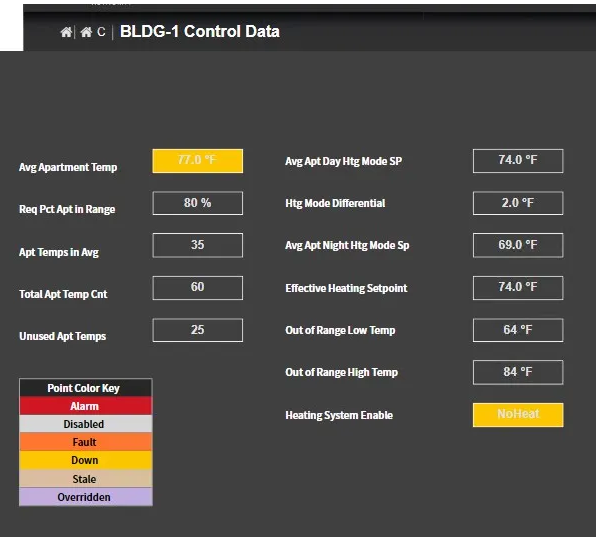
Temperature setpoints in Building Management System (“BMS”)
Image courtesy of the New York City Housing Authority (“NYCHA”)
(#1) Temperature set points (#2) Repair leaks (#3) Heating system function (#4) Radiator temperature controls* (#5) Piping insulation (#6) Water tank insulation (#7) Indoor/outdoor temp. sensors* (#8) Steam traps* (#9) Master steam system venting* (#10) Lighting (#11) Building envelope (#12) Exhaust fan timers (#13) Radiant barriers
(#2) Repair leaks
“Repairing all heating system leaks”

Why necessary:
Leak detection and repair should be a part of regular system maintenance, since (water, steam, oil, and/or refrigerant) leaks have cascading detrimental effects, such as reducing heating system operating efficiency, damaging surrounding interior finishes, and increasing stress on heating system components. Leaks out of a closed-loop steam or hydronic heating system necessitate adding feedwater, which can exacerbate scale buildup and metal corrosion because it has more dissolved solids and gases than water that has already been heated through.
Requirements:
Readily accessible leaks should be identified through visual inspection and review of maintenance records / tenant complaints, with all leaks repaired by December 31, 2024. Inspection must cover:
- 100% of common areas
- at least 20% of non-common owner areas
- at least 10% of non-common tenant areas
System components not subject to this PECM:
- Ducts; forced air systems
- Distribution piping concealed within walls, ceilings, or floors
- Electric resistance heating systems
(#1) Temperature set points (#2) Repair leaks (#3) Heating system function (#4) Radiator temperature controls* (#5) Piping insulation (#6) Water tank insulation (#7) Indoor/outdoor temp. sensors* (#8) Steam traps* (#9) Master steam system venting* (#10) Lighting (#11) Building envelope (#12) Exhaust fan timers (#13) Radiant barriers
Selected best practices and other guidance:
- DOE Steam System Survey Guide produced by the Oak Ridge National Laboratory.
- DOE guide to leak-detection technologies, including sensors, thermal imaging, and listening sticks.

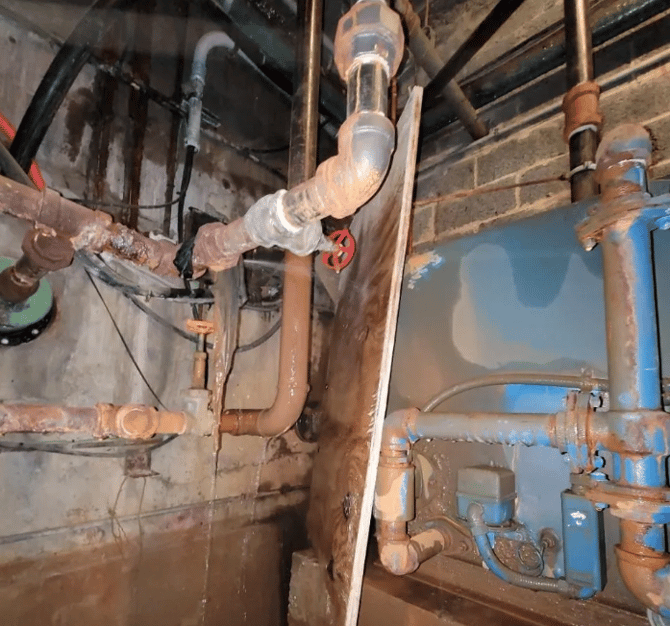
Water leak requiring repair
Image courtesy of NYCHA
(#1) Temperature set points (#2) Repair leaks (#3) Heating system function (#4) Radiator temperature controls* (#5) Piping insulation (#6) Water tank insulation (#7) Indoor/outdoor temp. sensors* (#8) Steam traps* (#9) Master steam system venting* (#10) Lighting (#11) Building envelope (#12) Exhaust fan timers (#13) Radiant barriers
(#3) Heating system function
“Maintaining the heating system, including but not limited to ensuring that system component parts are clean and in good operating condition”
Why necessary:
Dirty/clogged and inaccurate/inoperable components can reduce heating system operating efficiency and increase stress on the rest of the system, thereby leading to higher energy use and shortening the system’s overall lifespan. Besides cleaning or replacement of components, maintenance also includes calibrating processes (e.g., damper/valve/burner modulation, boiler/heat exchanger/fan coil sequence control, short cycling prevention).
Requirements:
Proper function can be verified through field observation combined with review of historical data. Investigation may include: interviews with facility staff, managers, and tenants; trend analysis; dedicated data logs; or review of available operations, maintenance (including Department inspections and internal maintenance as per manufacturer’s requirements), and complaints records.
NOTE: While forced air systems and electric resistance heating systems are exempt from PECM #2 (Repair leaks), they are not exempt from this PECM.
Sample maintenance procedures (including, but not limited to):
Check filters and vents, clean or replace as needed. Check condensate drains and clean as needed. Remove sediment and limescale from tanks, skim oily residue and flush dirty boiler water, optimize waterlines, and replace anode rods (in non-cast-iron boilers). Clean heat pump evaporator coils and condenser coils. Verify accuracy of sensors and gauges. Check that equipment sequences of operation are functioning properly.
(#1) Temperature set points (#2) Repair leaks (#3) Heating system function (#4) Radiator temperature controls* (#5) Piping insulation (#6) Water tank insulation (#7) Indoor/outdoor temp. sensors* (#8) Steam traps* (#9) Master steam system venting* (#10) Lighting (#11) Building envelope (#12) Exhaust fan timers (#13) Radiant barriers
Selected best practices and other guidance:
- DOE maintenance guides:
- DOE Standard Work Specifications, Heating and Cooling section.
- DOE Operations C Maintenance Best Practices, Section 9.2, Boilers.
- NYC Accelerator steam system tech guides (also applicable to other PECMs):
- ASHRAE Standard 100 Annex D provides guidance on energy efficient building operations and maintenance.
(#1) Temperature set points (#2) Repair leaks (#3) Heating system function (#4) Radiator temperature controls* (#5) Piping insulation (#6) Water tank insulation (#7) Indoor/outdoor temp. sensors* (#8) Steam traps* (#9) Master steam system venting* (#10) Lighting (#11) Building envelope (#12) Exhaust fan timers (#13) Radiant barriers
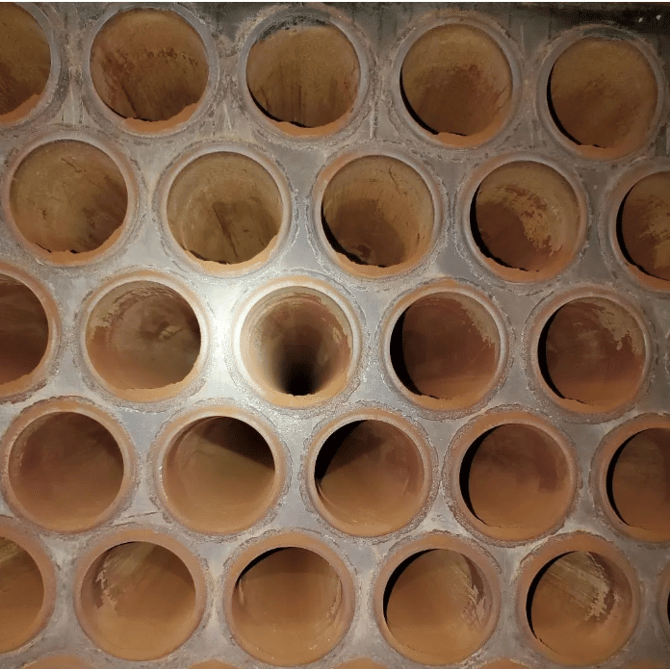
Visual inspection of boiler firetubes
Image courtesy of NYCHA
(#1) Temperature set points (#2) Repair leaks (#3) Heating system function (#4) Radiator temperature controls* (#5) Piping insulation (#6) Water tank insulation (#7) Indoor/outdoor temp. sensors* (#8) Steam traps* (#9) Master steam system venting* (#10) Lighting (#11) Building envelope (#12) Exhaust fan timers (#13) Radiant barriers
(#4) Radiator temperature controls*
“Installing individual temperature controls or insulated radiator enclosures with temperature controls on all radiators”

Why necessary:
Steam and hydronic radiators all have at least one valve with a knob on it, but that knob generally serves more as an on/off switch than a temperature control, unable to prevent radiators from overheating a room. Opening a window is not very energy-efficient but sometimes the only option many people have; proper controls are a better option.
Requirements (all applicable heating systems):
20% of all radiators must be confirmed through inspection to have functioning temperature controls (following the below heating system-specific guidelines), and if any controls are found to be missing/non-functioning, then all radiators in the building must be inspected. The applicable template may be downloaded here. For wireless (“smart”) systems, real-time and historical data may be referenced. Refer to 1 RCNY §103-17(c)(4) and Section II(A)(5) of this Guide for additional reporting requirements.
Requirements (heating system-specific):
- Steam systems
- For two-pipe steam systems, thermostatic radiator valves (“TRVs”) or insulated radiator enclosures – in good working order – should be documented to have been installed on all inspected radiators. To maximize efficiency, radiators should have properly functioning steam traps or orifice plates (see PECM #8).
- For one-pipe steam systems, TRVs or insulated radiator enclosures – in good working order – should be installed at every radiator in spaces where overheating has been reported or observed.
- Insulated radiator enclosures, sometimes called thermostatic radiator enclosures (“TREs”), are boxes that store heat and use fans to deliver hot air into the room as needed. They are alternatives to TRVs.
(#1) Temperature set points (#2) Repair leaks (#3) Heating system function (#4) Radiator temperature controls* (#5) Piping insulation (#6) Water tank insulation (#7) Indoor/outdoor temp. sensors* (#8) Steam traps* (#9) Master steam system venting* (#10) Lighting (#11) Building envelope (#12) Exhaust fan timers (#13) Radiant barriers
- Electric resistance systems
- For electric radiators, confirm that a functioning thermostat is installed in each dwelling unit in multifamily buildings, as one thermostat may control multiple radiators.
- Hydronic systems
- For hydronic distribution systems, the RCx agent must consult with the building manager or building owner to verify the presence of temperature controls in the system. If temperature controls are present, 20% must be inspected. If any controls are found to be missing/non-functioning, then 100% of known temperature controls in the building must be inspected and confirmed to be in good working order.
NOTE: fan coil units (“FCUs”) do not have radiators so are not subject to PECM #4.
Selected best practices and other guidance:
- TRVs may not function properly unless the system is balanced and tuned, including verification of (#1) Temperature set points, (#7) Indoor / outdoor temperature sensors*, and (#13) Radiant barriers. In steam systems, TRVs should be installed in conjunction with (#8) Steam traps* and (#G) Master steam system venting*, and care should be taken to not over-pressurize the system.
- Detailed guidance for TREs and additional guidance for TRVs may be found in the NYS Department of Public Service
(“DPS”)’s Technical Resource Manual (“TRM”), updated yearly.
- DOE’s Building America Solution Center has the helpful guide TRVs on Steam Heating Systems.
- For new buildings and alterations subject to the NYC ECC, thermostatic controls are mandatory (C403.4.1).
(#1) Temperature set points (#2) Repair leaks (#3) Heating system function (#4) Radiator temperature controls* (#5) Piping insulation (#6) Water tank insulation (#7) Indoor/outdoor temp. sensors* (#8) Steam traps* (#9) Master steam system venting* (#10) Lighting (#11) Building envelope (#12) Exhaust fan timers (#13) Radiant barriers
Two-pipe steam radiator with a TRV Insulated radiator enclosure
Image courtesy of NYCHA Image courtesy of Kelvin
(#1) Temperature set points (#2) Repair leaks (#3) Heating system function (#4) Radiator temperature controls* (#5) Piping insulation (#6) Water tank insulation (#7) Indoor/outdoor temp. sensors* (#8) Steam traps* (#9) Master steam system venting* (#10) Lighting (#11) Building envelope (#12) Exhaust fan timers (#13) Radiant barriers
(#5) Piping insulation
“Insulating all pipes for heating and/or hot water”



Why necessary:
While some steam/hot water pipes are intentionally left uninsulated to warm the space that they pass through, most other distribution piping in heating and domestic hot water systems should be insulated. The main benefit of piping insulation is reduction of heat loss, allowing the boiler and/or water heater to operate more efficiently and use less energy. Secondary benefits include:
- Reduced risk of burns and fires from hot pipe surfaces
- Improved steam quality (less condensation)
- Reduced wait time for domestic hot water
- Reduced risk of freezing when ambient temperature drops below the freezing point
Requirements:
Any missing or degraded piping insulation must be installed, replaced, or repaired by December 31, 2024. Pipes, fittings, and valves that are part of steam or hot water distribution systems should be visually inspected in:
- 100% of common areas
- at least 20% of non-common owner areas
- at least 10% of non-common tenant areas
NOTE: Compliance with this PECM does not require owners to remove wall, floor, or ceiling assemblies. Owners are also not required to disturb asbestos-containing materials (“ACMs”), which were once a popular material for piping insulation and one reason why insulation may have been removed over the years.
(#1) Temperature set points (#2) Repair leaks (#3) Heating system function (#4) Radiator temperature controls* (#5) Piping insulation (#6) Water tank insulation (#7) Indoor/outdoor temp. sensors* (#8) Steam traps* (#9) Master steam system venting* (#10) Lighting (#11) Building envelope (#12) Exhaust fan timers (#13) Radiant barriers
Selected best practices and other guidance:
- It may not be advisable to insulate condensate piping in pumped-return steam systems, as overly hot condensate can increase the risk of cavitation and thereby damage the pump(s). As such, this measure is NOT mandatory for pumped-return steam piping.
- While beyond the scope of LL97, piping whose surface temperatures are lower than their surrounding environment should ideally also be insulated. The benefits of insulating low-temperature piping are similar to those of insulating high-temperature piping, with the additional benefit of reduced condensation on the pipe surface. Refrigerant piping in heat pump systems should also be insulated to optimize the heat exchange process.
- In renovations, whenever wall, floor, or ceiling assemblies are removed and uninsulated piping is exposed, the piping must be insulated in accordance with Article 316 of Title 28 of the Administrative Code.
- In new buildings and alterations subject to the NYC ECC, piping insulation is mandatory:
- Minimum pipe insulation thicknesses are listed in Table C403.11.3.
- For piping that is part of a heating and/or cooling system, requirements for weather protection and exceptions where insulation is not required are listed in C403.11.3.
- For piping that is part of a service hot water system, detailed requirements and exceptions where insulation is not required are listed in C404.4.
- DOE guide to insulating hot water pipes.
(#1) Temperature set points (#2) Repair leaks (#3) Heating system function (#4) Radiator temperature controls* (#5) Piping insulation (#6) Water tank insulation (#7) Indoor/outdoor temp. sensors* (#8) Steam traps* (#9) Master steam system venting* (#10) Lighting (#11) Building envelope (#12) Exhaust fan timers (#13) Radiant barriers
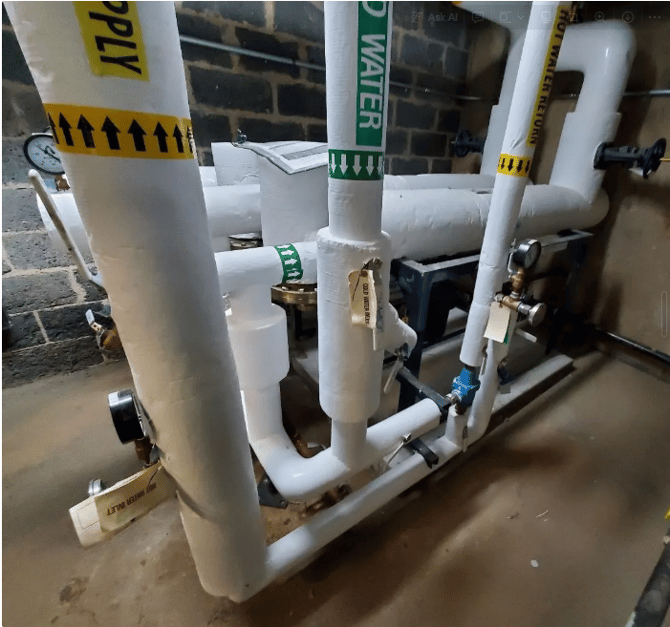
Insulated and labeled water pipes
Image courtesy of NYCHA
(#1) Temperature set points (#2) Repair leaks (#3) Heating system function (#4) Radiator temperature controls* (#5) Piping insulation (#6) Water tank insulation (#7) Indoor/outdoor temp. sensors* (#8) Steam traps* (#9) Master steam system venting* (#10) Lighting (#11) Building envelope (#12) Exhaust fan timers (#13) Radiant barriers
(#6) Water tank insulation
“Insulating the steam system condensate tank or water tank”

Why necessary:
Newer tanks for boilers and hot water heaters often come with a layer of rigid insulation integrated into the tank shell itself, but older tanks may need to be insulated in the field with a flexible blanket. Insulation reduces standby heat loss, thereby lowering energy use by reducing the need for continual reheating. Insulating condensate tanks can also improve system efficiency, since condensate often has a high level of heat energy that can be reused.
But, as stated under PECM #5, condensate water that is too hot can damage pumps. Therefore, condensate tank insulation is not recommended in pumped-return systems. Moreover, field-applied insulation must be done very carefully to avoid common pitfalls (see the DOE guide under “Selected best practices” below).
Requirements:
Feedwater, condensate, and hot water tanks should be reviewed for the presence of insulation, including review of specification sheets, and feeling for heat loss at the tank enclosure. Insulation should meet the requirements of the NYC ECC to the extent feasible given existing clearances.
NOTE: Compliance with this PECM does not require owners to disturb ACMs, which were once a popular material for tank insulation and one reason why insulation may have been removed over the years.
Selected best practices and other guidance:
- DOE guide to insulating water heater tanks.
(#1) Temperature set points (#2) Repair leaks (#3) Heating system function (#4) Radiator temperature controls* (#5) Piping insulation (#6) Water tank insulation (#7) Indoor/outdoor temp. sensors* (#8) Steam traps* (#9) Master steam system venting* (#10) Lighting (#11) Building envelope (#12) Exhaust fan timers (#13) Radiant barriers
- In new buildings and alterations subject to the NYC ECC, unfired storage tanks (i.e. not boiler or hot water heater tanks that contain heating elements) have a minimum insulation requirement of R-12.5 (Table C404.2).

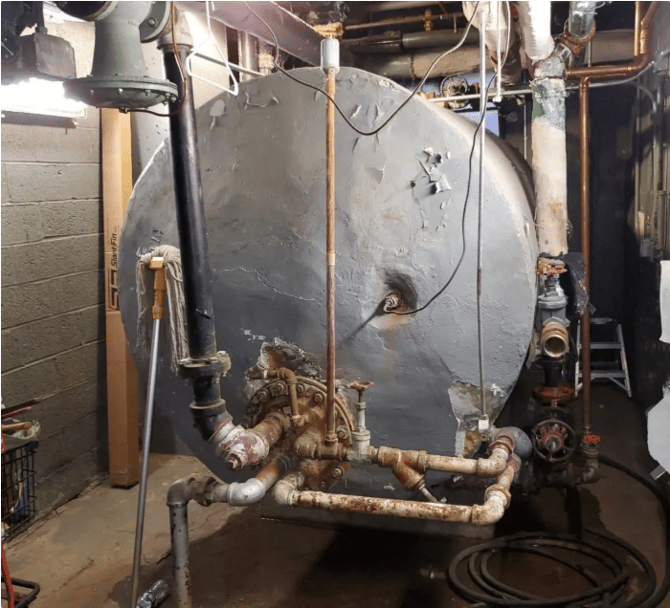
Insulated hot water tank
Image courtesy of NYCHA
(#1) Temperature set points (#2) Repair leaks (#3) Heating system function (#4) Radiator temperature controls* (#5) Piping insulation (#6) Water tank insulation (#7) Indoor/outdoor temp. sensors* (#8) Steam traps* (#9) Master steam system venting* (#10) Lighting (#11) Building envelope (#12) Exhaust fan timers (#13) Radiant barriers
(#7) Indoor/outdoor temperature sensors*
“Installing indoor and outdoor heating system sensors and boiler controls to allow for proper set-points”
Why necessary:
Steam and hydronic boilers are sized to provide sufficient warmth on the coldest day of the year but running them at full capacity on warmer days can cause discomfort and is an excessive use of energy. Unfortunately, many systems run at higher capacity than needed because they are manually set or have only primitive outdoor sensors that can result in short cycling. Upgrading system sensors to be more weather-responsive is an effective way to modulate boiler output.
There are both indoor and outdoor components:
- Wireless sensors at steam radiators can tell the boiler precisely how much heat is needed.
- Outdoor reset (“ODR”) control, in steam systems and hydronic systems with non-condensing boilers, can optimize on-off cycling length based on outside temperature.
Requirements:
All boilers must be inspected. Any missing or non-functioning indoor and outdoor reset temperature sensors identified during inspection should be installed or repaired by December 31, 2024. 1 RCNY §103-17(c)(7) lists the percentage of dwelling units to be checked for indoor sensors installed on steam heating systems. For HOWs, 25% of spaces or 25% of radiators should be checked for indoor sensors; the selection of what is sampled shall be at the RCx agent’s discretion.
Refer to the Rule and Section II(A)(5) of this Guide for reporting requirements; the applicable template may be downloaded here. As the template says, “a screenshot or other output from a digital control system showing that sensors are connected and in good working order” may be submitted in lieu of either a template or evidence of a completed utility incentive/rebate program.
(#1) Temperature set points (#2) Repair leaks (#3) Heating system function (#4) Radiator temperature controls* (#5) Piping insulation (#6) Water tank insulation (#7) Indoor/outdoor temp. sensors* (#8) Steam traps* (#9) Master steam system venting* (#10) Lighting (#11) Building envelope (#12) Exhaust fan timers (#13) Radiant barriers
System components not subject to this PECM:
- Central heat pumps (because sensors are integral to system)
- Unitized heating (e.g. mini-splits, PTACs, PTHPs)
- Fan-driven terminal units (e.g. FCUs, AHUs)
- Radiant heating
- Electric resistance heating
Selected best practices and other guidance:
- When used with non-condensing hydronic boilers, outdoor reset (“ODR”) must be calibrated so that the return water is hot enough (130 to 140 °F) for the flue gases to not condense. Flue gas condensation in a non-condensing boiler has a corrosive effect and will damage boiler components.
- DOE guides on ODR control (aka “modulating aquastats”) for gas-fired boilers and oil-fired boilers, and list of heating system sensor types.
- Other useful boiler-related sensors include: supply temperature, return water/condensate temperature, makeup water temperature, and stack temperature. For forced air systems, useful sensors include: outside air temperature, supply and return air temperature, air flow rate, and zone temperature (note that this PECM does not require such sensors to be installed in forced air systems if not already present).
- In new buildings and alterations subject to the NYC ECC, outdoor temperature setback control is mandatory for all hydronic heating systems (C403.4.1.5), while indoor sensors are required at each thermal zone (C403.4.1).
- Should be verified in conjunction with (#1) Temperature set points and (#4) Radiator temperature controls*.
(#1) Temperature set points (#2) Repair leaks (#3) Heating system function (#4) Radiator temperature controls* (#5) Piping insulation (#6) Water tank insulation (#7) Indoor/outdoor temp. sensors* (#8) Steam traps* (#9) Master steam system venting* (#10) Lighting (#11) Building envelope (#12) Exhaust fan timers (#13) Radiant barriers
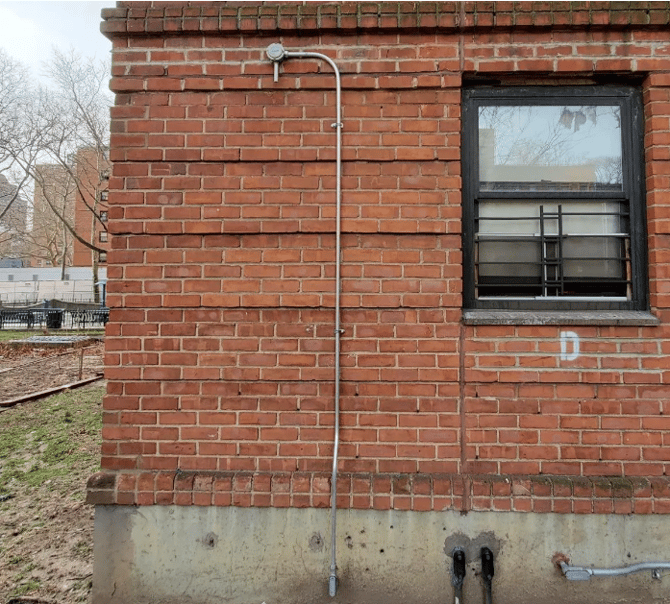
Outdoor temperature sensor
Image courtesy of NYCHA
(#1) Temperature set points (#2) Repair leaks (#3) Heating system function (#4) Radiator temperature controls* (#5) Piping insulation (#6) Water tank insulation (#7) Indoor/outdoor temp. sensors* (#8) Steam traps* (#9) Master steam system venting* (#10) Lighting (#11) Building envelope (#12) Exhaust fan timers (#13) Radiant barriers
(#8) Steam traps*
“Replacing or repairing all steam traps such that all are in working order”

Why necessary:
Steam traps are located at the return pipe of every radiator in two-pipe steam systems. Their purpose is to contain energy-rich steam while allowing condensate, air, and non-condensable gases to escape. They are small but mighty, and steam trap maintenance must be routine because when even a single trap fails it can result in cascading system- wide failures. Specific impacts of malfunctioning traps include:
- A steam trap that fails in the open position will leak steam into the condensate return, resulting in more steam production and energy use than would otherwise be needed. If there are pumps in the system, the leaked steam will likely damage the pumps.
- A steam trap that fails in the closed position (a “cold trap”) will allow air and condensate to build up within the
radiator, resulting in less heat output and accelerating corrosion.
- Both types of steam trap failure can result in water hammer and other adverse effects that are both noisy and damaging to the entire system.
Most steam traps are generally easier to replace than to repair. Orifice plates have longer lifespans than other types of steam trap since they have no moving parts; however, they require precise calculations/calibration and constant pressure to function effectively.
Testing requirements:
Visual observation, temperature testing, and/or ultrasonic testing of steam traps and orifice plates in the two-pipe steam system should be used to identify steam traps for repair/replacement. Remedial work must be completed by December 31, 2024.
(#1) Temperature set points (#2) Repair leaks (#3) Heating system function (#4) Radiator temperature controls* (#5) Piping insulation (#6) Water tank insulation (#7) Indoor/outdoor temp. sensors* (#8) Steam traps* (#9) Master steam system venting* (#10) Lighting (#11) Building envelope (#12) Exhaust fan timers (#13) Radiant barriers
If testing demonstrates that the main supply and main return piping have a surface temperature differential of 30 °F or more, test results with data logs may be submitted in lieu of sampling steam traps. But if the main supply and main return piping surface temperatures have a surface temperature differential of less than 30 °F, then steam traps in the following locations must be sampled:
- 100% of common areas
- at least 20% of non-common owner areas
- at least 10% of non-common tenant areas
When more than 20% of the aggregate or individual sample sets are found to be malfunctioning, then all steam traps in the system must be tested and all malfunctioning steam traps must be repaired or replaced.
Documentation requirements:
Refer to 1 RCNY §103-17(c)(8) and Section II(A)(5) of this Guide for additional reporting requirements; the applicable template(s) may be downloaded here.
Selected best practices and other guidance:
- As new steam traps can be damaged immediately by malfunctioning ones elsewhere in the system, it is best to replace all faulty steam traps at once while the boiler is off. In larger buildings, this may only be possible outside of the heating season.
- Another way to avoid damaging new steam traps is to install them after performing other PECMs to get the system into optimal shape: (#2) Repair leaks, (#3) Heating system function, (#4) Radiator temperature controls*, and (#G) Master steam system venting*.
(#1) Temperature set points (#2) Repair leaks (#3) Heating system function (#4) Radiator temperature controls* (#5) Piping insulation (#6) Water tank insulation (#7) Indoor/outdoor temp. sensors* (#8) Steam traps* (#9) Master steam system venting* (#10) Lighting (#11) Building envelope (#12) Exhaust fan timers (#13) Radiant barriers
- A typical steam trap has a lifespan of anywhere from 3 to 10 years. There are different types of steam traps (thermostatic, mechanical, thermodynamic, orifice plate), and an owner should consult with a qualified service provider to select the best type for each location in the system.
- Steam traps (along with valves, flanges and other fittings) can have removable insulation jackets (refer to PECM #5 for benefits of insulation); however, not all types can be insulated.
- DOE review of steam trap types, with a focus on the advantages / disadvantages of orifice plates.
- DOE review of steam trap performance assessment methodologies.
- DOE Operations C Maintenance Best Practices, Section 9.3, Steam Traps.
(#1) Temperature set points (#2) Repair leaks (#3) Heating system function (#4) Radiator temperature controls* (#5) Piping insulation (#6) Water tank insulation (#7) Indoor/outdoor temp. sensors* (#8) Steam traps* (#9) Master steam system venting* (#10) Lighting (#11) Building envelope (#12) Exhaust fan timers (#13) Radiant barriers
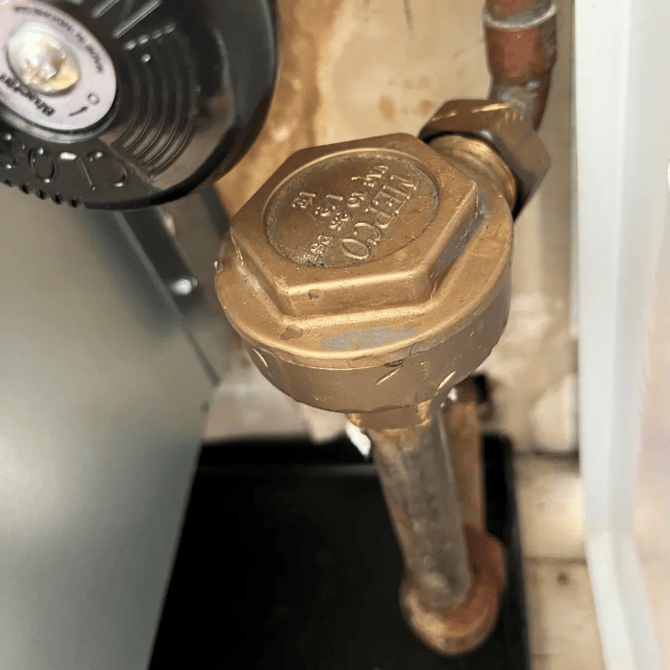
Thermostatic steam trap in a dwelling unit
Image courtesy of NYSERDA
(#1) Temperature set points (#2) Repair leaks (#3) Heating system function (#4) Radiator temperature controls* (#5) Piping insulation (#6) Water tank insulation (#7) Indoor/outdoor temp. sensors* (#8) Steam traps* (#9) Master steam system venting* (#10) Lighting (#11) Building envelope (#12) Exhaust fan timers (#13) Radiant barriers
(#G) Master steam system venting*
“Installing or upgrading steam system master venting at the ends of mains, large horizontal pipes, and tops of risers, vertical pipes branching off a main”

Why necessary:
Steam distribution systems fill with air when they are turned off, and this air must then be pushed out when the steam turns back on. Individual radiators are vented by steam traps (in two-pipe systems) and air vents (in one-pipe systems), but those are designed to let air out slowly and will hiss if forced to take on system venting duties.
To flush air out quickly so the steam can reach all the radiators at around the same time, master venting should be installed at the ends of the supply piping, at the ends of mains and at the tops of primary risers.
- Without master venting, the radiators farthest away from the steam source can take a long time to heat up, making the spaces served seem underheated.
- Master vents may have been removed from the system at some point, or they may exist but be poorly functioning. In these cases, the vents should be re-installed or repaired/replaced.
NOTE: Master venting should not be used in two-pipe steam systems with vacuum pumps.
Requirements:
For this PECM, partial sampling is not sufficient – the entire system must be checked. Refer to 1 RCNY §103-17(c)(9) and Section II(A)(5) of this Guide for reporting requirements; the applicable template may be downloaded here. Note that “Schematic diagrams of the steam loops in the covered building identifying the installed vents with a schedule indicating the date of testing of each loop” may be submitted in lieu of either a template or evidence of a completed utility incentive/rebate program.
(#1) Temperature set points (#2) Repair leaks (#3) Heating system function (#4) Radiator temperature controls* (#5) Piping insulation (#6) Water tank insulation (#7) Indoor/outdoor temp. sensors* (#8) Steam traps* (#9) Master steam system venting* (#10) Lighting (#11) Building envelope (#12) Exhaust fan timers (#13) Radiant barriers
Selected best practices and other guidance:
- Higher boiler pressure is not more effective at pushing air out of the system, as it decreases steam velocity. With proper master venting, the system should fill more quickly under lower boiler pressure.
- On down-feed systems, the master vents should be installed at the base of the risers. On up-feed systems, some master vent locations may end up being inside the top-floor dwelling units.
- Filters can be installed ahead of each vent to reduce the risk of debris buildup and clogging.
- DOE guide to master steam system venting in one-pipe systems.
- DOE guide to steam system balancing for multifamily buildings.
- Some of the ways in which air negatively affects steam system performance include:
- Air mixed with steam reduces the steam’s heat energy
- Air is a thermal barrier, so it can block heat conduction between steam and a radiator wall
- When air (e.g., oxygen, carbon dioxide) dissolves into condensate water, the conductivity of the water is increased, accelerating the electrochemical process of corrosion on surrounding metal components
- Also see the steam resources under (#3) Heating system function.
(#1) Temperature set points (#2) Repair leaks (#3) Heating system function (#4) Radiator temperature controls* (#5) Piping insulation (#6) Water tank insulation (#7) Indoor/outdoor temp. sensors* (#8) Steam traps* (#9) Master steam system venting* (#10) Lighting (#11) Building envelope (#12) Exhaust fan timers (#13) Radiant barriers
(#10) Lighting
“Upgrading lighting to comply with the standards for new systems set forth in section C405 of the New York city energy conservation code and/or applicable standards referenced in such energy code on or prior to December 31, 2024. This provision is subject to exception 1 in section 28-310.3”
Why necessary:
Upgrading a building’s lighting to current energy conservation standards is often the most cost-effective way to reduce energy use. Some upgrades, like lamp replacements and lighting power calculations, can even be done by building staff as part of routine maintenance.
Requirements:
The lighting system upgrade report required to be submitted by 5/1/2025 for Local Law 88 of 2009 (“LL88”) compliance (Article 310 of Title 28 of the Administrative Code and the corresponding 1 RCNY §103-18) shall be used to document this PECM. Such report is prepared by a licensed electrician or an RDP, not by the qualified RCx agent, and must demonstrate compliance with the 2009 NYC ECC at a minimum. If the lighting was installed after 7/1/2010, then it must follow a later NYC ECC, as indicated in the chart on page 45 of this guide.
NOTE: Landmarked buildings are not exempt from these requirements, except where historic lighting is deemed to be part of the historic fabric.
Selected best practices and other guidance:
- Links to free online versions of the 2020, 2016, 2014, and 2011 NYC ECCs are here. A link to the 2009 NYC ECC is here, but references the 2007 New York State (“NYS”) energy code which must be purchased.
(#1) Temperature set points (#2) Repair leaks (#3) Heating system function (#4) Radiator temperature controls* (#5) Piping insulation (#6) Water tank insulation (#7) Indoor/outdoor temp. sensors* (#8) Steam traps* (#9) Master steam system venting* (#10) Lighting (#11) Building envelope (#12) Exhaust fan timers (#13) Radiant barriers
- DOE guide to lighting controls.
- How-to guide, published by the Department, for lighting power calculations and lighting control programming.
- DOE Operations C Maintenance Best Practices, Section 9.12, Lighting.
- NYSERDA guide to different types of LEDs.
- Detailed calculations for how to determine energy savings resulting from lighting upgrades can be found in the
“Lighting” section of the NYS DPS TRM, updated yearly.
- In multifamily buildings or lots, LL88 does not apply to individual dwelling units but applies to all other building spaces. It is recommended that property managers of such covered buildings encourage unit owners and tenants to perform lighting upgrades within their units, perhaps by sharing the links listed above.
(#1) Temperature set points (#2) Repair leaks (#3) Heating system function (#4) Radiator temperature controls* (#5) Piping insulation (#6) Water tank insulation (#7) Indoor/outdoor temp. sensors* (#8) Steam traps* (#9) Master steam system venting* (#10) Lighting (#11) Building envelope (#12) Exhaust fan timers (#13) Radiant barriers
| Applicable NYC Energy Conservation Code for lighting upgrades required by Article 321
| Applicable NYC Energy Conservation Code for lighting upgrades required by Article 321 (Also applies to § 28-310.3, exception 1) |
Lighting system filed* or otherwise documented as having been installed on or after | ||||
| July 1, 2010 | December 28, 2010 | January 1, 2015 | October 3, 2016 | May 12, 2020 | |
| 200G NYC Energy Conservation Code ("ECC") Local Law 85 of 2009, based on: • 2007 Energy Conservation Construction Code of NY State ("ECCCNYS") • 2004 International Energy Conservation Code ("IECC")- ASHRAE 90.1-2001 |
|||||
| 2011 NYC ECC section 505, based on: • 2010 ECCCNYS • 2009 IECC- ASHRAE 90.1-2007 |
|||||
| 2014 NYC ECC section C405, based on: • 2014 ECCCNYS • 2012 IECC- ASHRAE 90.1-2010 |
|||||
| 2016 NYC ECC section C405, based on: • 2016 ECCCNYS • 2015 IECC- ASHRAE 90.1-2013 |
|||||
| 2020 NYC ECC section C405, based on: • 2020 ECCCNYS with NYStretch-2020 supplement • 2018 IECC- ASHRAE 90.1-2016 |
*in accordance with the completeness standards listed in Buildings Bulletin 2020-002
(#1) Temperature set points (#2) Repair leaks (#3) Heating system function (#4) Radiator temperature controls* (#5) Piping insulation (#6) Water tank insulation (#7) Indoor/outdoor temp. sensors* (#8) Steam traps* (#9) Master steam system venting* (#10) Lighting (#11) Building envelope (#12) Exhaust fan timers (#13) Radiant barriers
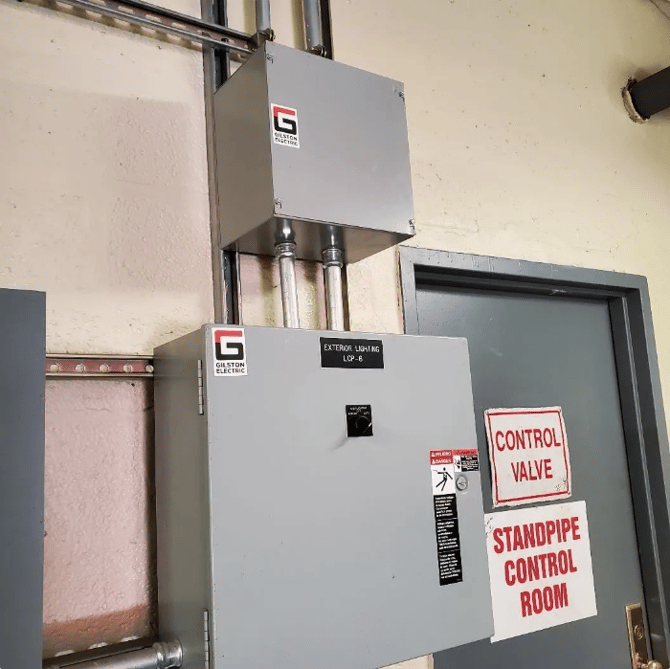
Exterior Lighting Controls
Image courtesy of NYCHA
(#1) Temperature set points (#2) Repair leaks (#3) Heating system function (#4) Radiator temperature controls* (#5) Piping insulation (#6) Water tank insulation (#7) Indoor/outdoor temp. sensors* (#8) Steam traps* (#9) Master steam system venting* (#10) Lighting (#11) Building envelope (#12) Exhaust fan timers (#13) Radiant barriers

(#11) Building envelope
“Weatherizing and air sealing where appropriate, including windows and ductwork, with focus on whole-building insulation”
Why necessary:
Weatherizing a building makes the indoor conditioned space more resistant to changes in outdoor temperature and humidity. This effectively makes heating and cooling systems more efficient, as the systems can run at lower intensities and still maintain a comfortable indoor environment. Weatherizing by plugging cracks and holes in the building thermal envelope slows convective heat transfer, i.e. the movement of air and moisture. Weatherizing by insulating walls/floors/ceilings slows conductive heat transfer, which is when temperature changes pass through solid materials.
Requirements:
Visual inspection for air leakage at envelope openings (including doors, windows, PTACs, skylights, roof curbs, vents, joints, bulkheads, and loading docks) and penetrations between conditioned and unconditioned spaces (including piping, ducting, conduits and other wiring, chimneys, flues, and dropped soffits). Missing or damaged gaskets, sealant, caulking, weatherstripping, etc. must be installed, repaired, or replaced by December 31, 2024.
Interior visual inspection must cover:
- 100% of common areas
- at least 20% of non-common owner areas
- at least 10% of non-common tenant areas
Exterior visual inspection can be limited to easily accessed areas of the building envelope; specialized façade access via scaffolding or rigging is not necessary.
(#1) Temperature set points (#2) Repair leaks (#3) Heating system function (#4) Radiator temperature controls* (#5) Piping insulation (#6) Water tank insulation (#7) Indoor/outdoor temp. sensors* (#8) Steam traps* (#9) Master steam system venting* (#10) Lighting (#11) Building envelope (#12) Exhaust fan timers (#13) Radiant barriers
Selected best practices and other guidance:
- To comply with this PECM, owners are not required to disturb potential ACMs, nor to replace broken fenestration.
- DOE general guide to air sealing, covering topics like detecting leaks, caulking, weatherstripping, and insulation.
- DOE’s Building America Solution Center, all “Air Seal” and “Building Science Introduction” topics.
- NYC Mayor’s Office’s Carbon Challenge Handbook for Multifamily Buildings, which has an illustrated overview of “Air Sealing and Insulation” topics.
- NY State Department of Homes and Community Renewal (“DHCR”)’s Weatherization Assistance Program (“WAP”), which provides no- and low-cost weatherization for income-eligible homeowners and owners of multifamily rental buildings with income-eligible tenants.
- NYSERDA’s Multifamily Buildings Low-Carbon Pathways Program offers financial incentives to building owners to perform more comprehensive envelope upgrades.
- In new buildings and alterations subject to the NYC ECC, allowable air leakage rates are listed in section C404.5.
- ASHRAE Standard 100 Annexes D and E provide guidance on energy efficient building envelope upgrades and maintenance.
(#1) Temperature set points (#2) Repair leaks (#3) Heating system function (#4) Radiator temperature controls* (#5) Piping insulation (#6) Water tank insulation (#7) Indoor/outdoor temp. sensors* (#8) Steam traps* (#9) Master steam system venting* (#10) Lighting (#11) Building envelope (#12) Exhaust fan timers (#13) Radiant barriers
(#12) Exhaust fan timers
“Installing timers on exhaust fans”
Why necessary:
Exhaust fans are critical for removing moisture, pollutants, and stale/overheated air from areas like bathrooms, kitchens, and laundry rooms. Some fans are designed to run continuously and quietly at low speeds; these should not have timers / occupancy sensors / humidistats (humidity sensors). On the other hand, fans that are designed to run intermittently at higher speeds are sometimes left on even when they are not needed; this is an excessive use of energy because it necessitates replacement of the conditioned air that is needlessly exhausted.
Requirements:
Refer to 1 RCNY §103-17(c)(12) for inspection requirements. Interior visual inspection must cover:
- 100% of common areas
- at least 20% of non-common owner areas
- at least 10% of non-common tenant areas
Selected best practices and other guidance:
- DOE guide to intermittent fan installation.
- In new buildings and alterations subject to the NYC Mechanical Code (“MC”), Table 403.3.1.1 lists Minimum Ventilation Rates for various occupancies and space types.
- For fans with two speeds, the timer or sensor can be used to switch back to the lower speed.
(#1) Temperature set points (#2) Repair leaks (#3) Heating system function (#4) Radiator temperature controls* (#5) Piping insulation (#6) Water tank insulation (#7) Indoor/outdoor temp. sensors* (#8) Steam traps* (#9) Master steam system venting* (#10) Lighting (#11) Building envelope (#12) Exhaust fan timers (#13) Radiant barriers
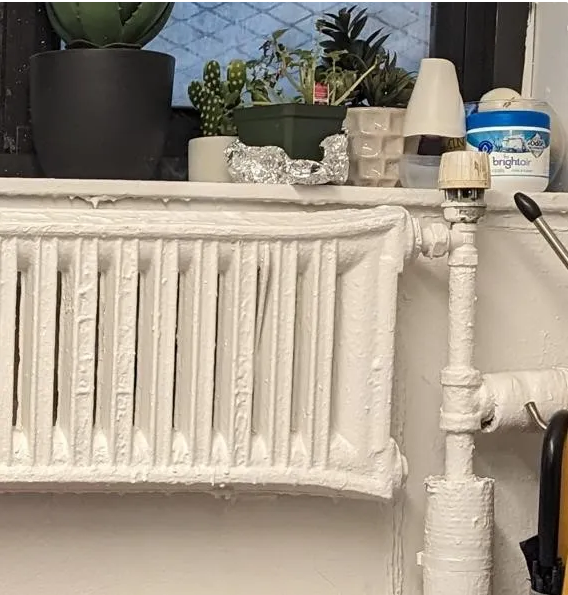
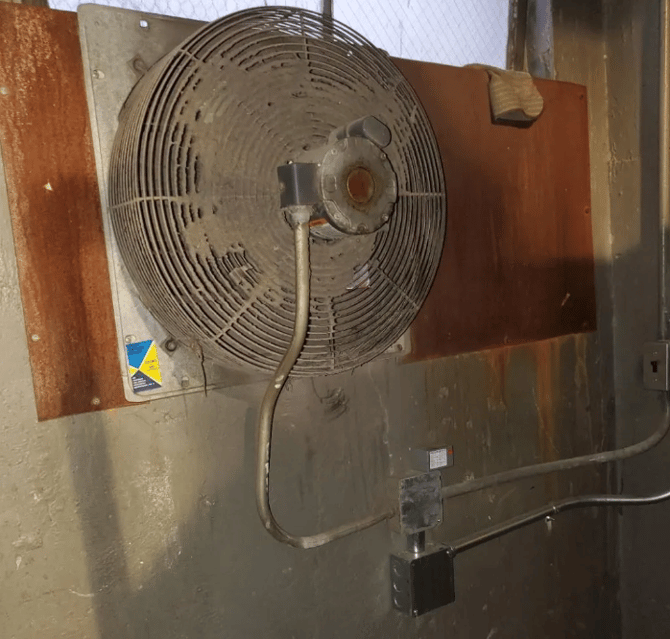
Exhaust fan with timer
Image courtesy of NYCHA
(#1) Temperature set points (#2) Repair leaks (#3) Heating system function (#4) Radiator temperature controls* (#5) Piping insulation (#6) Water tank insulation (#7) Indoor/outdoor temp. sensors* (#8) Steam traps* (#9) Master steam system venting* (#10) Lighting (#11) Building envelope (#12) Exhaust fan timers (#13) Radiant barriers

(#13) Radiant barriers
“Installing radiant barriers behind all radiators”
Why necessary:
Reflective, insulated surfaces placed on the wall behind a (steam, hydronic, or electric) radiator can prevent generated heat from escaping to the building exterior, thereby improving radiator efficiency and reducing energy use. They do this by addressing two of the three modes of heat transfer used by radiators:
- Radiant heat. Radiators send out infrared radiation to heat up objects in their line of sight without having any effect on the intervening air. Since radiation is sent out in all directions, including towards the wall behind, a radiant barrier’s reflective surface can bounce heat away from the wall and back into the space served.
- Convection. Radiators warm the air that surrounds them; the heated air then rises up to fill the room.
- Conduction. When air heated via convection touches a wall, it transfers its heat into the wall through vibration of adjacent molecules. The insulation in a radiant barrier slows conductive heat transfer, keeping the heat in the air.
Requirements:
Refer to 1 RCNY §103-17(c)(13) for inspection requirements. This PECM is intended to be implemented in conjunction with other PECMs – e.g. installation, repair, or replacement of TRVs. Otherwise, when no other radiator-related PECM work is proposed, new radiant barriers are not required to be installed.
NOTE: Compliance with this PECM does not require owners to perform destructive work, except for work to restore access to controls that were inadvertently covered up.
(#1) Temperature set points (#2) Repair leaks (#3) Heating system function (#4) Radiator temperature controls* (#5) Piping insulation (#6) Water tank insulation (#7) Indoor/outdoor temp. sensors* (#8) Steam traps* (#9) Master steam system venting* (#10) Lighting (#11) Building envelope (#12) Exhaust fan timers (#13) Radiant barriers
Selected best practices and other guidance:
- Radiant barriers work best when they can maintain an air gap between themselves and the radiator surface. This allows for more efficient convection and prevents heat transfer via conduction through the barrier itself.
- Radiant barriers should be installed behind equipment that heats a space primarily (> 50%) by radiation rather than convection. This includes, but is not limited to, the following radiator types (in steel, aluminum, or cast-iron):
- Single-panel and double-panel
- Tubular
- Sectional
Radiator types that work primarily through convection, and are therefore not ideal candidates for radiant barriers, include convectors and fin tube baseboard heaters.
(#1) Temperature set points (#2) Repair leaks (#3) Heating system function (#4) Radiator temperature controls* (#5) Piping insulation (#6) Water tank insulation (#7) Indoor/outdoor temp. sensors* (#8) Steam traps* (#9) Master steam system venting* (#10) Lighting (#11) Building envelope (#12) Exhaust fan timers (#13) Radiant barriers
Background
Article 321 Filing Guide, rev.S/1S/2024
Page 52 of c1
IV. Penalty Mitigation
(#1) Temperature set points (#2) Repair leaks (#3) Heating system function (#4) Radiator temperature controls* (#5) Piping insulation (#6) Water tank insulation (#7) Indoor/outdoor temp. sensors* (#8) Steam traps* (#9) Master steam system venting* (#10) Lighting (#11) Building envelope (#12) Exhaust fan timers (#13) Radiant barriers
- Covered buildings
- Rent regulated accommodation and other affordable housing
- Houses of worship
- Definitions
Article 321 compliance pathways
- PECM verification procedures – General
- Clarification of the Article 321 PECMs (includes PECM verification procedures – Specific)
Penalty mitigation
- Unexpected or unforeseeable event
- Eligible energy conservation project
- Mediated resolution
NYC Accelerator service types
- Acknowledgements
IV. Penalty Mitigation
When an owner of a covered building subject to Article 321 is unable to fully comply under either of the two pathways described in Section II of this Guide, they will be liable for a fixed penalty of $10,000; failure to file the report by the established deadline will result in an additional fixed penalty of $10,000. Penalties may be imposed annually, at the Department’s discretion, until Article 321 compliance is demonstrated. Penalties are levied per building, not per lot.
Owners who anticipate a report showing non-compliance may request penalty mitigation in consultation with the Department. Penalty mitigation requests have a hard deadline of May 1, 2025 and require supporting documentation, uploaded to the reporting portal, that verifies one of three circumstances:
Submit report on time Late penalty = $10,000 per building
Article 321 buildings are required to:
Demonstrate compliance Non-compliance penalty = $10,000 per building
Penalty mitigation opportunities
Unexpected or Unforeseeable Event
Eligible Energy Conservation Project
Mediated Resolution
(#1) Temperature set points (#2) Repair leaks (#3) Heating system function (#4) Radiator temperature controls* (#5) Piping insulation (#6) Water tank insulation (#7) Indoor/outdoor temp. sensors* (#8) Steam traps* (#9) Master steam system venting* (#10) Lighting (#11) Building envelope (#12) Exhaust fan timers (#13) Radiant barriers
Unexpected or unforeseeable event
An unexpected or unforeseeable event means that some condition out of the owner’s control has precluded compliance, such as when a building is affected by a natural disaster. In these cases, the owner must submit photographic documentation and a detailed narrative, as certified by a RDP or RCx agent, of how compliance is precluded.
For example, a building’s lower floors are flooded during a storm, displacing tenants and damaging the boiler plant. This lowers the building’s revenue generation while also requiring rental of an expensive, bulk fuel-burning temporary boiler to provide heat. The building owner now has an opportunity to implement electrification by replacing the boiler(s) with heat pumps, but this requires time for design and planning as well as significant capital investment. Due to the disruptions and delays, the owner becomes unable to complete Article 321 compliance by January 1, 2025.
Eligible energy conservation project
An eligible energy conservation project means that, no earlier than the original effective date of LL97 (November 15, 2019), a building received a commitment for governmental assistance via an agency or instrumentality to implement renovations that would enable compliance with one of the two Article 321 pathways.
To show that a building is undergoing an eligible energy conservation project, the owner must submit verification including:
- Documentation of the sponsoring entity’s commitment of assistance; and
- A detailed narrative, as certified by a RDP or RCx agent, of how the assistance will enable Article 321 compliance.
(#1) Temperature set points (#2) Repair leaks (#3) Heating system function (#4) Radiator temperature controls* (#5) Piping insulation (#6) Water tank insulation (#7) Indoor/outdoor temp. sensors* (#8) Steam traps* (#9) Master steam system venting* (#10) Lighting (#11) Building envelope (#12) Exhaust fan timers (#13) Radiant barriers
For example, an owner undertakes a partial electrification of a building’s heating system with assistance from HPD’s Retrofit Electrification Pilot program. Such owner can submit a letter from HPD officially confirming the assistance, together with a signed/sealed report from an RDP describing the energy efficiency measures and projected emissions reductions that will enable the renovated building to comply with 2030 emissions limits.
Mediated resolution
Mediated resolution is an option for building owners who can demonstrate that they are making diligent efforts to comply with Article 321 but need additional time for completion, and who do not fall under one of the other two circumstances for penalty mitigation. Required documentation includes:
- An attestation that the building is out of compliance with Article 321, showing either:
- How the building is out of compliance with §28-321.2.1, including calculations of 2024 annual emissions and 2030 emissions limits; or
- How the property is out of compliance with §28-321.2.2, including status of each PECM.
- For CY2024, an energy benchmarking report as outlined in Article 309. NOTE: This applies even when an Article 321 covered building is not otherwise subject to Article 30S.
- A work plan, certified by a RDP or RCx agent, describing either:
- How the building will comply with 2030 emissions limits by 2030, including estimated emissions reduction of proposed renovations and how such renovations will be financed and implemented; or
- How the 13 PECMs will be completed by December 31, 2025, including which vendors are responsible.
(#1) Temperature set points (#2) Repair leaks (#3) Heating system function (#4) Radiator temperature controls* (#5) Piping insulation (#6) Water tank insulation (#7) Indoor/outdoor temp. sensors* (#8) Steam traps* (#9) Master steam system venting* (#10) Lighting (#11) Building envelope (#12) Exhaust fan timers (#13) Radiant barriers
Article 321 compliance deferred
Mitigated penalty
START HERE for
Covered Buildings
Does Article
321 apply? yes
no
Submit one-time report showing 2024 compliance with 2030 limits
performance-based
Performance- based approach or
prescriptive approach?
prescriptive
yes, fully paid
Does owner choose to pay full
penalty? no
no
Does
building comply w/ Article 321?
yes
yes
Is non-compliance due to Unforeseeable Event or Eligible Energy
Conservation Project?
no
Owner must submit:
- attestation,
- benchmarking
report, and
- proposed work plan to DOB
Submit one-time LL97 report showing PECM completion
Refer to Article 320
Article 321 compliance satisfied
Zero or reduced penalty, DOB grants Mediated resolution
(#1) Temperature set points (#2) Repair leaks (#3) Heating system function (#4) Radiator temperature controls* (#5) Piping insulation (#6) Water tank insulation (#7) Indoor/outdoor temp. sensors* (#8) Steam traps* (#9) Master steam system venting* (#10) Lighting (#11) Building envelope (#12) Exhaust fan timers (#13) Radiant barriers
Background
Article 321 Filing Guide, rev.S/1S/2024
Page 57 of c1
V. NYC Accelerator service provider types
(#1) Temperature set points (#2) Repair leaks (#3) Heating system function (#4) Radiator temperature controls* (#5) Piping insulation (#6) Water tank insulation (#7) Indoor/outdoor temp. sensors* (#8) Steam traps* (#9) Master steam system venting* (#10) Lighting (#11) Building envelope (#12) Exhaust fan timers (#13) Radiant barriers
- Covered buildings
- Rent regulated accommodation and other affordable housing
- Houses of worship
- Definitions
Article 321 compliance pathways
- PECM verification procedures – General
- Clarification of the Article 321 PECMs (includes PECM verification procedures – Specific)
Penalty mitigation
- Unexpected or unforeseeable event
- Eligible energy conservation project
- Mediated resolution
NYC Accelerator service provider types
Acknowledgements

V. NYC Accelerator service provider types

Once building owners have familiarized themselves with what is required by Article 321 and 1 RCNY §103-17, a good resource to consult is the NYC Accelerator website. Here you can find links to LL97 information, lists of financing and grant opportunities, directories of service providers, case stories of successful building upgrades, and more – along with contact info to receive personalized one-on-one assistance on any of these topics.
The chart on the following page shows which of the “Services” you can select in NYC Accelerator’s “Find a Contractor” search
engine to find a suitable service provider. The search engine is reachable via either the “Service Providers” link on the homepage or the “Building Resources” link in the main drop-down menu.
(#1) Temperature set points (#2) Repair leaks (#3) Heating system function (#4) Radiator temperature controls* (#5) Piping insulation (#6) Water tank insulation (#7) Indoor/outdoor temp. sensors* (#8) Steam traps* (#9) Master steam system venting* (#10) Lighting (#11) Building envelope (#12) Exhaust fan timers (#13) Radiant barriers
| NYC ACCELERATOR SERVICE PROVIDER TYPE | |||||||||
| Article 321 Prescriptive Energy Conservation Measures ("PECMs") | Can building owner do themselves? | Boiler Services | Building Envelope/ Roof Services | Chilled Water Hot Water and Steam Distribution Systems | Controls/ Energy Management Systems | HVAC | Lighting | Maintenance | |
| 1 | Temperature set points | Y | 🡽 | 🡽 | |||||
| 2 | Repair leaks | N | 🡽 | 🡽 | 🡽 | 🡽 | |||
| 3 | Heating system function | Y and N | 🡽 | 🡽 | 🡽 | 🡽 | |||
| 4 | Radiator temperature controls | N | 🡽 | 🡽 | 🡽 | 🡽 | |||
| 5 | Piping insulation | Y | 🡽 | 🡽 | 🡽 | 🡽 | |||
| 6 | Water tank insulation | N | 🡽 | 🡽 | 🡽 | 🡽 | |||
| 7 | Indoor/outdoor temp. sensors | N | 🡽 | 🡽 | 🡽 | ||||
| 8 | Steam traps | N | 🡽 | 🡽 | |||||
| 9 | Master steam system venting | N | 🡽 | 🡽 | 🡽 | ||||
| 10 | Lighting | Y | 🡽 | ||||||
| 11 | Building envelope | N | 🡽 | ||||||
| 12 | Exhaust fan timers | N | 🡽 | 🡽 | |||||
| 13 | Radiant barriers | N | 🡽 | 🡽 |
(#1) Temperature set points (#2) Repair leaks (#3) Heating system function (#4) Radiator temperature controls* (#5) Piping insulation (#6) Water tank insulation (#7) Indoor/outdoor temp. sensors* (#8) Steam traps* (#9) Master steam system venting* (#10) Lighting (#11) Building envelope (#12) Exhaust fan timers (#13) Radiant barriers
Background
Article 321 Filing Guide, rev.S/1S/2024
Page c0 of c1
VI. Acknowledgements
(#1) Temperature set points (#2) Repair leaks (#3) Heating system function (#4) Radiator temperature controls* (#5) Piping insulation (#6) Water tank insulation (#7) Indoor/outdoor temp. sensors* (#8) Steam traps* (#9) Master steam system venting* (#10) Lighting (#11) Building envelope (#12) Exhaust fan timers (#13) Radiant barriers
- Covered buildings
- Rent regulated accommodation and other affordable housing
- Houses of worship
- Definitions
Article 321 compliance pathways
- PECM verification procedures – General
- Clarification of the Article 321 PECMs (includes PECM verification procedures – Specific)
Penalty mitigation
- Unexpected or unforeseeable event
- Eligible energy conservation project
- Mediated resolution
- NYC Accelerator service provider types
Acknowledgements
Article 321 Filing Guide, rev.S/1S/2024
Page c1 of c1
VI. Acknowledgements
The Department gratefully acknowledges the following individuals who contributed to the development of this Guide:
NYC Department of Housing Preservation and Development (HPD)
Jennifer Leone, AIA, LEED AP; St. Clair Logan
NYC Housing Authority (NYCHA)
Lichen Bao, Matthew Charney, Edwin Mendez
NYC Housing Development Corporation (HDC)
Sean Capperis
NYC Office of Management and Budget (OMB)
Ross MacWhinney
NYC Mayor's Office of Climate and Environmental Justice (MOCEJ)
Joe Chavez, CEA
NYS Energy Research and Development Authority (NYSERDA)
Lee Ping Kwan, AIA, CBO, LEED AP; Anthony Thompson, CEM, CEA, LEED AP
NYS Homes and Community Renewal (HCR)
Samantha Pearce, LEED AP, MFBA
NYC Department of Buildings (DOB)
James S. Oddo; Laura Popa, Esq.; Gina Bocra, FAIA, LEED Fellow; Beth Golub, Esq.; Emily Hoffman, PE, CEM, LEED AP; Drewpattie Kallu, LEED GA
AKF Group
Charles Marino, PE, CEA, LEED AP; David Sachs, PE, CEM, LEED AP
Association for Energy Affordability (AEA)
Asit Patel, CEM, CEA, EBCP; Francis Rodriguez
Cadence OneFive
Jason Block, PE; Marc Zuluaga, PE
EN-POWER Group (ENPG)
Amalia Cuadra, PE, CEM
Jaros, Baum s Bolles (JBsB)
Scott Frank, PE
Kelvin (fka Radiator Labs)
Matthew Isaacs
NYC Environmental Justice Alliance (EJA)
Shravanthi Kanekal
Opt-In Consultants
Saverio Grosso, CEM, CEA
Steven Winter Associates (SWA)
Adam Szlachetka, LEED AP, MFBA; Kelly Westby, PE, CCP
Urban Green Council
Chris Halfnight, Esq.
(#1) Temperature set points (#2) Repair leaks (#3) Heating system function (#4) Radiator temperature controls* (#5) Piping insulation (#6) Water tank insulation (#7) Indoor/outdoor temp. sensors* (#8) Steam traps* (#9) Master steam system venting* (#10) Lighting (#11) Building envelope (#12) Exhaust fan timers (#13) Radiant barriers