
Local Law 97
REQUIREMENTS FOR REPORTING ANNUAL GREENHOUSE GAS (GHG) EMISSIONS IN COVERED BUILDINGS
Article 320 Info Guide Version 1.3, 04/07/2025
I.Background
II. Article 320 compliance pathways
III.Reporting and extension requests
A. Building-level compliance
B. Multiple buildings on one lot
C. Shared energy service
D. Campus systems
E. Combined heat and power
IV.Emissions calculations
A. Selecting ESPM categories
B. Gross floor area
C. Special cases
V. Deductions
A. Beneficial electrification
B. Solar generation and energy storage
C. Offsets
VI.Mediated resolution
A. Good faith efforts
B. Decarbonization plan
I. Background
This Article 320 Info Guide has been developed through collaboration between the Department of Buildings (“the Department”) and members of the design, auditing, and energy services communities. Comments and questions related to the Guide may be sent to the Department at For step-by-step technical information related to the report filing process, please refer to the Local Law 97 (LL97) Compliance Report Submission Process document at along with the various User Guides available at the Department’s
Greenhouse gas (“GHG”) emissions – which are not limited to carbon dioxide (CO2) but are often collectively referred to as “carbon emissions” or simply “carbon” – greatly alter climate and weather patterns when concentrated in the Earth’s atmosphere. Therefore, to slow the increasing frequency of extreme weather events, it is imperative to reduce the production of GHG emissions through a strategy of decarbonization.
Local Law 97 of 2019 (“LL97”), as amended, is designed to greatly reduce building operational carbon emissions toward a goal of net zero by 2050. To understand LL97 as a whole, please see from the Department’s Office of Building Energy and Emissions Performance (“OBEEP”), on the Department’s website, and the citywide strategy outlined by the New York City (“NYC”) Mayor's Office of Climate and Environmental Justice (“MOCEJ”). For help with compliance, please contact a free resource to help building owners connect to service providers, incentives, and financing.
LL97 was first enacted in 2019 as part of a package known as the . The was later modified by and the composite law is still referred to as LL97. The law is described by Articles, which are primary legislation enacted by the NY City Council, and supported by Rules, which are secondary legislation enacted by the Department. LL97’s Articles pertaining to privately-owned buildings are and of Chapter 3 of Title 28 of the NYC Administrative Code. Article 320’s corresponding Rule is Article 321’s corresponding rule is These and future Rules were informed by the yearslong research and discussions of the and its eight
Articles 320 and 321 apply to certain structures categorized as covered buildings, described in Section I(A) below. Two groups of covered buildings are allowed to follow Article 321, both of which are addressed in the Department’s certain types of affordable housing and houses of worship. Other covered buildings must follow one of the Article 320 compliance pathways, as described in Section II of this Guide.
While some Article 321 compliance pathways do not require the assistance of a registered design professional (“RDP”), almost all Article 320 compliance pathways do. Specifically, an RDP must certify the various calculations that go into an emissions report, which can include detailed floor area measurements, comparisons of GHG emissions limits with GHG emissions generated, and equations to determine applicable deductions.
I(A). Covered buildings
The size threshold for LL97 is over 25,000 gross square feet (“GSF”) for a single building or over 50,000 GSF for multiple buildings that are either on a single lot or governed by the same board of managers; see chart on page 5 of this Guide.
The LL97 covered buildings list (“CBL”), compiled by the Department using Department of Finance (“DOF”) data, is downloadable The CBL is intended as a preliminary reference only and is subject to change due to circumstances unknown to the Department. The absence of a lot from the list cannot be construed to mean relief from LL97 or any other applicable law; conversely, the presence of a lot on the list with DOF or the Department revising the list upon evidence of more accurate/current information. Building owners should consult with legal representatives and RDPs if there are any perceived discrepancies with the CBL. (For more context, a webinar describing CBL-related issues is available on ASHRAE NY’s YouTube channel with presentation slides available )
Because the CBL is compiled at tax lot level, the entire lot gets flagged even if individual buildings within it may be excepted or follow alternative compliance pathways. Each building must show compliance with the specific LL97 compliance pathway, or exception, that applies to them – see Section III(A) of this Guide for more details. Combined reports covering more than one building are possible in certain cases – see Section III(B)(7) of this Guide.
Covered buildings that require upgrades to improve efficiency and reduce emissions may be eligible for various types of incentives, financing, and technical assistance. NYC Accelerator has a list of financing options The New York State Energy Research and Development Authority (“NYSERDA”) lists financial and technical support options
GSF vs. GFA:
-
GSF = Gross Square Feet or Gross Square Footage, as defined in is the “total square footage as provided in Department of Finance records.” As noted above, it is GSF that determines whether a building is “covered” under LL97. DOF recorded GSF is not affected if a different GFA number is submitted to the Department for LL97 reporting purposes; GSF can only be revised via to DOF.
-
GFA = Gross Floor Area, as defined in 1 RCNY §103-06, and of the NYC Building Code (“BC”), includes “all floors and spaces in a covered building” and is most likely different from the building’s DOF recorded GSF. GFA must be verified by an RDP; see of this Guide for more details. Only GFA is valid for LL97 reporting purposes.
Section IV(B)
| Definitions of "covered building" | General exceptions (for more specific exceptions, see the law) |
|
| / Building Energy and Emissions Limits (Local Law 97) |
- Single building > 25,000 GSF; - Multiple buildings, either on the same tax lot or governed by the same board of managers, which are in aggregate > 50,000 GSF (even if individual buildings are < 25,000 GSF). Not covered until CY2026: - Buildings with at least one, but no more than 35%, rent-regulated dwelling units. Not covered until CY2035: - Certain types of affordable housing not subject to Article 321, as per the rightmost (green) column in Annual CBL |
- Certain utilities; - Certain - City buildings, except for the eleven CUNY senior (4-year) colleges; - Buildings covered under Article 321. |
| / Energy Conservation Measure Requirements for Certain Buildings (Local Law 97) |
Buildings meeting the same size thresholds as Article 320 that: - Are or - Have verified more than 50% of the space is used for the purpose of worship (as explained . Annual CBL |
- Certain utilities; - Certain |
I(B). Definitions
The following terms are used throughout this guide and may benefit from additional information:
BBL, BIN
Refer to Section III(A), “Building-level compliance”, of this Guide.
Benchmarking
As outlined in the Department’s benchmarking is the recording of a building’s total energy and water use for the previous calendar year to an online database such as the US Environmental Protection Agency (“EPA”)’s (“ESPM”).
In NYC, the local laws governing benchmarking are as amended by , together known as “LL84” and codified in and of Chapter 3 of Title 28 of the NYC Administrative Code. Historical data collected under LL84 can be accessed as on the NYC Open Data website and visualized on the corresponding
Energy audit
Refer to for definition and applicable standard, as well as how the audit differs for buildings above and below a 50,000 GSF floor area threshold.
Energy type
As defined in energy type is “electricity, natural gas, steam, and/or [bulk fuel]. Energy type for a building may take the form of chilled or hot water when heating, cooling and/or service (domestic) hot water systems are shared by multiple buildings.”
GFA, GSF
Refer to Section I(A), “Covered buildings”, and Section IV(B), “Gross floor area”, of this Guide.
Good faith efforts (“GFE”)
Refer to Section VI(A) of this Guide.
Qualified energy auditor
Refer to for list of acceptable credentials/certifications. Such credentials must be valid both at the
time of audit and at the time of LL97 report submission.
Registered design professional (“RDP”)
A professional engineer (“PE”) or registered architect (“RA”) holding a license that is valid at the time of LL97 report
submission, with such license following the requirements of the Links to directories of
current RDPs are available on the Department’s website
II. Article 320 compliance pathways
If a LL97 covered building is not one of certain types of affordable housing (as defined in the ) or a house of worship (as described in the Department’s then it cannot follow Article 321 and must instead follow one of the Article 320 compliance pathways. The specific pathway depends on the building’s characteristics, with affordable housing being a primary delineator.
- Article 320 compliance pathways for grouped buildings (i.e. multiple buildings on one lot, shared energy service) are described in later sections of this Guide.
The five possible Article 320 compliance pathways for a stand-alone building on a CBL are as follows:
A. Non-covered building
B. Exception
C. 2026 Rent Regulated ≤ 35% pathway
D. 2035 Income Restricted extension pathway
E. Article 320 typical pathway
To quickly check what pathway may apply to a building, NYC Accelerator’s web app can be used to see “DOB Designated Compliance Pathway(s)” for any valid street address. And for guidance on which pathway to choose when more than one pathway applies – i.e., what pathway takes precedence over another – please refer to the under Why is my building’s BBL listed on multiple LL97 CBLs?
A. Non-covered building
If an RDP’s floor area analysis finds that GFA is less than or equal to 25,000, then it may be that DOF’s recorded GSF numbers need to be updated and the building does not belong on the CBL. In this case, a dispute can be filed with DOF via the process described in the under My building should not be subject to LL97 - how do I remove it from the CBL?
- If DOF agrees with the dispute, then the lot is taken off the CBL and no LL97 reporting is required. If DOF disapproves the dispute, then the first annual LL97 report is due
- A building that is delayed in submitting a report due to an open DOF dispute must request an extension before the annual LL97 report due date.
- If the building is enlarged above 25,000 GSF at any point, then it will become a LL97 covered building beginning with the first full calendar year following completion of the alteration.
B. Exception
Certain utilities and garden-style apartments are excepted from both Article 320 and 321, as noted in the table in Section I(A) of this Guide. Excepted from Article 320 are “city buildings” (as defined in ) and buildings on NYC Housing Authority (“NYCHA”) property. However, an excepted building may still inadvertently end up on a CBL; the process for challenging such inclusion is described in the
- If a building is altered such that the exception no longer applies, then it will become a LL97 covered building beginning with the first full calendar year following completion of the alteration.
C. 2026 Rent Regulated ≤ 35% pathway
Per residential buildings where at least one dwelling unit, but not more than 35% of all units, are rent regulated (as described in the definition of rent regulated accommodation in ), are not obligated to comply with LL97 emission limits until CY2026 (i.e. their initial annual report would use 2026 benchmarking data and be due by May 1, 2027).
- Lots that may be eligible for the 2026 Rent Regulated ≤ 35% pathway are flagged under the blue “CP1” column on the Properties in this category will automatically be noted within the LL97 reporting portal as not needing to submit annual reports for CY2024 and CY2025.
- Lots that are not flagged under the CP1 column may still be eligible for the 2026 pathway if supporting documentation, as listed in the Department’s is provided and approved per the process described in the under How do I dispute my building’s compliance pathway, as listed on one or more of the LL97 CBLs?
Note that an Article 321 building can become a 2026 pathway building if its percentage of rent-regulated units falls from above 35% to 35% or below, with the one-time Article 321 report superseded by annual Article 320 emissions reports beginning with the first full calendar year following the status change. (The reverse situation, where a 2026 pathway building becomes an Article 321 building, is unlikely for various reasons.)
D. 2035 Income Restricted extension pathway
Residential buildings with at least one rental unit are not obligated to comply with LL97 emission limits until CY2035 (i.e. their initial annual report would use 2035 benchmarking data and be due by May 1, 2036), as outlined in and this developed by the Department and the Department of Housing Preservation and Development (“HPD”).
- Lots that may be eligible for the 2035 Income Restricted extension pathway are flagged under the green “CP2” column on the Properties in this category will automatically be noted within the LL97 reporting portal as not needing to submit annual reports for CY2024 through CY2034.
- Lots that are not flagged under the CP2 column may still be eligible for the 2035 pathway if supporting documentation, as listed in the Department’s is provided and approved per the process described in the under How do I dispute my building’s compliance pathway, as listed on one or more of the LL97 CBLs?
More specifically, the 2035 Income Restricted extension pathway covers:
1) buildings in the aka Public Housing Finance Law (“PHFL”) Article II, that are not also subject to Article 321 or the 2026 pathway; and
2) buildings (that are not also subject to Article 321 or the 2026 pathway) with at least one income-restricted unit, whether through an agreement with HPD or through a DOF tax exemption such as or PHFL Article IV, Article V, or
Note that if a building loses all of its income-restricted units or leaves the Mitchell-Lama program through privatization, then it will fall out of the 2035 pathway and become subject to annual LL97 reports beginning with the first full calendar year following the status change.
E. Article 320 typical pathway
If an Article 320 building does not fall into any of the categories listed in items A through D above, then it will have to file an annual emissions report that reflects performance in CY2024 (i.e. its initial annual report would use 2024 benchmarking data and would be due May 1, 2025), as outlined in and Most Article 320 buildings fall under this typical pathway.

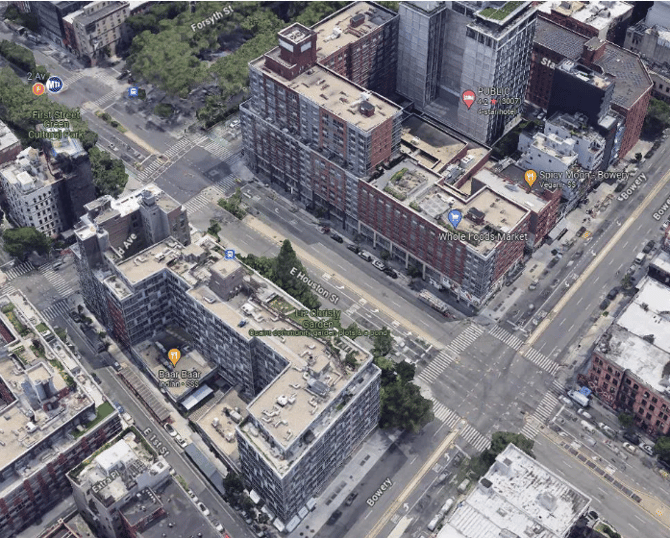
- Lots that may be eligible for the Article 320 typical pathway are flagged under the light blue “CP0” column on the
215 Chrystie St:
Article 320 typical pathway
273 Bowery:
2026 Rent Regulated
≤ 35% pathway
285 Bowery:
2035 Income Restricted
extension pathway
Imagery ©Google. Imagery ©Airbus, Maxar Technologies. Map data ©Google
III. Reporting and extension requests
Code language
§28-320.3.7 Reports required to be filed by owner. By May 1, 2025, and by May first of every year thereafter, the owner of a covered building shall file with the department a report, certified by a registered design professional…that for the previous calendar year such building is either:
1. In compliance with the applicable building emissions limit established pursuant to section 28-320.3; or
2. Not in compliance with such applicable building emissions limit, along with the amount by which such building exceeds such limit.
(…)
§28-320.3.7.1 Extension of time to file report.
An owner may apply for an extension of time to file an annual report required by section 28-320.3.7 in accordance with this section and the rules of the department…An extension granted pursuant to this section shall not modify the owner’s obligation to comply with the applicable emission limits for such calendar year.
1 RCNY §103-14
(b) Reporting. By May 1, 2025, a building emissions report for calendar year 2024, and by May 1 of every year thereafter…a building emissions report for the previous calendar year is required to be submitted to the Department by the owner of a covered building and must be submitted in accordance with the requirements of this section.
(1) Reporting tool. Energy use and emissions information for a covered building must be submitted in a form and manner as determined by the Department. Owners must maintain all documentation and information used in preparing the building emissions report for a minimum of six (6) years. Such documentation and information shall be submitted to the Department upon request.
(2) Condominium buildings. Building emissions for a covered building held in the condominium form of ownership must be submitted in a single report that includes the emissions for all condominium units in such building. Such report shall be submitted to the Department by the board of managers of such covered building.
(3) Multiple buildings that do not share energy service. [see “Shared energy service” section of this Guide]
(4) Multiple buildings that share energy service.[see “Shared energy service” section of this Guide]
(5) New buildings. An owner of a new covered building for which a Certificate of Occupancy [“CO”] or a Temporary Certificate of Occupancy [“TCO”] is issued on or after January 1, 2023, must begin reporting for such building for the first full calendar year following the year that such Certificate of Occupancy or Temporary Certificate of Occupancy is issued.
(6) Buildings with change in ownership. Notwithstanding any other provision of this section, for any covered building for which title is transferred to a new owner during a calendar year, such new owner is not required to submit a building emissions report for such building for such calendar year, provided the new owner is a subsequent bona fide purchaser of the covered building pursuant to Department rules.
(7) Full demolition of a covered building. An owner of a covered building for which a full demolition permit has been issued is not required to submit a building emissions report for the calendar year during which demolition work has commenced, provided that, no later than May 1 of the following year, the owner submits a written certification by a registered design professional that one or more energy-related systems within such building have been compromised and legal occupancy is not possible prior to January 1 of such following year.
(…)
(g) Penalty for failing to file a building emissions report. An owner of a covered building shall be liable for a civil penalty for failing to file a building emissions report within 60 days of the reporting deadline or by the date of any extension deadline granted by the Department pursuant to this rule.
(1) Calculation. Such penalty shall be an amount equal to the gross floor area of such building, multiplied by $0.50, for each month such report is not submitted within the 12 months following May 1 of each year, including the 60 days following the deadline.
(2) Extension of time to file. An owner who is unable to file the building emissions report by the reporting deadline despite such owner’s good faith efforts may apply for an extension in accordance with section 28-320.3.7.1 of the Administrative Code and this paragraph. An application for an extension must be filed with accompanying documentation no earlier than 30 days before and no later than 60 days after May 1 of each year. For purposes of this subdivision, an owner demonstrates good faith efforts for consideration of an extension where:
(i) The registered design professional hired for purposes of completing the building emissions report could not complete such report by the reporting deadline. For purposes of this paragraph, acceptable documentation in support of such extension request includes a contract between the owner and the registered design professional executed no later than February 1 of the year such report is required to be filed and an affidavit signed by the owner and the registered design professional stating that such professional was unable to complete the report on time and that the report will be completed and filed within 120 days of the reporting deadline; or
(ii) The owner has challenged a determination by the Department of Finance regarding whether the square footage of the building qualifies such building as a covered building, provided that such owner must file the building emissions report within 120 days of the first determination by the Department of Finance that such building qualifies as a covered building following the commencement of such challenge. For purposes of this paragraph, acceptable documentation in support of such extension request includes an attestation signed by the owner indicating why the square footage of the building does not qualify such building as a covered building and all correspondence between the Department of Finance and such building owner related to such dispute.
Reporting and extension requests – summary
Starting in 2025 for most buildings, an annual LL97 compliance report is due by May 1st covering emissions and emissions limits from the calendar year prior (January 1st through December 31st). There is an annual through June 30th where the report may be submitted without penalty, but reports submitted after June 30th will incur a $0.50/sf penalty for each month that has passed since May 1st. Calculations and floor area diagrams used to create the report should ideally be included in the submission; otherwise, the Department may request to see them.
If an owner wishes to pursue penalty mitigation, the request and related documentation must be submitted with the annual emissions report. Non-compliant reports submitted after the end of the grace period and not pursuing penalty mitigation will incur fines for both late submission and non-compliance.
Annual deadline extension requests may be submitted until June 30th and are allowed for two reasons:
i)The RDP submitting the report needs until August 29th to finish (e.g. due to delayed utility-provided energy data); or ii)There is a pending dispute at DOF challenging the building’s recorded GSF, as described in Section II(A) of this Guide.
Certain building statuses may affect reporting and are elaborated upon in 1 RCNY §103-14:
- Condominiums (“condos”)
- Multiple buildings on one lot
- Newly constructed buildings
- Ownership changes
- Fully demolished buildings
Condos are single structures that have been subdivided into condo lots, individual units that can each be under separate ownership. Condo units can be stacked or otherwise agglomerated, and they often share egress and life safety systems with other condo units. Department-related matters in condos are generally handled by the property manager and/or condo board.
Multiple buildings on one lot have unique reporting requirements, especially when the buildings follow different compliance pathways and/or share energy service. These topics are covered in Sections III(B) and III(C) of this Guide.
New buildings (“NBs”) are obligated to report emissions beginning with the first full calendar year following the building’s initial Temporary Certificate of Occupancy (“TCO”). The entire building – not just the areas under TCO – must be accounted for in GFA, emissions limit, and energy use calculations. If unoccupied areas of the building temporarily have to use energy types other than the utility-provided energy types used in the rest of the building, those must be noted in the LL97 report.
Ownership changes for an existing building exempt such building from LL97 reporting for the entire calendar year in which the sale/transfer was closed (e.g. a building sold in April 2026 would not need to submit a CY2026 emissions report by May 1st, 2027). The submitted documentation would need to show that the “owner is a subsequent bona fide purchaser” as described in the Department’s and which is basically verification that the new owner is not merely the old owner under a different name/entity.
Buildings undergoing full demolition (“demo”) potentially become exempt from LL97 immediately but must still file an annual report (by May 1st of the following year) attesting that the building’s energy-using systems ceased to be operational by the end of the calendar year in which demo work commenced. When demo phasing results in building systems staying online and/or legal occupancy continuing past the end of the year, a LL97 compliance report must be submitted for that year.
Reporting and extension requests – additional information
1. Deadline extension requests may be submitted as early as April 1st.
2. For more on condo lots, see “Lots / BBLs – additional information” in Section III(A) of this Guide.
3. The initial TCO for an NB can be downloaded from using the address search function. Once the building pops up, the “Certificate of Occupancy” tab will list all of the TCOs, with the “Initial” TCO shown under the “CO Submission Type” column. Click on the “Print” icon (not the “View” icon) to see the document’s issuance date.
4. Even if the initial TCO covers only a small percentage of the building floor area, it still starts the clock for LL97 compliance reporting purposes.
5. If an NB shows up on a CBL but is still within its grace period following initial TCO, then an exception request can be submitted to the Department following the steps under My building should not be subject to LL97 - how do I remove it from the CBL? in the
III(A). Building-level compliance
Code language n/a
Building-level compliance – summary
Owner submission of LL97 compliance reports, as well as issuance of associated penalties by the Department, takes place at the level of an individual building (or “BIN”, Building Information Number), even though the identifying information in the is at the level of the tax lot (or “BBL”, Borough-Block-Lot).
Eligibility for adjustments and exceptions applies to individual buildings, not to entire lots. For this and other reasons, when more than one building exists on a lot it is up to the owner(s) to demonstrate LL97 compliance status for each building individually; see Section III(B) of this Guide.
Lots / BBLs – additional information
- Every official tax lot in the City has a unique ten-digit BBL assigned by the Department of Finance (“DOF”) for recordkeeping.
- The first digit of the BBL is the borough code.
- Manhattan = 1, Bronx = 2, Brooklyn = 3, Queens = 4, Staten Island = 5.
- The next five digits of the BBL are the block number.
- Manhattan blocks go from 1 to 2255; Bronx blocks go from 2260 to 5958, with block 9999 used for various green spaces; Brooklyn blocks go from 1 to 8955; Queens blocks go from 1 to 16350; and Staten Island blocks go from 1 to 8050.
- Leading zeros are used in the BBL if the block number is fewer than five digits long (e.g. Block 1 = 00001).
- The last four digits of the BBL are the lot number.
- Most lot numbers are one or two digits, beginning on each block at 1; lots created through plan subdivisions are three digits since they generally add multiples of 100 to the original lot number.
- Condo lot numbers start at 1000. Multiple condo lots within a single building are grouped under a single “billing lot” number, which is four digits beginning with 75 (e.g. 7501).
- When the upper portion of a building is subdivided off as an “air lot” for tax purposes, it receives a four-digit lot number beginning with 9 (e.g. 9001). Similarly, when the below-grade portion of a building is subdivided off as a “subterranean lot”, it receives a four-digit lot number beginning with 8 (e.g. 8001). Air and subterranean lot floor areas must be combined with base building floor area for LL97 reporting, even if they are under different ownership – similar to condo lot reporting.
- Leading zeros are used in the BBL if the lot number is fewer than four digits long (e.g. Lot 1 = 0001).
- The first digit of the BBL is the borough code.
- Condo building records are sometimes kept under the original pre-condo lot number, which can be found by zooming into the official NYC (aka DOF tax map) and locating the crossed-out number next to the “C”. Meanwhile, the condo billing lot number (“75XX”) is the one shown on the official NYC the Department’s Property File database uses the condo billing lot number.
- Zoning lot boundaries can be different from tax lot boundaries in that one zoning lot might encompass multiple tax lots. Zoning lots and the related concept of zoning floor area (“ZFA”) generally do not factor into LL97 compliance.
- For more information on what happens to BBLs in special situations, such as when they are merged or cut through with new streets, see the Department of City Planning (“DCP”)’s
Buildings / BINs – additional information
1. Every stand-alone building in New York City has its own seven-digit BIN.
A. The first digit of the BIN is the borough code.
▪ Manhattan = 1, Bronx = 2, Brooklyn = 3, Queens = 4, Staten Island = 5.
B. The second digit of the BIN is used to indicate permanent vs. dummy status, as described in item 4 below. It can also indicate certain types of infrastructure (subway/rail stations, bridges, tunnels, skybridges) when it is a “7”.
C. The last five digits of the BIN do not have any special significance, except that BINs are assigned by DCP sequentially so buildings on the same block will often have sequential BINs.
2. BINs are assigned for a building’s lifetime and only retired when that building undergoes a signed-off full demo filing. Then, a new building going up in the same location is assigned a completely new BIN (which begins life as a Transitional BIN or T-BIN). A retired BIN should not be reused.
3. For a list of all the BINs on a BBL, use search function “BL” in DCP’s (“GOAT”). For a list of the address range(s) associated with a BIN, use GOAT function “BN”.
- GOAT does not return dummy BINs, so there should only be as many BINs on a BBL as there are discrete buildings. If there are more BINs than buildings showing up in GOAT, it means that BINs have been assigned to stand-alone non-building structures (e.g. storage sheds, ceremonial archways, permanently-installed tents).
- A less common situation is for there to be fewer BINs on a BBL than discrete buildings. In such cases, DCP’s Geographic Research (“GR”) Unit can assign the missing BIN(s) if contacted at .
4. Unfortunately, the Department’s Property File database will not recognize a BIN listed in DCP’s Geosupport database unless there is an address range associated with that BIN.
- This is evident when creating a new filing in the DOB Now: Build system, as the only option for building identification is to input an address – the BIN then populates automatically based on the address.
- To issue violations on a building without an address, the Department sometimes creates a dummy BIN where the second digit is an “8”. Dummy BINs only exist in the Department’s Property File database, not in Geosupport, and cannot be used for LL97 reporting purposes. Dummy BINs can be obsoleted by submitting a DOB NOW helpdesk ticket; any “Actions” associated with a dummy BIN within the Department’s Buildings Information System (“BIS”) may need to be transferred to a non-dummy BIN.
5. To associate an address range to a BIN, DCP must receive a House Number Certification from the corresponding borough’s Topographical Bureau (“Topo”). The certification process differs slightly in each borough, but generally requires the services of an RDP and takes about 1-3 months after submission of the application.
- The building owner is responsible for applying to Topo. After certification, Topo will forward official house numbers to DCP, or the owner can speed things up by emailing DCP’s GR Unit directly.
- DCP updates Geosupport on a quarterly basis with bi-weekly lot-level updates in between. The Department’s Property File database then pulls address ranges from the updated Geosupport, activating BINs (that did not previously have address ranges) for filing purposes.
- Information on Manhattan Topo’s application process is Bronx’s is Brooklyn’s is Queens’ is and Staten Island’s is
6. For more background on how BINs are useful, see DCP’s
7. To see a map of all BINs in the city keyed to their specific footprint (including those without address ranges) you can open and turn on the “Building” data type. Then, click on a shape outline to see the associated BIN.
III(B). Multiple buildings on one lot
Code language
§28-320.1 Definitions.
(…)
COVERED BUILDING. The term “covered building” means, as it appears in the records of the department of finance, (i) a building that exceeds 25,000 gross square feet…or (ii) two or more buildings on the same tax lot that together exceed 50,000 gross square feet…or (iii) two or more buildings held in the condominium form of ownership that are governed by the same board of managers and that together exceed 50,000 gross square feet…
1 RCNY §103-14
(b) Reporting. (…)
(…)
(3) Multiple buildings that do not share energy service. Where two or more covered buildings (i) are on the same tax lot, and (ii) do not share energy service, the owner must submit individual and separate building emissions calculations for each covered building on the tax lot.
(4) Multiple buildings that share energy service. (…)
1 RCNY §103-17 (for Article 321 covered buildings)
(b) Required report for certain buildings. (…)
Where an owner has multiple covered buildings on a lot, such owner may choose to provide a separate report for each such covered building on the lot, or a single report pursuant to either section 28-321.3.1 or section 321.3.2 of the Administrative Code for all such covered buildings on the lot. (…)
Multiple buildings on one lot – summary
When a lot with multiple buildings appears on a CBL, each individual building on the lot may follow its own compliance pathway that is separate from the other buildings. Article 320 typical pathway buildings can co-exist on a lot with 2026 Rent Regulated, 2035 Income Restricted, Article 321, and City buildings. Because the CBLs do not specify which buildings on a lot follow which pathway, each building must submit its own LL97 compliance report (except where combined reports are allowed). The range of possible compliance pathways for each of the multiple buildings on one lot is as follows:
1. Non-covered
2. Exception
3. 2026 Rent Regulated ≤ 35%
4. 2035 Income Restricted extension
5. Article 320 typical pathway
6. Article 321 (Performance-based pathway, Prescriptive pathway)
7. Combined reports
1. Non-covered – multiple buildings on one lot
a. Lot should not be on CBL
If an assessment of the lot’s GFA finds that no building on the lot is larger than 25,000 GSF and the aggregate area of all buildings combined is not more than 50,000 GSF, then it may be that the DOF recorded GSF numbers need to be updated and that the building does not belong on the CBL.
-
The steps to address this are the same as described in of this Guide.
Section II(A)(1)
b. Non-covered building on the same lot as a covered building
If one building on a lot is larger than 25,000 GSF, then the entire lot will be pulled onto the CBL even when the aggregate GSF is less than or equal to 50,000 (the threshold at which every building on the lot must comply with LL97). In this case, the other buildings on the lot could be considered non-covered.
|
Building 1 (26,000 GSF. Covered) Only buildings greater than 25,000 GSF are covered. Building 2 (10,000 GSF. Non-covered) 46,000 < 50,000 Building 3 (10,000 GSF. Non-covered) Total GSF on lot = 46,000. |
If the aggregate GSF increases above 50,000 (due to enlargements, extensions, additional structures), all buildings on the lot would then be considered covered buildings.
|
Building 1 (26,000 GSF. Covered) Building 2 (15,000 GSF. Covered) All buildings on lot 51,000 > 50,000 are covered. Building 3 (10,000 GSF. Covered) Total GSF on lot = 51,000. |
2. Exception – multiple buildings on one lot
Buildings falling under this category are the same as described in Section II(B) of this Guide, with the addition of certain garden-style apartments as defined in and described in the under My building should not be subject to LL97 - how do I remove it from the CBL?
3. 2026 Rent Regulated ≤ 35% – multiple buildings on one lot
Buildings falling under this category are the same as described in Section II(C) of this Guide.
4. 2035 Income Restricted extension – multiple buildings on one lot
Buildings falling under this category are the same as described in Section II(D) of this Guide.
5. Article 320 typical pathway – multiple buildings on one lot
Buildings falling under this category are the same as described in Section II(E) of this Guide.
6. Article 321 – multiple buildings on one lot
For lots with multiple LL97 covered buildings, the orange “CP3” column on the indicates that at least one building may be subject to Article 321 but does not indicate which one(s). Therefore, it is up to the owner to demonstrate which specific buildings are covered under Article 321.
As described in the there are two possible compliance pathways for Article 321 buildings:
a.Performance-based pathway
This requires a report certified by an RDP that describes the building as if it were subject to Article 320. In this report, the building’s emissions for CY2024 must be shown to be under the emissions limit for 2030 using the 2030 emissions coefficients, as described in and expanded upon in
b.Prescriptive Pathway
This requires a report certified by a that demonstrates the completion or non-applicability of the 13 Prescriptive Energy Conservation Measures (“PECMs”) listed in and detailed in and the Article 321 Filing Guide. A PECM report can include Department-provided and/or other approved documentation, as noted in the guidance.
Unlike Article 320 covered buildings which must submit emissions reports every year, Article 321 covered buildings only need to submit a one-time report in 2025. In certain circumstances, Article 321 buildings can apply for to extend the reporting window beyond 2025; for example, if they need more time to complete the PECMs, or if they will not be able to comply with 2030 emissions limits until 2030.
7. Combined reports – multiple buildings on one lot
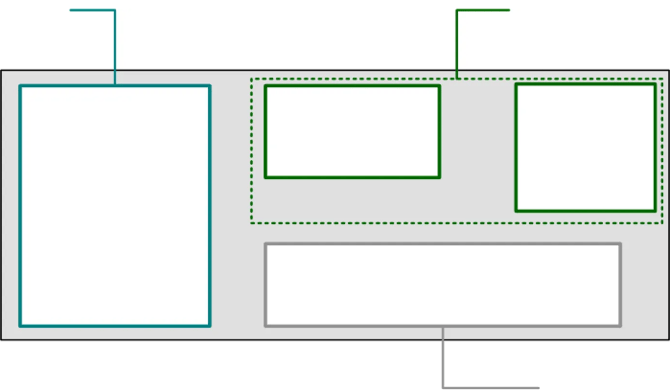
Combined reports (or “single reports” in the Rule) are when multiple buildings report together under a single filing fee and RDP attestation. According to and combined reports are possible when buildings:
i) have the same owner;
ii) are on the same lot or adjacent lots; and
iii) follow the same LL97 compliance pathway.
In certain cases of shared energy service, emissions and emissions limit calculations may be aggregated; otherwise, combined reports must still show separate calculations for each building. Combined reports are optional, not mandatory, and are only allowed during the initial compliance period (CY2024-29).
Owner A. Owner B.
Annual reports due One-time combined
starting 2025 report due in 2025
Building 2
321 prescriptive Building 3
pathway, 321 prescriptive
shared energy service pathway, shared
Building 1 energy service
320 typical pathway,
shared energy service
Building 4
City-supported (Cultural Institutions Group),
shared energy service
Owner C.
Exception; no report required
III(C). Shared energy service
Code language
1 RCNY §103-14
(a) Definitions. (…)
Energy service. Energy service is the delivery of energy from the energy supply or energy distribution system to or throughout a building, including any equipment used for such delivery. Two or more buildings may share energy service. Two or more buildings share energy service if such buildings share a meter or other point of connection to the energy supply or energy distribution system.
(…)
(b) Reporting. (…)
(4) Multiple buildings that share energy service. For building emissions reports for calendar years 2024 -2029, emissions for two or more covered buildings, regardless of whether such buildings are on the same tax lot, may be included in an aggregated building emissions calculation in a single building emissions report, provided all such covered buildings share energy service.
Shared energy service – summary
Each energy type – as defined in Section I(B) – serving a building should be able to be tracked back to a meter that tracks how much of that energy type passes through. When one meter covers energy type distribution for multiple buildings, then all buildings under the meter are considered to share energy service (or “share an energy system” per for Article 321 covered buildings).
As noted in the previous section of this Guide, covered buildings that have the same owner, are on the same lot or adjacent lots, and follow the same LL97 compliance pathway may combine their reports under a single LL97 submission and filing fee during the initial compliance period (CY2024-29). Once they are in a combined report, whether the buildings share energy service affects how their emissions may be calculated:
- If the buildings donot share energy service, the combined report must show separate emissions / emissions limit calculations for each building, with compliance assessed individually.
- If the buildings do share energy service, it is permissible to aggregate the emissions / emissions limit calculations into a total number, with compliance assessed as though the group of buildings is one big building.
The allowance for aggregate calculations provides flexibility for covered buildings that may not be able to install submetering equipment in time for the annual reporting deadline. As with combined reports, aggregate calculations are optional, not mandatory, and only permitted during the initial compliance period (CY2024-29). The reason for this limitation is that all buildings are expected to eventually submit individual emissions / emissions limit calculations.
If buildings share energy service but choose to not aggregate emissions calculations, then an RDP must determine a consistent method for apportioning energy consumption among each individual building. Calculations should be based on specific building characteristics – for example by using the emissions limit-based apportionment methodology described in the “Gross floor area” section of this Guide.
NOTE: Energy losses incurred during transmission and distribution may not be measurable and can be apportioned among the buildings served. Energy shared with buildings not covered in the same report should be excluded from any calculations.
Shared energy service – diagrams
The following diagrams illustrate when combined reports and/or aggregate calculations are allowed.
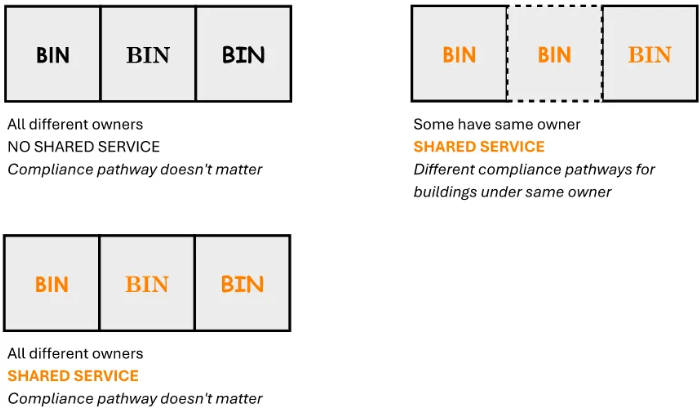
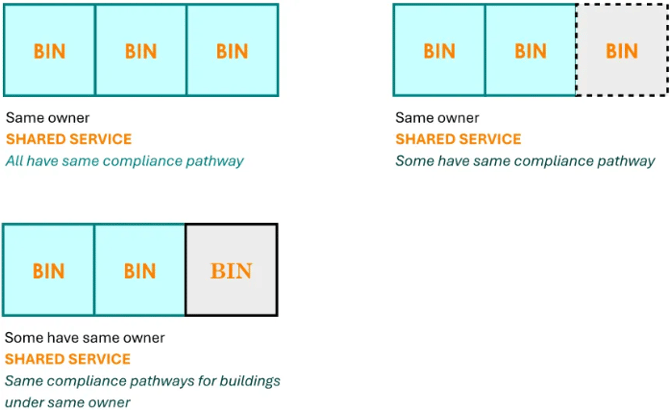
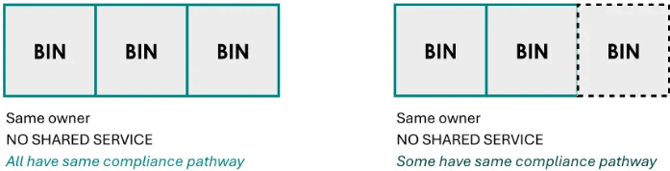
- Different fonts denote different owners.
- Orange font denotes shared energy service.
- Solid and d-a-s-h-e-d outlines denote different compliance pathways.
- Cyan outlines denote combined reports. Cyan hatch denotes aggregate calculations.
1. For covered buildings on separate and nonadjacent lots,
- Individual reports, and
- Individually calculated emissions / emissions limits
are alwaysrequired.
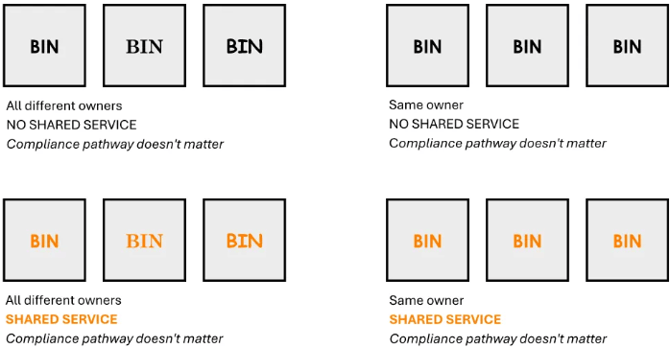
2. For covered buildings on the same lot or directly adjacent lots (meaning the lots share a portion of a boundary line),
- Individual reports, and
- Individually calculated emissions (and emissions limits)
are required when owners or compliance pathways are different, even if the buildings share energy service.
 3. For covered buildings on the same lot or directly adjacent lots,
- Combined reports, and
- Aggregate emissions (and emissions limits) calculations
are allowed for buildings on the same compliance pathway, under the same owner, that share service:
4. For covered buildings on the same lot or directly adjacent lots,
- Combined reports are allowed, but
- Individually calculated emissions (and emissions limits) are required
for buildings on the same compliance pathway, under the same owner, that do not share service:

Shared energy service – additional information
1. Aggregate calculations are not allowed when using fuel cells or renewable energy credits (“RECs”).
2. If buildings A and B share energy service, buildings B and C share a different energy service, and A and C do not share service, then the aggregate group of A, B, and C is considered to share service and may aggregate emissions if the qualifying conditions are met.
3. Shared fuel oil tanks that are not able to track usage should instead report based on delivery amounts.
4. Shared energy service can be reflected in ESPM by selecting a “multi-building property” where a meter is associated at the “Parent” (group) level rather than at the “Child” (individual) level.
5. Buildings are considered to share service even if only one energy type (out of several) is shared. In the example below, the two buildings share energy service because of the shared gas, even though incoming electricity is separately metered:
Utility Natural Gas
M
Building 1 Building 2
M Utility Electricity M
6. Shared service does not apply when a single building in a group (of any size) lacks a meter or submeter, since that building’s energy use can be determined through simple subtraction:
Utility Natural Gas
m M
5 -3 =
3 therms 5 therms 2 therms
Building 1 Building 2
III(D). Campus systems
Code language
1 RCNY §103-14
(a) Definitions. (…)
(…)
Campus energy resource. A campus energy resource is any form of energy that is generated by a central plant energy system and distributed to multiple buildings in a campus setting. A campus energy resource may include but is not limited to electricity, chilled water, condenser water, steam, high temperature hot water, medium temperature hot water, and low temperature hot water.
(…)
Plant input energy. Plant input energy is energy, such as electricity, fossil fuel, district steam, hot water, and chilled water, that is purchased from a public utility or commercial energy provider and is used to generate energy in a central plant in a campus-style energy system.
(…)
(d) Calculations. (…)
(3) Greenhouse gas coefficients of energy consumption. (…)
(iv) Greenhouse gas coefficient for campus-style electric systems. The greenhouse gas coefficient for electricity generated by a campus-style electric system, where electricity consumed by any covered building served by such system is generated in whole or in part on the premises of the campus, must be calculated in accordance with this subparagraph (iv).
a.The GHG coefficient for electricity generated by the campus-style electric system, must be calculated as follows:
[Refer to Rule for ]
b.Where a covered building consumes electricity generated by the campus-style electric system and also consumes utility electricity, the combined GHG coefficient for campus electricity must be calculated as follows:
[Refer to Rule for ]
c.Where electricity consumed by any covered building on the campus is generated on the site of the campus, and the owner elects to calculate emissions from such electricity based on time of use (TOU), the GHG coefficient shall be calculated as follows:
[Refer to Rule for ] (v) Greenhouse gas coefficients for certain campus-style energy systems. Notwithstanding any other provision of this section, the GHG coefficient for energy generated by a campus-style energy system must be calculated in accordance with this subparagraph (v). Such energy may include district heating and cooling or other district energy.
a. The GHG coefficient for each type of campus energy resource that is generated by a system or equipment in a campus central plant and consumed by a covered building shall account for the plant input energy utilized by such plant to generate and deliver such campus energy resource. Such systems or equipment in a campus central plant may include, but need not be limited to, prime generators, such as boilers, chillers, and cooling towers; ancillary equipment, such as pumps and fans; and associated controls. Any energy generated by any such system or equipment that serves a single building shall not be included in the input energy for the campus-style energy system and shall be considered part of the energy use of the covered building it is serving. Any plant input energy recovered by the campus-style energy system from any other plant energy source on campus and included in the calculation of the emissions coefficient for such other central plant energy source may be assigned an emissions coefficient of zero for purposes of calculating the GHG coefficient for a campus energy resource generated by the campus-style energy system.
b. Calculations.
- For each type of campus energy resource generated by the campus-style energy system, the GHG coefficient shall be calculated as follows:
[Refer to Rule for ] - Where, for each type of campus energy resource, a group of covered buildings consumes energy generated by the campus-style energy system and consumes energy generated by a utility, a combined GHG coefficient for such campus energy resource shall be calculated as follows:
[Refer to Rule for ]
Campus systems – summary
Campus-style systems are when a central plant, not managed by a utility, produces electricity and/or energy for one or more buildings on the same lot or nearby lots. Because energy types produced by a central plant are different from energy types whose GHG coefficients are published in LL97 (e.g. utility electricity and district steam), custom campus GHG coefficients must be determined for LL97 reporting purposes.
In 1 RCNY §103-14, the fuels consumed by the central plant are called plant input energy and the energy types produced – which can include “electricity, chilled water, condenser water, steam, [and] high…medium…low temperature hot water” – are called campus energy resources, in other words plant output energy. Plant input energy can either be sourced from a utility (electricity, natural gas, steam) or delivered in bulk (fuel oil).
Transmission and distribution (“T&D”) losses throughout the system do not have to be accounted for when determining the campus GHG coefficient; similarly, buildings served by the central plant that are not LL97 covered buildings do not have to be accounted for. This is because deducting the proportional amount of plant input energy / campus energy resources assignable to such exclusions results in a coefficient that is equal to simply looking at totals.
For example, a central boiler on a university campus uses utility-provided natural gas to generate steam, then the steam is sent out to campus buildings to supply radiators and hot water heaters. A campus steam coefficient is determined by dividing the boiler’s emissions (the product of the LL97 natural gas GHG coefficient and the boiler’s metered natural gas consumption in kBtu) by the boiler’s metered steam output in kBtu. Then, each building served would determine its own emissions attributable to campus steam through multiplying their metered steam consumption by the campus steam coefficient.
NOTE: Electricity and/or steam produced at central plants using cogeneration (“cogen”) equipment may be able to use the CHP methodology described in Section III(E) of this Guide instead of taking a custom campus GHG coefficient.
Campus systems – additional information
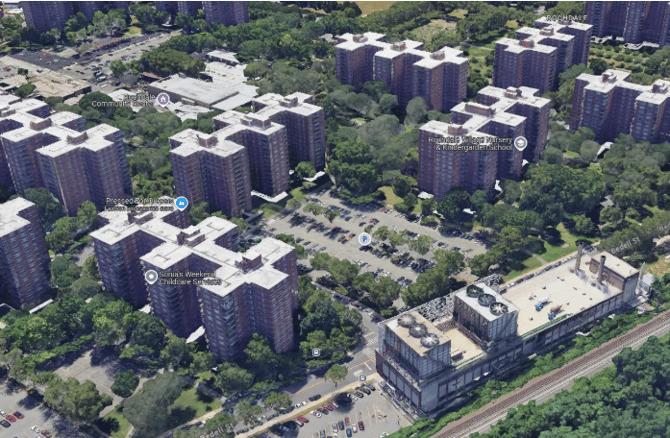
1.LL97 campuses are not limited to those that are academic in nature – they can describe any use or occupancy where the energy distribution system fits LL97’s description of a campus-style energy distribution system. Typical campuses in NYC can include religious properties, hospital properties, residential properties, and other uses in addition to schools/universities. For example, a primarily residential campus-style system is shown below:
Lot A:
27-building campus
Lot B:
Central plant for electricity,
steam, and chilled water
Imagery ©Google. Imagery ©Airbus, Maxar Technologies. Map data ©Google
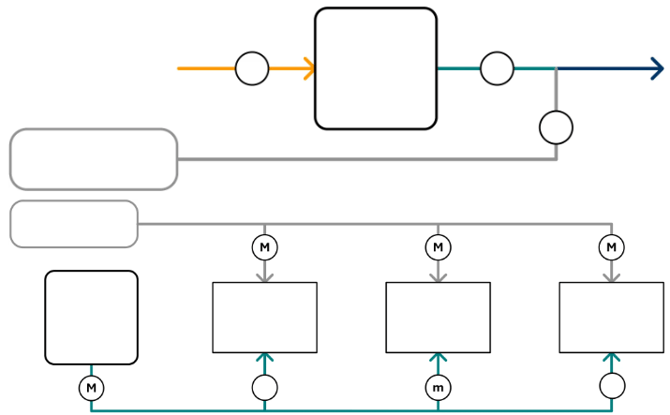
2.When utility electricity and/or district steam are mixed in with campus energy resources before distribution, a blended campus GHG coefficient must be created – this is described in Equations 103-14.8 and 103-14.11 in the Rule:
Plant input Central Blended M M
energy plant electricity
M
Utility electricity
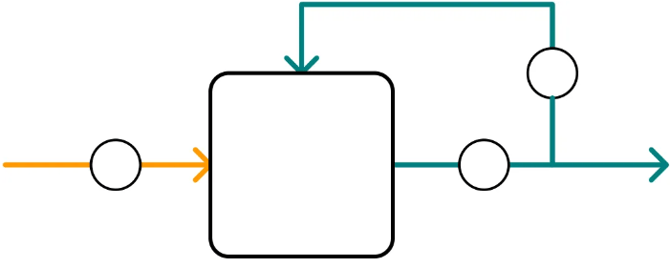
3.But, when utility electricity and/or district steam are mixed in with campus energy resources at an individual building, it is possible to separately meter utility-provided energy vs. central plant-produced energy. Here the emissions from utility-provided energy can be calculated using their published coefficients and the emissions from campus energy resources can be calculated using non-blended campus GHG coefficients (Equations 103-14.7 and 103-14.10 in the Rule):
Utility electricity
Central
Building 1 Building 2 Building 3 plant
m m
4.“Campus” as used in LL97 differs from the concept of “campus” as used in ESPM and LL84 Benchmarking. In ESPM, “campus” is synonymous with “Parent” or “Multi-building property” and is a term used to describe multiple “Child” buildings that are grouped together because they are on the same lot or because they share energy service. For more on “campus” in the context of ESPM and LL84, see from the EPA or from the (a division of the CUNY Building Performance Lab that conducts trainings on behalf of the Department).
5.Electricity exported off-campus (e.g. to the grid) may be included under campus energy resources ONLY when it has lower calculated emissions than grid electricity, per the description of the variable 𝑚𝑐𝑒 in The way to compare emissions from central plant electricity to those from grid electricity is to first calculate the campus electricity coefficient while including all exported electricity. If the resulting campus coefficient is smaller than the published LL97 grid electricity coefficient for that year, then the equation is fine and exported electricity may be included. Otherwise, the campus electricity coefficient must be re-calculated after first subtracting all exported electricity.
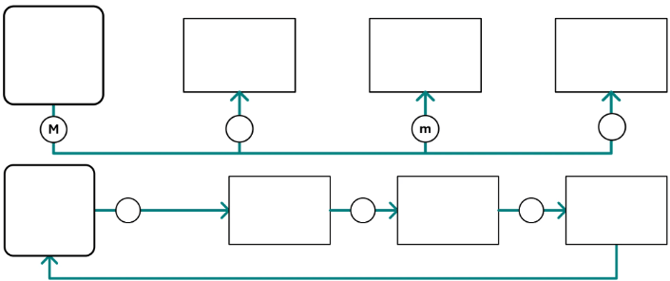
6.Parasitic loads, also known as station service, describe the energy used to operate a power plant (e.g. energy for space conditioning, machinery startup, heat recovery, pollution control / carbon sequestration, lighting, and other support functions). 1 RCNY §103-14(d)(3)(v) refers to station service as “the plant input energy utilized…to generate and deliver [a] campus energy resource.” Parasitic loads should be served after metering for total produced campus energy resources, as shown in the diagram below. Emissions for the central plant building should be calculated using parasitic loads only.
Parasitic loads
m
Plant input Central Campus energy M M
energy plant resources
7.If the buildings served by the campus-style system are not sufficiently submetered, then they will have to follow the
reporting guidelines for shared energy service as outlined in Section III(C) of this Guide.
8.The most straightforward way to submeter campus buildings is in a parallel configuration, where separate branch lines connect the central plant with each building served and a submeter is installed on each branch line:
Central
Building 1 Building 2 Building 3 plant
25 tons m 100 kBtu/hr 100 kBtu/hr m 100 kBtu/hr
9. Certain energy types, such as water loops, do not always run along separate branch lines and must be submetered in a series configuration. In such cases, if a shared energy service emissions report is not possible or desired, the campus energy consumption of each building in the series will have to be derived mathematically; T&D losses may end up being attributed to the preceding building in the series:
Central
M Building 1 m Building 2 m Building 3 plant
25 tons (300 kBtu/hr) 190 85
kBtu/hr kBtu/hr
III(E). Combined heat and power
Code language
§28-320.1 Definitions. (…)
(…)
DISTRIBUTED ENERGY RESOURCE. The term “distributed energy resource” means a resource comprised of one or multiple units capable of generating or storing electricity, all at a single location that is directly or indirectly connected to an electric utility transmission and distribution system. The resource may serve all or part of the electric load of one or more customers at the same location, and it may simultaneously or alternatively transmit all or part of the electricity it generates or stores onto the electric transmission and distribution system for sale to or use by other customers at other locations.
(…)
§28-320.3 Building emissions limits. (…)
§28-320.3.1 Annual building emissions limits 2024-2029. (…)
§28-320.3.1.1 Greenhouse gas coefficient of energy consumption for calendar years 2024 through 2029. (…) (…)
7. The amount of greenhouse gas emissions attributable to other energy sources, including but not limited to distributed energy resources, shall be determined by the commissioner and promulgated into rules of the department.
Local Law 97 Advisory Board Report
1.0 Calculating and Reporting GHG Emissions
1.3 Establish Carbon Coefficients for Certain Distributed Energy Resources (DERs)
(…) The Advisory Board also recognizes that as the grid cleans over time, the value of some DER – primarily those that are fossil fuel-based – should change. Once the grid has cleaned to a certain level, operating some DER systems may have a higher carbon output than the grid, and this would be reflected in the TOU methodology. At that transition point, owners may need to reconsider what options they have for provision of on-site energy and the City should consider whether additional rulemaking is necessary to reflect the changing energy grid and the role that DERs play. (…)
1 RCNY §103-14
(a)Definitions. (…)
(…)
Critical facility. A critical facility means a facility the operation of which is critical to human life or safety, such as a hospital, dialysis clinic, or a facility that manufactures vaccines.
(…)
Qualified generation facility. A qualified generation facility is any combined heat and power system, permitted prior to September 1, 2024, that (i) operates at a minimum annual average efficiency as established by this rule, (ii) emits levels of Nitrogen Oxide (NOx) below the limits established by this rule, (iii) is not owned by a utility, and (iv) meets the requirements of the New York City Air Pollution Control Code.
(…)
(d) Calculations. (…)
(…)
(3) Greenhouse gas coefficients of energy consumption. (…)
(…)
(vi) GHG coefficients for distributed energy resources. For the purposes of this subparagraph, all distributed energy resources must be separately metered or sub-metered in a manner that produces data for the year being reported. Notwithstanding any other provision of this section, the GHG coefficient for the distributed energy resources described in this subparagraph may be determined as follows:
(…)
e. GHG coefficients for qualified generation facilities. For the purposes of reporting emissions, an owner of a qualified generation facility may utilize the coefficients listed in section 28-320.3.1.1 of the Administrative Code for electricity and district steam where such owner is able to demonstrate in a form and manner established by the Department that such co-generation plant operates as a qualified generation facility. For annual electric output of the plant, the coefficient for utility electricity may be utilized, and for annual heat output of the plant, the coefficient for district steam may be utilized, provide that:
- Average annual efficiency. The average annual efficiency of the plant, as calculated pursuant to Department guidance based on all generation units, must be no less than the efficiency of the utility grid identified by the Department in guidance based on the published Inventory of New York City Greenhouse Gas Emissions.
Exceptions. A co-generation plant may be eligible as a qualified generation facility without meeting the minimum efficiency requirement if:
(1) The co-generation plant operates year-round and is essential to prevent voltage drops serving a critical facility; or
(2) The co-generation plant serves a building in an area designated by the Department as having limited spare electrical capacity as verified by the utility.
- Nitrogen oxide (NOx) emissions limit. For each power generation unit that is part of the cogeneration plant, the owner must confirm that the NOx emissions are below 1.6 lbs-NOx/MWh, or 4.4 lbs-NOx/MWh if the interconnection application and/or air permit application were accepted on or before January 1, 2017.
Combined heat and power – summary
Combined heat and power (“CHP”), also known as cogeneration / trigeneration / quadgeneration depending on how many useful outputs are produced, is when an engine takes a single (or blended) fuel stream and multiplies it into more than one energy type by harnessing the thermal energy thrown off by the prime mover. For example, the most common form of CHP is when a natural gas-fed turbine generates electricity and uses the waste heat to run a heating system (via steam or hot water) and/or a cooling system (via a heat energy source run through an absorption chiller).
By its very nature, CHP is theoretically more energy efficient than operating a stand-alone generator, heating system, and/or cooling system. CHP can be a more cost-effective way to supply building needs than purchasing utility electricity, natural gas,

and/or steam separately. On-site CHP can compensate for fluctuations in the local electrical grid and can even support standby loads during a complete electrical outage if configured to run in “island mode”. For these and other reasons, CHP installation has been incentivized since at least the 2000s; in fact the Department published in 2010.
However, now that LL97 is making decarbonization as important as energy efficiency, fossil fuel combustion – including CHP – must be tapered off. To evaluate the ongoing usefulness of CHP within the long-term framework of decarbonization, the Department convened a months-long CHP-focused working group with technical experts and industry stakeholders, resulting in additions to 1 RCNY §103-14 that outline a methodology for the LL97-compliant use of CHP.
The revised Rule allows favorable calculations for CHP systems meeting the definition of a “qualified generation facility”, meaning that a permit was issued by the Department prior to September 1, 2024 and all of the following apply:
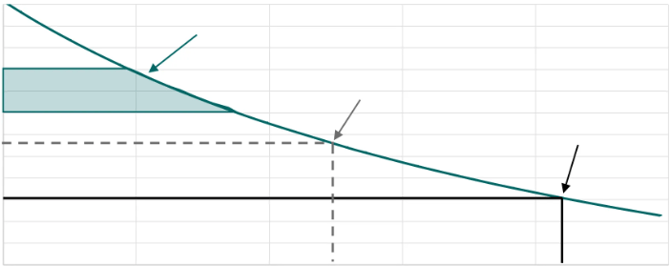
i)The system operates at a minimum annual average efficiency, which at the time of this Guide is set at 55%.
100%
95% Peak CHP efficiency:
CHP Min. Average Annual Efficiency
0.00021 to 0.00025 tCO2e/kWh
90% 75% to 85%
85%
LL97 (2024 - 2029):
80%
0.000288962 tCO2e/kWh
75% 67% efficiency
MOCEJ (2023): 70%
0.0003699 tCO2e/kWh 65% 55% efficiency 60%
55%
50%
45%
40%
0.00016000 0.00021000 0.00026000 0.00031000 0.00036000 0.00041000 Grid Electricity Coefficient (tCO2e/kWh)
- The Department determines CHP minimum annual average efficiency by taking the grid electricity coefficient listed at the published on MOCEJ’s website (in the table “GPC Carbon Intensity of NYC Electricity Grid”) and using it to calculate the emissions for a grid-connected building with a gas-fired hot water boiler of 82% peak/80% average efficiency. Those emissions are then compared to those for a building using gas-fired CHP to generate the same amount of electricity and hot water.
- As more renewable energy sources come online, the MOCEJ grid electricity coefficient will decrease and required CHP minimum efficiency will have to increase accordingly.By the time grid performance aligns with the 2030-2034 LL97 grid electricity coefficient published in , required minimum efficiency will exceed what is technically possible.
- Basic CHP efficiency is calculated by dividing energy produced by energy consumed. Annual average efficiency is a more complicated calculation described under “Combined heat and power – additional information” below.
Minimum efficiency is not required for:
1) CHP that is essential to power a “critical facility” as such term is defined in 1 RCNY §103-14; or
2) CHP in areas identified by the Department and verified by the utility as having limited spare electrical capacity. At the time of this Guide, these areas are the ones served by the following Con Edison (“Con Ed”) substations: oJamaica
o Newtown/Glendale
o Brownsville No. 1 and No. 2 (Brooklyn Queens Demand Management, “BQDM”)
ii) The system does not emit levels of nitrogen oxide (“NOx”) greater than or equal to 1.6 lbs/MWh.
- Allowable NOx levels increase to 4.4 lbs/MWh if the system’s interconnection application and/or Department of Environmental Protection (“DEP”) air permit application were accepted on or before January 1, 2017.
- These numbers align with Con Ed’s standards for CHP systems that may be exempt from Standby Service rates, as published in the with the NYS Public Service Commission ("PSC").
iii) The system is not owned by a utility.
iv) The system meets the performance requirements of Title 24 of the NYC Administrative Code, aka the
(“Air Code”).
Once it counts as a “qualified generation facility”, a CHP system’s emissions may be calculated by applying grid coefficients to its output energy types. This methodology is advantageous because it produces a significantly lower number than calculating emissions by applying fuel coefficients to the input energy type(s).
For example, a turbine that consumed 10,000 MMBtu of natural gas in 2024 would be considered to have produced (0.00005311 * 10,000,000 = ) 531.1 tCO2e if input energy is used for emissions calculations. Say that the turbine ran at 55% efficiency and generated 5,500 MMBtu of energy: 2,500 MMBtu of steam and 3,000 MMBtu of electricity (equivalent to 3,000 * 293.07 = 879,210 kWh). Using output energy for emissions calculations and applying district steam and grid electricity coefficients gives a lower emissions number of (0.00004493 * 2,500,000 + 0.000288962 * 879,210 = ) 366.383 tCO2e.
Combined heat and power – additional information
1. The formula for determining a CHP system’s average annual efficiency is derived from the December 2008 NYSERDA CHP
Systems Manual, with minor corrections by the working group:
∑8760
𝑖=1𝑄useful,𝑖+ 3,412 ⋅(∑8760
𝑖=1 𝑘𝑊ℎoutput,𝑖−∑8760
𝑖=1𝑘𝑊ℎparasitic,𝑖)
𝜂𝑐ℎ𝑝,ℎℎ𝑣= 8760
𝐻𝐻𝑉gas ⋅∑𝑖=1 𝑔𝑎𝑠input,𝑖
Where:
𝜂𝑐ℎ𝑝,ℎℎ𝑣 = Average annual CHP efficiency
𝑄useful,𝑖 = Useful heat recovery provided for hour i (Btu)
𝑘𝑊ℎoutput,𝑖 = Generator power output provided for hour i (kWh)
𝑘𝑊ℎparasitic,𝑖 = Parasitic power consumption for CHP system for hour i (kWh)
𝑔𝑎𝑠input,𝑖 = Generator gas input for hour i (cu ft)
𝐻𝐻𝑉gas = Higher heating value for natural gas supplied at site from utility bills, average of 12 months (Btu / cu ft)
2. “Useful heat recovery” is thermal energy that displaces fuel use in a boiler, furnace, chiller, desiccant wheel, or other system that serves a useful purpose such as heating, cooling, or dehumidification.
▪ Not all heat output from a prime mover can be assumed to be useful heat.
▪ Useful heat measurements will vary from hour to hour because thermal energy needs can vary based on time of day, time of year, or other factors.
3. “Parasitic power consumption” is electricity that would not be used if the CHP system was not present. This includes loads such as controls, pumps, fuel compressors, fans, and heat recovery / rejection.
▪ Parasitic power consumption can be the sum of several instruments or be derived from one-time power readings with component runtime information.
▪ Parasitic loads can be approximately 3%-10% of generation.
▪ Ideally, metering would be set up such that any measured generation is net of parasitic losses.
4. When multiple buildings are connected to a common CHP system, the buildings are considered to share energy service.
Guidelines for whether such buildings’ LL97 compliance reports can be combined and their emissions / emissions limits aggregated are the same as those described in Section III(C) of this Guide.
5. Required documentation for any CHP system that uses the “qualified generation facility” methodology of can include the following:
a. Analysis verifying the system’s average annual efficiency, including measured data for: oFuel input(s) to the CHP system;
o Energy outputs of the CHP system;
o Useful heat recovery, as described in item 3 above;
o Parasitic power consumption, as described in item 4 above.
b. Determination of a system’s NOx emissions, based on the manufacturer’s guarantee or via an approved measurement methodology (e.g. stack test).
c. Data on equipment type, equipment quantity, peak capacity, peak electrical efficiency, date of installation, combustion process (e.g. dry low NOx, diffusion, flue gas recirculation), post-combustion controls (e.g. selective catalytic reduction), and building end uses.
6. A CHP system that does not count as a “qualified generation facility” may still use the TOU approach allowed for DERs, as outlined in
IV. Emissions calculations
Code language
§28-320.1 Definitions.
(…)
BUILDING EMISSIONS. (…) The term “building emissions” shall not include greenhouse gas emissions emitted during a local state of emergency declared by the mayor pursuant to section 24 of the executive law or a state of emergency declared by the governor pursuant to section 28 of the executive law, where such local or state emergency has an impact on building emissions.
(…)
§28-320.3 Building emissions limits.
Except as otherwise provided in this article, or otherwise provided by rule, on and after January 1, 2024, a covered building shall not have annual building emissions higher than the annual building emissions limit for such building as determined in accordance with this section based on the occupancy group of the building.
§28-320.3.1 Annual building emissions limits 2024-2029.
(…) For a covered building with spaces classified in more than one occupancy group, the annual building emissions limit shall be the sum of the calculated values from items 1 through 10 of this paragraph, as applicable for each space.
1. For spaces classified as [occupancy group]: multiply the building emissions intensity limit of [specific factor per occupancy group] by the corresponding gross floor area (sf);
[refer to for list of 2024-2029 building emissions intensity limits]§28-320.3.1.1 Greenhouse gas coefficient of energy consumption for calendar years 2024 through 2029.
The annual building emissions of a covered building in accordance with this section, greenhouse gas emissions shall be calculated as follows for calendar years 2024 through 2029: (…)
[refer to for list of 2024-2029 emissions coefficients]§28-320.3.2 Building emissions limits for calendar years 2030 through 2034.
(…) The department may establish different limits, including a different metric or method of calculation, set forth in the rules of the department, where the department determines that different limits are feasible and in the public interest. (…)
[refer to for list of 2030-2034 building emissions intensity limits]§28-320.3.2.1 Greenhouse gas coefficients of energy consumption for calendar years 2030 through 2034.
(…) When developing such coefficients, the commissioner shall consider factors, including but not limited to the best available New York state energy research and development authority and State Energy Plan marginal forecasts for Zone J for the end of the compliance period and beneficial electrification.
§28-320.3.3 Reserved.
§28-320.3.4 Building emissions limits for calendar years 2035 through 2050.
…the commissioner shall establish by rule annual building emissions limits and building emissions intensity limits applicable for calendar years 2035 through 2039 and building emissions limits and building emissions intensity limits applicable for calendar years 2040 through 2049. (…)
§28-320.3.5 Building emissions limits on and after calendar year 2050.
…the commissioner shall establish by rule annual building emissions limits and building emissions intensity limits applicable for calendar years commencing on and after January 1, 2050. (…)
1 RCNY §103-14
(a) Definitions. (…)
(…)
Emissions factor. An emissions factor is the building emissions intensity limit for an occupancy group or property type as determined in accordance with section 28-320.3 of the Administrative Code.
(…)
(c) Occupancy groups and emissions factors. (…)
(…)
(3) Annual emission factors. For purposes of reporting annual greenhouse gas emissions pursuant to this section, emissions factors shall be determined in accordance with this paragraph.
[refer to for lists of 2024-2029, 2030-2034, 2035-2039, and 2040-2049 emissions factors] (vi) For purposes of reporting for calendar years 2050 or later, an emissions factor of 0.00 applies to all Energy Star Portfolio Manager property types.
(d) Calculations. (…)
(…)
(2) Building emissions limits.
(i) Buildings with a single occupancy group. The building emissions limit for a covered building with a single occupancy group or property type must be calculated as the gross floor area multiplied by the emissions factor for the building’s occupancy group or property type.
(ii) Buildings with multiple occupancy groups. The building emissions limit for a covered building with multiple occupancy groups or property types must be calculated as the sum of the emissions factor for each occupancy group or property type multiplied by the floor area of each occupancy group or property type in the covered building:
[refer to for Equation 103-14.1] (3) Greenhouse gas coefficients of energy consumption. Greenhouse gas coefficients for energy consumption shall be determined in accordance with this paragraph (3):
(i) Greenhouse gas coefficients for certain fuels combusted or consumed on premises for calendar years 2024 - 2034. For building emissions reports for calendar years 2024 - 2034, the GHG coefficients for fuel types combusted or consumed on premises provided in section 28-320.3.1.1 of the Administrative Code apply, except as provided in this subparagraph (i) or in subparagraph (ii) of this paragraph, provided that for any fuel type with a biogenic blend, the owner may propose an alternate coefficient pursuant to clause c of this subparagraph.
a. For the following fuel types combusted or consumed on premises, greenhouse gas emissions must be calculated as generating the following amounts of tCO2e per kBtu:
[refer to for list of emissions coefficients for 18 uncommon bulk fuels] b. Exceptions. Notwithstanding any other provision of this subparagraph, for building emissions reports for calendar years 2030 – 2034:
[refer to for 2030-2034 emissions coefficients for #2 and #4 fuel oil] c. For any fuel type that is combusted or consumed on site, not listed in this subparagraph or section 28-320.3.1.1 of the Administrative Code and not prohibited by applicable rule or law, the owner must propose a carbon coefficient, in tCO2e per kBtu, that serves the public interest of reducing GHG emissions…
(ii) Greenhouse gas coefficients for utility energy consumption for calendar years 2030 through 2034. For building emissions reports for calendar years 2030 - 2034, the GHG coefficients for consumption of energy generated by a utility shall be determined in accordance with this subparagraph (ii).
[refer to for 2030-2034 emissions coefficients for utility electricity, natural gas, and district steam] (iii) Greenhouse gas coefficient for utility electricity based on time of use (TOU). (…)
(iv) Greenhouse gas coefficient for campus-style electric systems. (…)
(v) Greenhouse gas coefficients for certain campus-style energy systems. (…)
(vi) GHG coefficients for distributed energy resources. (…)
a. GHG coefficient for certain distributed energy resources. (…)
b. Greenhouse gas coefficient for subscription to off-site solar energy generation.
(…)
c. GHG coefficient for energy storage. (…)
d. GHG emissions differential for certain natural gas-powered fuel cells. (…)
e. GHG coefficients for qualified generation facilities. (…)
(vii)GHG Coefficient for beneficial electrification. (…)
(4) Annual building emissions. Annual building emissions for a covered building must be calculated in accordance with this paragraph (4).
(i) Calculation. Annual building emissions must be calculated as follows:
[refer to for Equation 103-14.13] (ii) Energy consumption to be included. All energy consumed by a covered building, including fuels used for normal testing of emergency or stand-by power generators, must be included in the calculation of the annual building emissions for such covered building, provided, however:
(…)
b. Energy consumed during a local state of emergency declared pursuant to section 24 of the NYS Executive Law or a state of emergency declared pursuant to sections 28 of the New York State Executive Law, where such state of emergency has an impact on building emissions, such as a state of emergency resulting from severe thunderstorms or flooding.
Emissions calculations – summary
LL97’s approach to compliance is straightforward. First, a building calculates its allowable emissions limit, which is the maximum GHG emissions amount that it can generate; this limit ratchets down in stages until it reaches zero by CY2050. Second, a building calculates its GHG emissions for the previous calendar year. If a building’s emissions are lower than its allowable emissions limit, then it is compliant under LL97.
A building’s emissions limit is the ∑ (sigma or sum) of the emissions limits for each of its property types. Each property type’s emissions limit is the product of its prescribed emissions factor (as listed in the Article and/or Rule) and that property type’s total GFA within the building.
-
Property type refers to either ESPM property type or BC occupancy group (under limited circumstances) – see “” section of this Guide for further clarification.
Selecting ESPM categories
-
GFA must be verified in an energy-focused way that is specific to LL97 – see “” section of this Guide.
Gross floor area
A building’s emissions are the ∑ of the emissions for each of its consumed energy types. Each energy type’s emissions are the product of its prescribed emissions coefficient (as listed in the Article and/or Rule) and that energy type’s annual quantity consumed. Covered buildings subject to will have already been recording energy consumption via ESPM since 2013; buildings that are covered under LL97 but not covered under LL84 will need to start using ESPM.
The glide path to zero emissions is broken up into five compliance reporting periods of increasing stringency: 2024-2029, 2030-2034, 2035-2039, 2040-2049, and 2050 onward. Stepping down emissions limits in this way allows a building to make incremental changes to achieve compliance during each reporting period, rather than having to make all changes immediately.
Alternate calculations may be possible if a building is non-compliant under the standard calculations. These include:
- Upward adjustments for emissions limits if…
o The building has excessive energy use due to special circumstances ), or the building is a not-for- profit hospital or health care facility . Requests for such adjustments were due by January 1, 2025. oIt is not reasonable to achieve strict compliance with the emissions limits because of a constraint imposed by another provision of law or a physical condition of the building site (aka external constraints), or if a building faces financial circumstances that prevent compliance (aka financial constraints). Guidance for adjustment requests is available for Article 320 building owners and for Article 321 owners
o The corresponding Rule for LL97 adjustments is
- Emissions methodologies that may result in more favorable coefficients, such as…
o Time of Use (“TOU”), which uses hourly emissions coefficients and hourly energy use to create a list of 8,760 (the number of hours in a year) emissions values. TOU is addressed in
o Campus-style, where a central plant generates electricity and/or other energy types to be distributed among multiple buildings. Campus is addressed in Section III(D) of this Guide;
o DERs, including cogeneration and fuel cells, as addressed in and Section III(E) of this Guide;
o Differential emissions from natural gas-powered fuel cells older than January 19, 2023, as addressed in
o Purchased electricity from off-site solar in conjunction with TOU, as addressed inSection V(B) of this Guide; oEnergy storage in conjunction with TOU, as addressed in Section V(B) of this Guide; and
o Beneficial electrification (“BE”), as covered in more detail in Section V(A) of this Guide.
-
Deductions, as covered in more detail in of this Guide.
Section V
NOTE: Energy used during a state of emergency, as declared by NYC under an or by NYS under a “Disaster Emergency” must be specifically measured and documented in narrative form if it is to be proposed to be deducted from overall emissions.
Emissions calculations – additional information
1. The number (in units of tCO2e / sf) by which a space’s GFA is multiplied to obtain an emissions limit is called an “emissions factor” under 1 RCNY §103-14 when it applies to ESPM property types but is called a “building emissions intensity limit” under Article 320 when it applies to BC occupancy groups.
2. Future rulemaking will address emissions coefficients for CY2035 and beyond; this provides time to account for changing technologies and grid conditions.
3. A webinar describing various topics related to LL97 emissions calculations is available on ASHRAE NY’s YouTube channel with presentation slides available
4. A helpful feature of ESPM is that utility electricity use can be automatically uploaded by Con Ed and natural gas use can be automatically uploaded by either Con Ed or National Grid (“Nat Grid”). Con Ed’s data is uploaded on a BBL basis while Nat Grid’s is uploaded per (separately metered) building. Usage of other energy types must be manually entered, with the amounts obtained through auditable measuring techniques.
5. Article 320 requires an average buildings emissions intensity of “no more than 0.0014 tCO2e /sf/yr” starting in CY2050, reflecting the “80 x 50” policy in effect at the time of LL97’s original enactment; this set a goal of reducing City emissions to 80% below 2005 levels by 2050. As both NYC and NYS regulations have gotten more stringent since 2019, 1 RCNY §103-14 now sets the allowable average buildings emissions intensity in CY2050 to zero.
6. Proposing an emissions coefficient for a fuel type not listed in the rule can be done via a (“CCD1”) request to the Department that includes substantiating evidence. Established benchmarks may be referenced, such as the published annually by the EPA. For example, a CCD1 for a hydrogen coefficient could describe the origin of the hydrogen (grey, black, brown, blue, green, pink, yellow) and how the hydrogen is consumed.
NOTE: Biofuels will be specifically addressed in forthcoming guidance.
7. As illustrated in the below graph, the only emissions coefficients that change between LL97 reporting periods are those for electricity and district steam. This reflects the fact that electricity will increasingly be provided through renewable sources – as mandated by the NYS (“CLCPA”) – and that district steam is proposed to decarbonize through
0.090
0.040
0.030
0.020
0.010
0.000

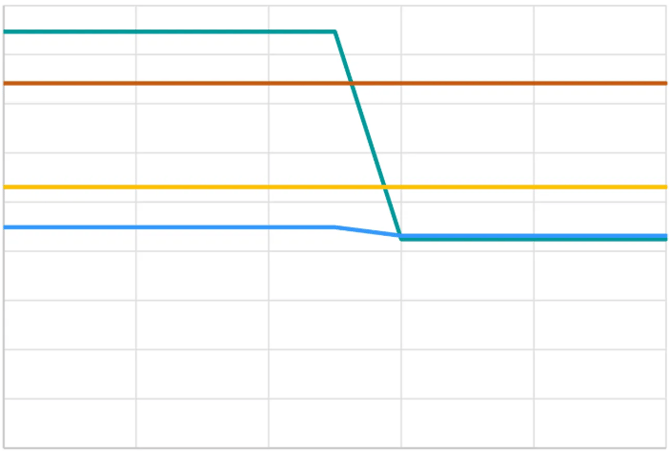
0.080
0.070
Emissions Coefficient
0.060
(tCO2e / MMBtu)
0.050
2024 2026 2028 2030 2032 2034
Utility electricity Natural gas #2 fuel oil District steam
IV(A). Selecting ESPM categories
Code language
§28-320.3 Building emissions limits. (…)
§28-320.3.1 Annual building emissions limits 2024-2029.
(…) For the purposes of such calculation the department shall provide a method for converting categories of uses under the United States environmental protection agency Portfolio Manager tool to the equivalent uses and occupancy groups set forth in this section. (…)
§28-320.3.2 Building emissions limits for calendar years 2030 through 2034.
(…) For the purposes of such calculation, the department shall provide a method for converting categories of uses under the United States environmental protection agency Portfolio Manager tool to the equivalent uses and occupancy groups set forth in this section. (…)
Local Law 97 Advisory Board Report
1.0 Calculating and Reporting GHG Emissions
1.1 Metric of Measure and GHG Emissions Limits Changes
1.1.1 Align Emissions Limits with Energy Star Portfolio Manager (ESPM)
LL97 sets annual building GHG emissions limits for calendar years 2024-2029 and 2030-2034, with limits based on Building Code occupancy categories. After discussing the effectiveness and practical impact of using Building Code occupancy categories, the Advisory Board recommends that the City revise emissions limits to align with the United States Environmental Protection Agency Portfolio Manager (ESPM) property types. The ESPM categorization is more reflective of energy use patterns (e.g., hours of operation, process loads, etc.), leading to more accurate reporting as well as a more equitable distribution of carbon reduction responsibility. While the law already directs DOB to provide a method for converting to ESPM categorization, the Board supports the change. (…)
1 RCNY §103-14
(c) Occupancy groups and emissions factors. (…)
(1) For each covered building, the owner must submit the following information:
(i) Each occupancy group or property type within the building during the calendar year for which building emissions are reported; (…)
(2) The occupancy group for each space in a covered building must be determined according to the Energy Star Portfolio Manager (ESPM) property type as set out in this rule, or any successor ESPM name for such property type, that most accurately describes the use of such space during the year for which building emissions are reported, provided that the ESPM property types “Other” and “Mixed Use” may not be assigned to any portion of a covered building. Such determination must be made by the registered design professional preparing the building emissions report.
(3) Annual emission factors. For purposes of reporting annual greenhouse gas emissions pursuant to this section, emissions factors shall be determined in accordance with this paragraph.
(i) Except as provided in subparagraph (ii) of this paragraph, for the purposes of reporting for calendar years 2024 – 2029, the following emissions factors apply to the following Energy Star Portfolio Manager (ESPM) property types:
[refer to for table of 2024-2029 ESPM Emissions Factors]
(ii) For purposes of reporting for calendar years 2024 and 2025, an owner may utilize a building emissions intensity limit for an occupancy group set forth in section 28-320.3.1 of the Administrative Code, provided such building emissions intensity limit is greater than the emissions factor assigned pursuant to subparagraph (i) for the ESPM property type that most accurately describes the use of the building or space, as determined in accordance with paragraph (2) of this subdivision. Building emissions must be calculated in accordance with either this subparagraph or subparagraph (i) of this paragraph, and may not be calculated by using a combination of such provisions. (…)
[refer to for tables of 2030-2049 ESPM Emissions Factors]
(vi) For purposes of reporting for calendar years 2050 or later, an emissions factor of 0.00 applies to all Energy Star Portfolio Manager property types.
Selecting ESPM categories – summary
The original 2019 text of LL97 assigned emissions limits based on NYC Building Code (“BC”) which are familiar to owners and RDPs but tend to be organized around life safety rather than energy cticipation of future rulemaking, the original text also contained language pointing to eventual categorization based on the in an online benchmarking tool maintained by the EPA. LL97-ESPM categorization was finalized in 2023 via the charts in and the Department’s associated reference guide, and ESPM property types are grouped by energy use profiles, making them more suitable than BC occupancy groups for emissions limit projections.
ESPM’s official guidance recommends applying as few property types to a building as possible (within , and a building’s online ESPM profile should follow this guidance since streamlined categorization is required for (LL84) and (LL33). However, LL97 reporting does not necessarily use the same property type breakdown as the online ESPM profile and in general can be more granular, with more ESPM property types listed in a building’s LL97 report than in the building’s ESPM profile.
Under LL97, building property types should at a minimum be subdivided – where applicable – between residential, non-residential (e.g. commercial), and parking. Within those broad categories, a single primary ESPM property type may be used to subsume all other property types when that primary property type has the lowest emissions factor of the group. For example, “Multifamily Housing” can cover accessory spaces that would otherwise be “Fitness Center” or “Social/Meeting Hall” because “Multifamily Housing” has the lowest emissions factor.
An alternative to setting a blanket emissions limit using a single property type is to derive a higher emissions limit by giving distinct uses within a building their own property type when their energy use pattern (e.g. room conditioning, lighting) diverges from the primary property type. For example, a trading floor within a commercial high-rise can be broken out as “Financial Office” since that property type has a higher emissions factor than “Office.” A lab floor within a university building can be broken out as “Laboratory” since that property type has a higher emissions factor than “College/University”. Food-related uses have higher emissions factors than “Retail Store”, so they can be broken out as “Food Sales”, “Restaurant”, etc. instead of being lumped in with other retail tenants.
ESPM property type boundaries may or may not line up with BC occupancy group divisions as listed on the TCO/CO. Multiple occupancy groups on a floor can be consolidated under one ESPM property type if their energy use pattern is similar, and conversely one occupancy group with multiple energy use patterns can be broken out into multiple ESPM property types.
Note that a single building typology may fall under several ESPM property types depending on its physical configuration. Temporary emergency housing comes in many different forms, so the property type(s) chosen for LL97 reporting should reflect the energy use patterns of the space; “Hotel”, “Residence Hall/Dormitory”, or “Multifamily Housing” could all potentially apply.
Selecting ESPM categories – additional information
1. The ESPM property types of “Mixed use” and “Other (unspecified)” are not allowed for LL97 reporting because they are not specific enough. Similarly, no floor area within a building should be unassigned, including
2. For CY2024 and CY2025 reporting years only, BC occupancy groups are allowed to be used to determine emissions limits if it can be demonstrated that the limits calculated using BC occupancy groups are higher than the limits calculated using ESPM property types – in other words, the more lenient emissions limit applies. GFA allocations between differently-categorized spaces may vary between the two approaches, as discussed above; however one approach must be used for a single building (BC occupancy limits may not be mixed with ESPM limits).
3. If it is unclear which property type applies to a space, there are on the Energy Star website, along with an Whenever ESPM guidance conflicts with Department guidance, Department guidance governs.
- Note that because ESPM encourages consolidating multiple spaces under a single property type while LL97 does not, the portions of the ESPM definitions beginning with “Gross Floor Area should include…” can be disregarded for LL97 reporting.
- A specific ESPM definition that does not apply to LL97 reporting is the sentence under “Hotel” that says “Hotel does not apply to properties where more than 50% of the floor area is occupied by fractional ownership units such as condominiums or vacation timeshares.” In NYC, condo and hotel uses located within the same building should always be categorized as separate ESPM property types, regardless of the specific mix.
- Non-GFA-related details within the ESPM definitions can be helpful for categorization, such as:
- “Properties whose primary business revenues are generated from the sale of food should be entered using one of the Restaurant property uses, even if there is a Bar.”
- “Energy use associated with outside areas…should be included with the total energy use for the building(s), but the square footage associated with these outdoor areas should not be included in [GFA].”
- “Conference facilities located within a Hotel should be included along with your Hotel property use details, rather than added as a separate Convention Center property use. Conference facilities primarily serving smaller meetings should be entered as Social/Meeting Hall.”
- “Data Center is intended for sophisticated computing and server functions; it should not be used to represent a server closet or computer training area.”
- “Food Sales refers to buildings used for the sales of food on either a retail or wholesale basis, but which do not meet the definition of Supermarket/Grocery Store [or] Convenience Store…For example, specialty food sales like a cheese shop or butcher.”
- “Food Service refers to buildings used for preparation and sale of food and beverages, but which do not meet the definition of Restaurant or Bar/Nightclub. For example, a bakery or coffee shop.”
- “Lifestyle centers have an open-air design, unlike traditional enclosed malls, and often include landscaped pedestrian areas, as well as streets and vehicle parking.”
- “Personal Services refers to buildings used to sell services rather than physical goods.”
- “If a facility is designed to provide nursing and assistance to seniors only, then the Senior Care Community property type should be used [instead of Residential Care Facility].”
4. A detailed report on the Department’s methodology for converting from the BC occupancy group-based emissions limits in to the ESPM property type-based emissions limits in may be found
5. A chart showing the relationship between ESPM property types and BC occupancy groups is on the next page.
- RED text means that there was not enough existing NYC benchmarking data to create an emissions factor for that property type. In such cases, the emissions factors for another type within the same ESPM category may be used; “Suggested Property Type” offers one option, but any chosen substitute can be evaluated by an RDP for equivalency. Additional guidance on how to choose emissions limits for property types that are not listed in 1 RCNY §103-14 are in the Department’s
- ESPM publishes an of national median source and site energy use intensity (“EUI”) for the various property types. However, this table may not be helpful in selecting equivalent property types for LL97 purposes as it does not necessarily reflect EUI patterns in NYC.
- The asterisk (*) denotes that a Group A space with an occupant load of 74 persons or fewer shall be classified as a Group B occupancy.
- Certain ESPM property types are left off the table because they are unlikely to be LL97 “covered buildings” in NYC. These include zoos, single-family homes, wastewater treatment plants, and power stations.
ESPM Category ESPM Property Type BC Occupancy Group Suggested Property Type
| Banking/financial services | Bank Branch | B | |
| Financial Office | B | ||
| Education | Adult Education | B | |
| College/University | B | ||
| K-12 School | E | ||
| Pre-school/Daycare | I-4 | ||
| Vocational School | B | ||
| Other - Education | tbd | ||
| Entertainment/public assembly* | Aquarium | A-3 | Museum |
| Bar/Nightclub | A-2 | Restaurant | |
| Bowling Alley | A-3 | ||
| Casino | A-2 | Social/Meeting Hall | |
| Convention Center | A-3 | Social/Meeting Hall | |
| Fitness Center/Health Club/Gym | A-3 | ||
| Ice/Curling Rink | A-4 | Fitness Center/Health Club/Gym | |
| Indoor Arena | A-4 | Fitness Center/Health Club/Gym | |
| Movie Theater | A-1 | ||
| Museum | A-3 | ||
| Performing Arts | A-1 | ||
| Race Track | A-5 | Fitness Center/Health Club/Gym | |
| Roller Rink | A-4 | Bowling Alley | |
| Social/Meeting Hall | A-3 | ||
| Stadium (Closed) | A-4 | Fitness Center/Health Club/Gym | |
| Stadium (Open) | A-5 | Fitness Center/Health Club/Gym | |
| Swimming Pool | A-4 | Fitness Center/Health Club/Gym | |
| Other - Entertainment/Public Assembly | tbd | ||
| Other - Recreation | tbd |
ESPM Category ESPM Property Type BC Occupancy Group Suggested Property Type
| Food sales and service* | Fast Food Restaurant | A-2 | Restaurant |
| Food Sales | M | ||
| Food Service | F-1, M | ||
| Restaurant | A-2 | ||
| Supermarket/Grocery Store | M | ||
| Other - Restaurant/Bar | tbd | ||
| Healthcare | Ambulatory Surgical Center | B | |
| Hospital (General Medical & Surgical) | I-2 | ||
| Outpatient Rehabilitation/Physical Therapy | B | ||
| Residential Care Facility | I-1 | ||
| Senior Care [Living] Community | I-1 | ||
| Urgent Care/Clinic/Other Outpatient | B | ||
| Other - Specialty Hospital | tbd | ||
| Lodging/residential | Barracks | R-1 | Residence Hall/Dormitory |
| Hotel | R-1 | ||
| Multifamily Housing | R-2 | ||
| Residence Hall/Dormitory | R-1 | ||
| Other - Lodging/Residential | tbd | ||
| Manufacturing/industrial | Manufacturing/Industrial Plant | F | |
| Office | Medical Office | B | |
| Office | B | ||
| Veterinary Office | B | Urgent Care/Clinic/Other Outpatient | |
| Parking | Parking | S-2 |
| ESPM Category | ESPM Property Type | BC Occupancy Group | Suggested Property Type |
| Public services* | Courthouse | A-3 | |
| Fire Station | B | Hotel | |
| Library | B | ||
| Mailing Center/Post Office | B | ||
| Police Station | B | Hotel | |
| Prison/Incarceration | I-3 | Enclosed Mall | |
| Transportation Terminal/Station | A-3 | ||
| Other - Public Services | tbd | ||
| Religious worship* | Worship Facility | A-3 | |
| Retail | Automobile [Vehicle] Dealership | B | |
| Convenience Store with Gas Station | M | Convenience Store w/o Gas Station | |
| Convenience Store without Gas Station | M | ||
| Enclosed Mall | M | ||
| Lifestyle Center | M | ||
| Retail Store | M | ||
| Strip Mall | M | ||
| Wholesale Club/Supercenter | M | ||
| Other - Mall | tbd | ||
| Services | Personal Services | B | |
| Repair Services | S-1, B | ||
| Other - Services | tbd | ||
| Technology/science | Data Center | B | |
| Laboratory | B | ||
| Other - Technology/Science | tbd | ||
| Utility | Utilities are not covered under LL97 | - | - |
| Warehouse/storage | Distribution Center | S-1 | |
| Non-Refrigerated Warehouse | S-1 | ||
| Refrigerated Warehouse | S-2 | ||
| Self-Storage Facility | S-1 |
IV(B). Gross floor area
Code language
1 RCNY §103-14
(a) Definitions. (…)
Gross floor area. Gross floor area is the total area in square feet of all floors and spaces in a covered building, as measured between the exterior surfaces of the enclosing fixed walls. Gross floor area includes vent shafts, elevator shafts, flues, pipe shafts, vertical ducts, stairwells, light wells, basement space, cellar space, mechanical/electrical rooms, and interior parking. Gross floor area does not include unroofed courtyards or unroofed light wells. For atria, gross floor area only includes the area of atrium floors. For the purposes of calculating gross floor area in tenant spaces, interior demising walls should be measured to the centerline of the wall.
(…)
(c) Occupancy groups and emissions factors. (…)
(1) For each covered building, the owner must submit the following information: (…)
(ii) The total floor area of each such occupancy group or property type in such building.
(…)
(d) Calculations. An annual building emissions report submitted pursuant to subdivision (b) of this section must be prepared using the calculation methodologies set forth in this subdivision.
(1) Gross floor area. The owner must calculate and report the gross floor area of a covered building, and the floor area of each occupancy group or property type in a covered building. The floor area of each occupancy group or property type reported must add up to the covered building’s gross floor area.
(…)
(g) Penalty for failing to file a building emissions report. (…)
(1) Calculation. Such penalty shall be an amount equal to the gross floor area of such building, multiplied by $0.50, for each month such report is not submitted within the 12 months following May 1 of each year, including the 60 days following the deadline.
Gross floor area – summary
LL97 accounting follows a specific definition of GFA that is calibrated to capture energy use. That definition is listed in 1 RCNY §103-14(a) and elaborated upon in the , but is not unique to LL97 as it is virtually the same as the definition of “gross floor area” in the Benchmarking Rule () and “” in ASHRAE publications. GFA, as defined in LL97, includes all above- and below-grade square footage within the enclosing walls of a building as measured to the enclosure exterior surface. Roof overhangs are disregarded in plan, along with projecting balconies; the only interior deductions are for the upper floor voids of atrium spaces.
Total GFA, broken down by primary property type(s), is already listed in a building’s ESPM profile and must be verified by an RDP. For buildings with more property types than are listed in ESPM, total GFA will need to be manually subdivided for LL97 reporting (meanwhile the ESPM profile should remain simplified for LL84 and LL33 reporting as noted earlier in this Guide). Specific documentation that the reporting RDP uses to verify GFA is at their discretion and may include, but is not limited to, the following: a dimensioned field survey; visual imaging tools; previously-approved Department drawings or other archival drawings showing scale and overlaid dimensions; condo maps or declarations indicating floor areas for the entire building; and any other method that the RDP attests to be representative of total GFA. The RDP's verification method must align with the required reporting granularity. If property type granularity changes, the GFA determination approach should be adjusted accordingly. Such documentation should be preserved for at least three years and made available to DOB upon request.
Ancillary spaces (such as shafts, stairwells, corridors, and mechanical rooms) serving a single property type can have their GFA included with that property type. When ancillary spaces serve multiple property types, the GFA of the ancillary space can be assigned proportionally among all property types served. For example, one way to apportion the GFA of a circulation core that serves both a 1,000 sf “Food Service” (kitchen) and a 4,000 sf “Social/Meeting Hall” would be to assign 20% to the former and 80% to the latter since the social hall is four times as large as the kitchen. A more energy-centric way to determine the proportion would be to calculate the emissions limits for each space as shown in the chart below; using this method, 23% of the circulation core GFA can be assigned to the kitchen and the remaining 77% to the social hall.
ESPM Property Type
| (served by same ancillary space) | GFA (sf) | Emissions factor (tCO2e/sf) | Emissions limit (tCO2e) | Ancillary space allocation | |
|---|---|---|---|---|---|
| Based on floor area | Based on emissions | ||||
| Food Service | 1,000 | 0.01181 | 11.81 | 20% | 23% |
| Social/Meeting Hall | 4,000 | 0.00987 | 39.48 | 80% | 77% |
Gross floor area – additional information
- As noted at the end of Section I(A) of this Guide, the DOF GSF differs from LL97 GFA. GSF is used to determine whether a lot is subject to LL97, while GFA is used to determine a building’s emissions limit. GSF and GFA will rarely be identical; in general, measured GFA will be larger than GSF as recorded by DOF in the ,resulting in a higher emissions limit for a building. Simply restating DOF’s GSF number as GFA, without further consideration of appropriate other documentation, may result in non-compliance.
- LL97 GFA also differs from the definition of “” in the Energy Conservation Code (“ECC”), the concept of “modeled floor area” as used in energy models, the definition of ” in the BC, and other floor area metrics that can be used in property calculations such as “exterior gross area” and “construction gross area”. For instance, LL97 GFA includes unconditioned parking garage levels and exterior wall thickness but does not deduct shafts or structure and does not include exterior space on balconies.
- ZFA follows the definition of “” in the NYC Zoning Resolution and is not the same as LL97 GFA.
- For buildings where the exterior architectural features change in depth as they go from floor to ceiling (i.e. a canted wall), plan cuts are generally taken at 4’ above the finish floor.
- As noted in Section IV(A) of this Guide, the describes how to measure GFAfor ESPM purposes. Whenever ESPM guidance conflicts with Department guidance, Department guidance governs.
IV(C). Special cases
Special cases – summary
Some categories of energy use are so specialized that the language in the LL97 Articles and Rules cannot cover them explicitly. At times, the LL97 language may refer to Department “guidance” – e.g. Bulletins, FAQs, Filing Guides, and other publications that do not require legislative approval or a formal rulemaking process.
Two of these special cases can lead to deductions from total electricity use:
- Electric vehicle (“EV”) charging
- Cell towers
1. EV charging – Code language
1 RCNY §103-14
(d) Calculations. (…)
(…)
(4) Annual building emissions. (…)
(…)
(ii) Energy consumption to be included. (…)
a. Energy used for unidirectional charging of electric vehicles may be deducted where separately metered or sub- metered pursuant to guidance issued by the Department.
Buildings Bulletin 2021-019
II. APPLICABILITY
A. Definitions
-
ELECTRIC VEHICLE SUPPLY EQUIPMENT (EVSE) refers to the conductors, including the ungrounded, grounded, and equipment grounding conductors and the electric vehicle connectors, attachment plugs, and all other fittings, devices, power outlets, or apparatus installed specifically for the purpose of transferring energy between the premises wiring and the electric vehicle.
-
PLUG-IN ELECTRIC VEHICLES (PEV) refers to plug-in hybrid electric vehicles (PHEVs) and all-electric vehicles (EVs) that can plug in to an EVSE that is connected to a building’s electrical system.
B. Treatment of Electric Vehicle Supply Equipment under Article 320
For the purposes of reporting building emissions…an owner may exclude electricity attributable to unidirectional electric vehicle charging systems used exclusively for charging PEV. Systems that charge other types of storage devices (including but not limited to portable storage batteries and stationary batteries) are not eligible for this deduction.
Where an owner chooses to deduct electricity used for charging vehicles, an owner must be able to document hourly records and total annual electricity consumption for vehicle charging…The EVSE installation must meet at least one of the following in order to deduct the electricity from the building’s total annual consumption.
-
must be separately metered by the utility; or,
-
must be separately metered or submetered by the owner in a manner that produces auditable data aligned with the reporting year; or,
-
must be capable of and configured to produce data that records the electricity supplied to vehicles over the course of the reporting year by means of hardware and software integrated with the equipment. (…)
1. EV charging – additional information
1. Buildings Bulletin (“BB”) 2021-019, which describes the circumstances under which EV charging electricity use can be deducted from total building electricity use, is available
2. BC requirements for EV charging stations, including electrical capacity and minimum number, are listed . NYC zoning allowances for EV charging stations are listed
3. Financial incentives, best practices, and other info for EV charging installations are listed on NYSERDA’s website
2. Cell towers – additional information
1. For the initial compliance period (CY2024-29), electricity consumed by cell tower equipment may be excluded from a building’s total electricity use where:
a. Such equipment provides service that is open and utilized by the public;
b. Such equipment is sub-metered; and
c. The building owner provides a report (guidance forthcoming) to the Department describing such equipment and its annual energy usage .
2. Lots containing cell towers are generally designated on the DOF (tax map) with the letter “R”. The R stands for (“REUC”), which covers entities that are owned by utilities.
V. Deductions
Code language
§28-320.3.6 Deductions from reported annual building emissions.
The department may authorize a deduction from the annual building emissions required to be reported…in accordance with this section. For such sections that limit the dates of applicability of such deductions, the department may promulgate rules to extend such deductions for each future compliance date.
§28-320.3.6.1 Deductions from reported annual building emissions for renewable energy credits.
A deduction from the reported annual building emissions resulting from the consumption of electricity may be authorized equal to the number of renewable energy credits purchased by or on behalf of a building owner, provided (i) the renewable energy resource that is the source of the renewable energy credits is considered by the New York independent system operator to be a capacity resource located in, or whose output directly sinks into, the zone J load zone for the reporting calendar year; (ii) the renewable energy credits are solely owned and retired by, or on behalf of, the building owner; (iii) the renewable energy credits are from the same year as the reporting year; and (iv) the building that hosts the system producing the energy does not receive a deduction under section 28-320.3.6.3 for the same energy upon which the renewable credits are based. Covered buildings claiming deductions for renewable energy credits under this section must provide the department with the geographic location of the renewable energy resource that created the renewable energy credits. (…)
§28-320.3.6.1.1 Limitation on the use of renewable energy credits.
The department shall by rule limit the amount of a deduction authorized pursuant to section 28-320.6.1. In determining such limit, the department shall consider items 1 through 3 of this section.
1. The availability or expected availability of renewable energy credits;
2. Environmental justice impacts; and
3. Any other relevant factor determined to be related to the use of or restrictions on the use of such credits.
§28-320.3.6.2 Deductions from reported annual building emissions for purchased greenhouse gas offsets. (…)
§28-320.3.6.3 Deductions from reported annual building emissions for clean distributed energy resources. (…)
1 RCNY §103-14
(e) Deductions from reported annual building emissions. (…)
(1) Deductions from reported annual building emissions for Renewable Energy Credits (RECs). (…)
(i) Applicability of renewable energy credits (RECs). Renewable energy credits may only be deducted from the emissions attributed to consumption of utility supplied electricity in a covered building.
(ii) RECs generated by clean distributed energy resources on the premises of the covered building. (…)
(2) Deductions from reported annual building emissions for clean distributed energy resources. (…)
(i) Deduction for solar electric generation. (…)
(3) Deductions from reported annual building emissions for offsets. (…)
Deductions – summary
A building’s reported emissions can be reduced in two ways before the total is calculated: by lowering emissions coefficients or by lowering produced emissions through implementation of Energy Conservation Measures (“ECMs”) / Energy Efficiency Measures (“EEMs”). After the total is calculated, reported emissions can be reduced in a third way – deductions. In cases of clear public benefit, LL97 allows certain activities (e.g. the EV charging stations described earlier in this Guide) to be subtracted from either total emissions or total electricity use.
Whether a deduction is taken against total emissions (on-site energy storage, beneficial electrification) or against total electricity use before it is converted into emissions (RECs, solar) depends on the characteristics of the eligible activity. Generally, deductions may only be taken against emissions resulting from electricity consumption and not against emissions resulting from the combustion of fossil fuels. This is to encourage overall decarbonization, as utility electricity has a greater ability to decarbonize over time than fossil fuels (see figure at the end of Section IV of this Guide).
Regarding offsets and RECs, LL97-eligible GHG offsets are described in Section V(C) of this Guide. Department literature on RECs may be revised as LL97-eligible RECs become available (see “Deductions – additional information” below). Note that whether the RECs generated by clean distributed energy resources (“CDERs”) are LL97-eligible determines whether the associated electricity can also then be deducted from the host building and/or off-taking buildings’ electricity consumption – this is described in more detail in Section V(B) of this Guide.
Deductions – additional information
- The typical way that RECs are created, traded, and retired in NY State is via the (“NYGATS”).
- LL97-eligible RECs must either be located within or directly serve which as managed by the (“NYISO”) is the load zone corresponding to the five boroughs of NYC. These characteristics are fulfilled by what NYSERDA’s program calls RECs, which currently have only one approved source: Champlain Hudson Power Express (“CHPE”), a project to bring hydroelectric power to NYC from Canada whose RECs may become available as early as 2026. Other LL97-eligible Tier 4 RECs may emerge as renewable energy infrastructure is built out near NYC (e.g. offshore and onshore wind, utility-scale solar).
- Beneficial electrification, as described in Section V(A) of this Guide, is not listed under the “Deductions” section of the Rule, but rather under “Calculations / GHG coefficients of energy consumption”, and “Calculations / Annual building emissions”, Nonetheless, it can be considered a type of deduction, as it can lead to regional emissions reductions.
- For more on the difference between offsets and RECs, see from the EPA.
- A building’s total energy use should be exported from ESPM to the LL97 reporting portal without taking any deductions within ESPM itself. Technical References published by ESPM, such as and are not applicable for purposes of LL97 reporting.
V(A). Beneficial electrification
Code language
Advisory board. There shall be an advisory board convened…to provide advice and recommendations…to effectively reducing greenhouse gas emissions from buildings. Such recommendations shall include, but not be limited to:
1.A report [that] shall include, but not be limited to: (…)
1.2. A methodology that includes…credit for beneficial electrification…
Local Law 97 Advisory Board Report
3.0 Maximizing emissions reductions
3.4 Incentivize Beneficial Electrification
Beneficial electrification - or the use of high efficiency electrical equipment to replace direct fossil fuel use or very low efficiency electric equipment - is a key strategy in the push to decarbonize buildings. The Advisory Board recommends that as early as possible, the City make beneficial electrification a central component of LL97 implementation to reduce overall emissions in the short term, accelerate equipment development and manufacturing, and expand the labor market needed to install and maintain this equipment in the medium to long term. The Board’s recommendation supporting electrification and LL97 compliance considers simple and complex installations:
- Deemed credit: credit simple installations with equipment under 100 tons of capacity, based on the capacity of the equipment.
- Measured credit: credit complex installations of equipment over 100 tons of capacity, based on measured energy consumption.
For equipment installed prior to January 1, 2027, the Advisory Board recommends that the beneficial electrification credit could be double either the capacity or actual savings, as applicable. For equipment installed on or after January 1, 2027, credit could equal the deemed or actual savings, as applicable. To qualify, equipment should have a Coefficient of Performance (COP) of 1.5 or higher, at 5 degrees Fahrenheit. As there was much debate on the COP, this value should be carefully monitored and adjusted as the market for heat pumps matures and availability increases.
(b)Definitions. (…)
(…)
Beneficial electrification: “Beneficial electrification” means the installation and use of energy efficient electric-based heating, cooling and domestic hot water systems to displace the use of fossil fuel sources (e.g., fuel oil, natural gas, district steam) and/or less efficient electric-based heating systems. Qualifying equipment shall have a minimum efficiency as determined based on the reference test procedure associated with the equipment as follows:
[refer to Rule for of qualifying electric equipment] Note: Equipment and systems not listed in the table that otherwise meet the definition of beneficial electrification shall have a coefficient of performance (COP) for the system equivalent to greater than 1.5 when the outdoor dry bulb temperature is 5°F or lower, where the COP of the system is calculated based on the energy required for all parts of the system to deliver the peak capacity.
(…)
(d) Calculations. (…)
(…)
(3) Greenhouse gas coefficients of energy consumption. (…)
(…)
(vii) GHG Coefficient for beneficial electrification. For each building emissions report required pursuant to section 28- 320.3.7 of the Administrative Code, the beneficial electrification coefficient for qualifying electrical equipment and systems meeting the definition of beneficial electrification shall be as established herein. Such coefficient may be modified by the department as necessary.
a. Equipment installed and operating between January 1, 2027, and December 31, 2029, shall be -0.00065 tCO2e/kWh.
b. Equipment installed and operating prior to January 1, 2027, shall be -0.0013 tCO2e/kWh.
(4) Annual building emissions. (…)
(…)
(iii) GHG emissions generated under beneficial electrification. An owner may utilize the beneficial electrification coefficient in calculating GHG emissions resulting from the use of qualifying electric equipment as set forth in subparagraph (vii) of paragraph 3 of this subdivision. The annual electric energy use for beneficial electrification shall be determined based on either (a) Metered Electric Use or (b) Deemed Electric Use approach as described in this subparagraph. GHG emission savings accrued from beneficial electrification may be banked for future use for the covered building in which the qualifying equipment was installed as described herein.
a. Metered electric use. An owner may calculate electricity emissions based on the measured annual electricity use of the qualifying installed electric equipment using the coefficients for beneficial electrification as established in paragraph (3) of this subdivision. Such owner must be able to document hourly records, monthly energy consumption, and total annual electricity consumption for such equipment. Such documentation may be requested by the Department. Records should be retained for a minimum of six years. The installation must meet at least one of the following to qualify for use of a beneficial electrification coefficient for metered electric use:
i. must be separately metered by the utility; or
ii. must be separately metered or sub-metered by the owner in a manner that produces auditable data aligned with the reporting year; or
iii. must be capable of and configured to produce data that records the electricity supplied to the equipment over the course of the reporting year by means of hardware and software integrated with the equipment.
b. Deemed Electric Use. For installed electric equipment, qualifying as beneficial electrification, with a rated heating capacity of less than 1,200,000 btu/h, an owner may calculate electricity emissions based on the installed capacity of the equipment and using the coefficients for beneficial electrification as established in paragraph (3) of this subdivision. Only equipment that meets the requirements of the test procedures listed in the definition of beneficial electrification are eligible to calculate using deemed electric use; other equipment or systems whose test procedures are not listed in the definition of beneficial electrification shall determine beneficial electric use based on the requirements for Metered Electric Use. The deemed electric use shall be calculated based on the following:
[refer to Rule for andPeak Service Hot Water Load table] c. Applying and reserving beneficial electrification GHG savings. Owners who have qualifying equipment that is installed and remains in operation in the covered building, may apply GHG emissions savings or accrue savings for future use in reporting emissions for such building, provided that in any reporting year between 2024 and 2036 in which such covered building’s emissions are not below the emissions limit set forth in section 28-320.3 of the Administrative Code, any such savings must be applied. Beneficial electrification savings from a calendar year may be applied in whole to reporting for that calendar year or in whole to another future calendar year but may not be combined with accrued savings from other years. Such savings may be accrued as follows: [refer to Rule for of how to apply yearly BE deduction] d. When submitting a building emissions report in which an owner applies the beneficial electrification coefficient to a portion of their annual energy consumption, such owner must document installation of the equipment with the letter of completion for such equipment along with the DOB job number.
Beneficial electrification – summary
Beneficial electrification (“BE”) is a term with a . It refers to the replacement of combustion-based equipment with high-efficiency, electricity-using equipment in such a way that at least one of the following four goals is attained and none are made less attainable: reducing costs over time; reducing emissions; improving quality of life; and fostering a more robust grid. LL97’s definition of BE goes even further in that it also encourages the replacement of inefficient electricity-using equipment (such as certain electric resistance heaters) with more efficient heat pumps. Basically, electrification can be considered beneficial when it decreases emissions even if it increases energy use.
Within the context of LL97, BE helps owners to reduce/avoid penalties by lowering reported emissions. Within the context of Citywide carbon initiatives, BE and electrification in general are designed to decarbonize existing buildings and advance the clean energy transition. Because there are many reasons why a building may need to phase their electrification (cost, occupant displacement, contractor/utility availability, older equipment having useful life of equipment, etc.) BE is designed to reward any degree of equipment upgrade, no matter how incremental. For example, individual dwelling units within a multifamily building can electrify while the combustion-based central boiler plant continues to operate.
In LL97’s version of BE, high-efficiency electricity-using equipment (for heating, cooling, and service hot water; cooking and other process load equipment is excluded) that displaces existing fossil fuel or steam-using equipment is allowed to multiply its energy use by a negative emissions coefficient to generate a deduction against total emissions. Early action is encouraged since the BE deduction (called a “savings” in the Rule) can only be generated during the initial compliance period (CY2024-29); even earlier action is further encouraged by making the negative emissions coefficient twice as large for equipment installed prior to 2027. The BE deduction is taken against a building’s total energy use, not just its electricity use.
For buildings that are already under their emissions limits – or that have been allowed to exceed emissions limits via mediated resolution – one year’s BE deduction can be reserved for future years extending out to 2036. Reserved deductions must be used in full even if the entire deduction is not necessary to meet emissions limits – in other words, excess deduction may not be carried over to another reporting year. Only one reserved year may be used per reporting year; reserved deductions from multiple years may not be combined.
Minimum equipment efficiencies required to qualify as BE are listed under the definition in along with corresponding test procedures. Equipment not explicitly listed can still qualify as BE if such equipment has better than a 1.5 Coefficient of Performance (“COP”) at an outdoor dry bulb temperature of 5°F or below. Heat pumps are generally tested at a range of temperatures that may not include 5°F exactly, so any test result at ≤ 5°F showing at least a 1.5 COP (as reported by the manufacturer) is acceptable. Generally, equipment will need to use heat pump technology to qualify for BE.
As noted in documentation must be submitted to the Department showing the installation date of any equipment used to calculate the BE deduction. For installations requiring a work permit, such documentation can consist of the Letter of Completion (“LOC”) for the associated job filing and the Certificate of Compliance (“CoC”) for each piece of equipment. For installations not requiring a work permit, such documentation can consist of paid itemized invoices, time-stamped photographs, etc. The date of the CoC or the photograph counts as the date of installation.
Beneficial electrification – additional information
1. For illustrative statistics showing the impact of BE on both individual building emissions and overall NYC emissions, see the NYC Accelerator page
2. A webinar covering beneficial electrification is available on ASHRAE NY’s YouTube channel with presentation slides available
3. New construction meeting s requirements for all-electric buildings (effective dates from January 1, 2024 to December 31, 2027, depending on building configuration) may not take the BE deduction, as equipment in new buildings is not replacing or displacing existing equipment.
4. COP describes the useful heat added to (or removed from) a system divided by the work required to do so. When only one COP is listed, it usually refers to heating.
5. Representative lists of available heat pumps that can function effectively in a climate like NYC may be found at and
6. CoCs – formerly called and still colloquially referred to as Equipment Use Permits (“EUPs”) – are certified before a filing is signed off. The process for doing so is described and instructions for printing a CoC are
- As required by LL154, MOCEJ’s report (2023) studies the holistic effects of building electrification including heat pump technology, impact on residents’ energy bills, and ramifications for the NYC electrical grid. The section titled “Beneficial Electrification & Building Upgrades” start
8. The chart below illustrates when a reserved BE deduction can be used based on the year that the deduction was generated. Darker hatch indicates the larger “early action” negative coefficient:
| year in which Beneficial Electrification savings can be applied | |||||||||||||
| 2024 | 2025 | 2026 | 2027 | 2028 | 2029 | 2030 to 2034 | 2035 | 2036 | |||||
| year in which qualifying equipment is first installed |
2024 or earlier | ||||||||||||
| 2025 | |||||||||||||
| 2026 | |||||||||||||
| 2027 | |||||||||||||
| 2028 | |||||||||||||
| 2029 |
← any 4 years
← any 3 years
← any 2 years
← any 1 year
← any 6 years
← any 5 years
▪ Because emissions limits become more stringent starting in CY2030 with the second reporting period (2030-34), it may be most effective to wait until the second reporting period to deploy reserved deductions. This is especially true for deductions accrued before 2027, which as previously noted are twice as large as deductions accrued from 2027-29. For example, if a building installed BE equipment in 2023, one way to optimize deployment of the six years of double deductions might be to use the 2024 deduction in 2030, the 2025 deduction in 2031, the 2026 deduction in 2032, the 2027 deduction in 2033, the 2028 deduction in 2034, and the 2029 deduction in 2035.
9. There are two approved methods of separating out electricity use attributable to qualified BE equipment, as noted in deemed and metered.
a. Deemed is a term that comes from energy contracts, where it describes an estimated rate that is used in the absence of fixed rate agreements. For LL97 BE purposes, the deemed electric use methodology produces a rigorous estimate of energy use, based on equipment capacity and average user demand, that precludes the need for separately metering equipment. Deemed electric use is only allowed for smaller equipment with an individual heating capacity of less than 1,200,000 BTU/h (100 tons). Additionally, only certain system types may follow the deemed approach, and such equipment must have test results following the procedures in the Rule.
b. Metered electric use is for individual equipment whose capacity is over 100 tons, as well as for equipment whose test procedures are not listed in the Rule (e.g. water-source heat pumps, heat pump chillers). A metered electric use methodology requires equipment to have its energy supply separately measured on an hourly / monthly / annual basis using revenue-grade meters or energy tracking software.
Deemed electric use – calculations
1 RCNY §103-14(d)(4)(iii)(b) explains how to derive deemed annual electricity use for air-source heat pumps (“ASHPs”) and heat pump water heaters (“HPWHs”). Certain terms in the equations point to guidance outside the Rule, as outlined below:
- ASHPs are addressed in EFLH, or Equivalent full-load hours for the year, may be taken from tables in the NYS Department of Public Service (“DPS”) (“TRM”), Appendix G.
- The TRM is updated every January 1st; a link to Appendix G in the 2023 edition of the TRM is For CY2024 reporting, the TRM effective January 1st, 2025 will need to be used.
- Heating EFLH should be used for BE calculations, as it is heating equipment that is under consideration. ▪Definitions for occupancy groups, including the thresholds between Large/Small and High-rise/Low-rise, are in TRM Appendix A (link to 2023 Appendix A .
- HPWHs are addressed in GPD, or Gallons per day, is taken from the TRM section on HPWHs (link to 2023 edition ).
- The TRM says that GPD shall be “as defined in the… Commercial Storage Tank Water Heater [section]”, where there is a table listing GPDs for various occupancies/building types (link to 2023 table .
- Combining the TRM GPD table with the Peak Service Hot Water Load table under Equation 103-14.16 gives:
- The TRM says that GPD shall be “as defined in the… Commercial Storage Tank Water Heater [section]”, where there is a table listing GPDs for various occupancies/building types (link to 2023 table .
| Occupancy / Building Type | GPD Rate | Peak Load Factor | Occupancy Metric |
|---|---|---|---|
| Assembly | 7.02 | 0.31 | per 1,000 square feet |
| Auto Repair | 4.89 | 0.216 | per 1,000 sf |
| Big Box Retail | 3.43 | 0.151 | per 1,000 sf |
| Community College | 1.9 | 0.084 | per person |
| Dormitory | 17.2 | 0.759 | per resident |
| Elementary School | 0.5 | 0.022 | per student |
| Fast Food Restaurant | 500 | 22.07 | per restaurant |
| Full-Service Restaurant | 2500 | 110.4 | per restaurant |
| Grocery | 3.43 | 0.151 | per 1,000 sf |
| High School, Middle School | 1.9 | 0.084 | per person |
| Hospital | 54.42 | 2.403 | per 1,000 sf |
| Hotel / Motel | 45.52 | 2.01 | per 1,000 sf |
| Office, Large / Small | 1.1 | 0.049 | per person |
| Light Industrial | 4.89 | 0.216 | per 1,000 sf |
| Multifamily High-Rise, Low-Rise | 46 | 2.031 | per dwelling unit |
| Refrigerated Warehouse | 0.93 | 0.041 | per 1,000 sf |
| Religious | 7.02 | 0.31 | per 1,000 sf |
| Retail, Large / Small | 3.43 | 0.151 | per 1,000 sf |
| University | 0.5 | 0.022 | per student |
| Warehouse | 0.93 | 0.041 | per 1,000 sf |
| Other | 4.89 | 0.216 | per 1,000 sf |
- Equipment whose test procedures are not explicitly cited in the table under the definition of BE in may not use the deemed approach and must instead use the metered electric use approach. Listed below are some examples of such equipment; such equipment must be separately metered (or tracked) to be eligible for the BE deduction.
| Test procedure reference in BE table | Exclusions | Test procedure for excluded equipment |
| n/a | n/a | |
| "...heat pumps or water heaters covered in…ISO Standard 13256-1 & 2…AHRI Standard 1160 or…AHRI Standard 870 [or] Air-Cooled or Water-Cooled Heat Reclaim Condensers covered in…AHRI Standard 550/590..." |
ISO 13256-1 & 13256-2 (to be replaced by AHRI 600) AHRI 1160 AHRI 870 AHRI 550/590 |
|
| [only certain gas-fired equipment] | n/a | |
| n/a | n/a | |
| "Heat operated air-conditioning/heat pump equipment... Room air-conditioners/heat pumps... Water-source Heat Pumps, Ground Water-source Heat Pumps, or ground-source closed-loop Heat Pumps as defined in ISO...Standards 13256-1 and 13256-2... Units equipped with desuperheater/water heating devices in operation..." |
ISO 13256-1 & 13256-2 (to be replaced by AHRI 600) | |
| "...individual assemblies, such as condensing units or coils, for separate use... Water-Source Heat Pumps as defined in...ISO Standard 13256-1... units equipped with desuperheater/water heating devices (as defined in...AHRI Standard 470) in operation... Commercial and industrial unitary air-conditioning condensing units with a capacity greater than 135,000 Btu/h as defined in...AHRI Standard 365..." |
ISO 13256-1 (to be replaced by AHRI 600) AHRI 470 AHRI 365 |
|
| "Individual assemblies, such as separate condensing units or indoor units... Water-source Heat Pumps (with the exception of Multi-split Systems) as defined in...ISO Standard 13256-1... Units equipped with desuperheater/water heating devices as defined in AHRI Standard 470; Commercial and Industrial Condensing units with a capacity greater than 135,000 Btu/h as defined in AHRI Standard 365..." |
ISO 13256-1 (to be replaced by AHRI 600) AHRI 470 AHRI 365 |
|
| "heat-operated air-conditioning/heat pump equipment or room air-conditioners/heat pumps, as defined in...CSA-C368.1... water-to-air and brine-to-air heat pumps, as defined in...[ISO] 13256-1… |
CSA C368.1 ISO 13256-1 (to be replaced by AHRI 600) |
|
| "...Unit Ventilators as defined in AHRI Standard 840… Computer and Data Processing Room Air-conditioners as defined in AHRI Standard 1360…" |
AHRI 840 AHRI 1360 |
V(B). Solar generation and energy storage
Code language
§28-320.1 Definitions. (…)
(…)
CLEAN DISTRIBUTED ENERGY RESOURCE. The term “clean distributed energy resource” means a distributed energy resource that (i) uses any of the following sources to generate electricity: hydropower, solar photovoltaics, geothermal wells or loops, tidal action, waves or water currents, or wind; or (ii) is designed and operated to store energy, including but not limited to batteries, thermal systems, mechanical systems, compressed air, and superconducting equipment.
(…)
DISTRIBUTED ENERGY RESOURCE.[see Section III(E) of this Guide]
(…)
§28-320.3 Building emissions limits. (…)
(…)
§28-320.3.6 Deductions from reported annual building emissions. (…)
(…)
§28-320.3.6.3 Deductions from reported annual building emissions for clean distributed energy resources. A deduction from the reported annual building emissions shall be authorized based upon the calculated output of a clean distributed energy resource located at the building subject to the report. The department shall promulgate rules to set forth how such deduction shall be calculated, in accordance with the following:
1. For a clean distributed energy resource that generates electricity, the department shall establish separate calculations for each type of commercially available clean distributed energy resource, which shall not be revised more frequently than once every three years.
2. For a clean distributed energy resource that stores electricity, the deduction shall be based on the size of the resource and its ability to reduce greenhouse gas emissions during designated peak periods.
1 RCNY §103-14
(d) Calculations. (…)
(…)
(3) Greenhouse gas coefficients of energy consumption. (…)
(…)
(vi) GHG coefficients for distributed energy resources. For the purposes of this subparagraph, all distributed energy resources must be separately metered or sub-metered in a manner that produces data for the year being reported. Notwithstanding any other provision of this section, the GHG coefficient for the distributed energy resources described in this subparagraph may be determined as follows:
(…)
b. Greenhouse gas coefficient for subscription to off-site solar energy generation.
-
The GHG coefficient for electricity generated by an off-site solar energy system purchased by the owner of a covered building is 0.0 tCO2e per kWh, provided such energy sinks directly into the zone J load zone and the other requirements of this clause b are satisfied.
-
Such coefficient may be applied to the utility electricity consumption, in kWh, for the covered building in an amount that is no more than the amount of electricity from the off-site solar energy system, provided that the exports of such electricity are not also registered or retired as renewable energy credits claimed by any covered building for purposes of compliance with section 28-320.3 of the Administrative Code. Owners must submit documentation of the amount of solar electricity purchased by the owner to the Department with the building emissions report, or such information may be submitted by a utility on behalf of the owner. Where an owner opts to use a coefficient for electricity based on TOU, electricity generated by an off-site solar energy system must also be reported pursuant to subparagraph (iii).
c. GHG coefficient for energy storage. In reporting annual building emissions, an owner of a covered building that utilizes an energy storage system may account for on-site or off-site storage of energy, in accordance with this subparagraph. A GHG coefficient for electricity consumption based on TOU may be applied to the electricity consumed during hours that such energy storage system is charging and discharging, provided that such a TOU coefficient may only be utilized to calculate electricity consumption for an off-site energy storage system where the discharged electricity of such system sinks directly into Zone J.
-
An owner of a covered building with behind the meter energy storage that is using the utility electricity GHG coefficient as provided pursuant to Article 320 of Chapter 3 of the Administrative Code or subparagraphs (i) or (ii) of this paragraph for utility electricity consumption in lieu of TOU may account for such storage as provided by this subparagraph, provided that such storage must be separately metered or sub-metered and must be reported using the TOU coefficient methodology pursuant to subparagraph (iii).
-
An owner of a covered building that contracts with an off-site energy storage provider via subscription may report an equal portion of their electricity consumption, in kWh, as if it were supplied from an energy storage system on premises. Such owner shall calculate the carbon savings for that owner’s share of the stored energy using the TOU coefficient methodology pursuant to subparagraph (iii) and submit such data to the Department in the building emissions report for the calendar year being reported.
(…)
(e) Deductions from reported annual building emissions. Deductions from the total annual emissions for a covered building are authorized in accordance with this subdivision (e).
(1) Deductions from reported annual building emissions for Renewable Energy Credits (RECs). (…)
(i) Applicability of renewable energy credits (RECs). (…)
(ii) RECs generated by clean distributed energy resources on the premises of the covered building. Notwithstanding any other provision of this section, where an owner elects to register RECs generated by a clean distributed energy resource located on the premises of the covered building, the owner may not take an additional deduction for the energy generated by the clean distributed energy resource pursuant to paragraph (2) of this subdivision.
(2) Deductions from reported annual building emissions for clean distributed energy resources. A deduction for energy generated by a clean distributed energy resource located on the premises of a covered building is authorized in accordance with this paragraph.
(i) Deduction for solar electric generation. For calendar years 2024 to 2029, a deduction from emissions resulting from annual electricity consumption is allowed where electricity is generated by a solar energy system on the premises of the covered building, in accordance with this subparagraph.
a. Where electricity is generated by the solar energy systems, in front of the meter or behind the meter, and exported to the grid, an owner may deduct from the total utility electricity consumed by the covered building in the year being reported, an amount equal to the electricity exported, in kWh.
b. Where the greenhouse gas coefficient used to calculate emissions from electricity is calculated based on the TOU methodology pursuant to subparagraph (iii) of paragraph (3) of subdivision (d) of this section, such owner shall submit a record of hourly generation of on-site solar energy during the calendar year being reported.
(ii) Deduction for on-site energy storage system. For calendar years 2024 to 2029, a deduction from annual building emissions is allowed where energy is stored on the premises of the covered building as electricity, in accordance with this subparagraph. Such deduction may be calculated as follows:
[refer to for Equation 103-14.17]
Solar generation and energy storage – summary
While clean distributed energy resources (“CDERs”) come in many forms, including geothermal wells and wind turbines, two of the most prevalent types are solar panels and battery storage. To incentivize their installation, in the first compliance period LL97 allows the electricity associated with such systems to be deducted from reported electricity use (or calculated emissions) twice – once at the point of receipt (“POR”) and once at the point of delivery (“POD”).
The POR for the CDER can be referred to as the Host / Source; this is the building where the solar panels and/or batteries are installed and activated. The POD for the CDER can be referred to as the Off-taker / Sink / Subscriber; this is the building where electricity generated or stored by the CDER is ultimately deployed. A CDER only has one Host, but it may have multiple Off-takers (including the Host itself). Host and Off-taker(s) must all be behind-the-meter (“BTM”) together – CDERs that export exclusively to the grid are not considered to have Off-takers.
When the Host is the only Off-taker, LL97 describes the system as “on-site / onsite”; when at least one Off-taker is different from the Host, LL97 describes the system as “off-site / offsite”. Host and Off-taker(s) do not all have to be LL97 covered
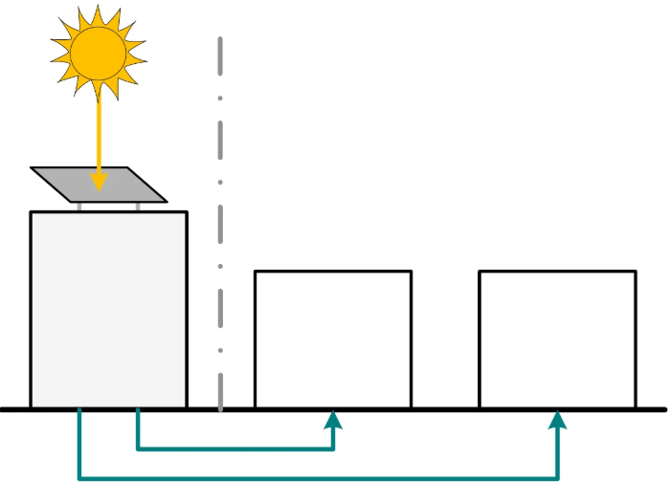
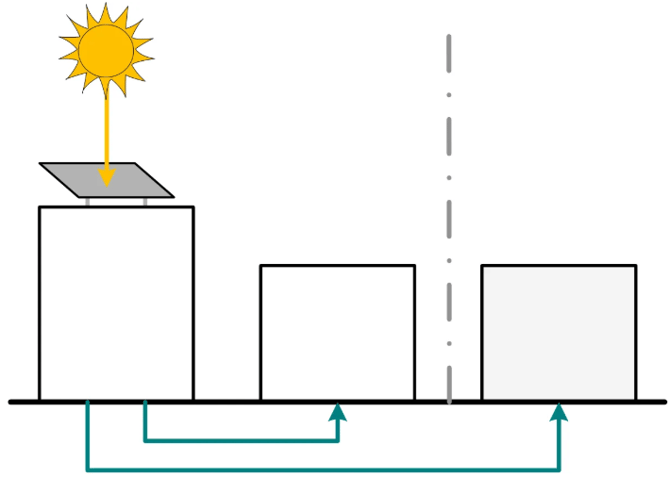
buildings, nor do they all need to be in NYC. However, only electricity that is delivered to Off-takers located within (New York City) may be counted towards deductions, and only buildings located within Zone J may take deductions. See below:
Zone J Zone J not Zone J
40,000 kWh 40,000 kWh
generated generated
Host Host
Off-taker A Off-taker B 30,000 kWh Off-taker A Off-taker B
30,000 kWh 10,000 kWh deduction 30,000 kWh
deduction deduction deduction
NOTE: Solar/storage deductions are currently only available during the initial compliance period (CY2024-29).
Solar generation – additional information
1. The most straightforward solar deduction is calculated using the total electricity output of a solar array (that feeds into Zone J) in a given reporting year. This net output number, in kWh, can first be deducted from the Host’s electricity consumption in their LL97 compliance report. Then, each Off-taker who receives that output can use an emissions coefficient of zero for the received solar-generated electricity, so that such electricity is effectively deducted from their emissions calculations.
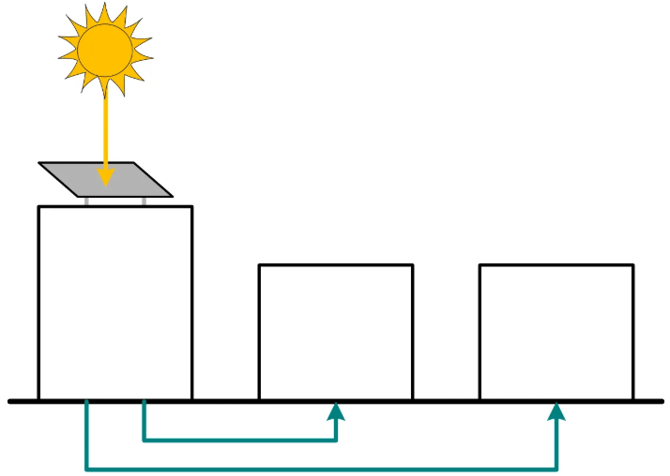
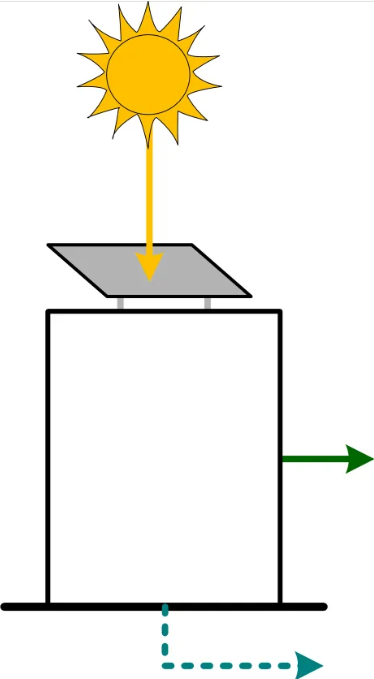
a. If the Host chooses to register the generated solar kWh as LL97-eligible RECs (as described in Section V of this Guide), there can be neither a Host deduction nor an Off-taker deduction. Otherwise, if the registered RECs are not LL97-eligible (which is most RECs), there can still be a Host deduction and/or Off-taker deduction(s).
40,000 kWh 40,000 kWh
generated generated
Host Host 40 RECs
40,000 kWh Off-taker A Off-taker B or, no deduction if
deduction 30,000 kWh 10,000 kWh RECs are for LL97
deduction deduction
Off-takers
no deduction if
RECs are for LL97
2. An alternate type of solar deduction uses a TOU approach, matching hourly solar production with corresponding hourly emissions coefficients. TOU deductions are taken against emissions, not against electricity use.
a. Every January, the Department will publish a TOU template containing 8,760 hourly electricity emissions coefficients for the previous calendar year.
b. For TOU, the amount of electricity (that feeds into Zone J) generated by a solar array must be measured and recorded on an hourly basis so it can be subtracted from the Host building’s hourly consumption. Each Off-taker will need their own hourly records of the electricity received from such solar array.
3. When a solar array is front-of-the-meter (“FTM”) and exports electricity directly to the grid, there can be no Off-taker deductions, only a Host deduction. This is often the case with community solar.
4. Whether the solar array is part of a Power Purchase Agreement (“PPA”), which is when the array is owned by a third party rather than by the building owner, does not affect how Host and Off-taker deductions are assigned.
5. Free-standing solar arrays that are not on a building rooftop – e.g. solar canopies over an open parking lot – may have their Host deductions assigned to an adjacent building that is under the same owner, even if that building is on a different lot.
6. Documentation submitted to the Department in support of Host solar deductions should include:
- Peak system capacity, in kW
- Metered data for generated solar electricity, in kWh/yr
- Description of grid interconnection if applicable, including participation in Net Metering or Value Stack (see items #8 and #9 below)
- BINs of Off-takers if applicable, along with electricity sent to each one
- Confirmation that no LL97-eligible RECs were created (highly unlikely since only are LL97-eligible)•Owner of the solar array, if different from building owner
- Unique PV array identifier if available (e.g. NYGATS Certificate Serial Number)
7. Documentation submitted to the Department in support of Off-taker solar deductions should include:
- Metered data for consumed solar electricity, in kWh/yr
- BIN of Host
- •Confirmation that no LL97-eligible RECs were created (highly unlikely since only are LL97-eligible)
8. If a solar array participates in the NYS (“VDER”) program, aka “the Value Stack”, then evidence of this should be submitted together with the LL97 deduction claim.
9. If a building has a solar array that is small enough to use Net Metering (see the section “Utility Crediting/Compensation” at , then for LL97 purposes there is a Host deduction but no Off-taker deduction; this is because net metering already accounts for the consumption of the generated electricity.
Energy storage – additional information
1. Unlike solar, there is no direct subtraction option for storage – i.e. the Host cannot simply subtract the supplied charging electricity from its total electricity consumption, and the Off-taker(s) cannot simply exclude the received discharged electricity from their total electricity consumption. Instead, if TOU is not used, the only way to calculate storage deductions is via the Total Emissions Spread (“TES”) methodology described in the next sub-section.
2. TOU can be used by either Host or Off-taker(s) of energy storage if hourly data for charging and discharging activity is available. Advantages of TOU include: providing larger emissions deductions if batteries are set up to charge during off-peak hours and discharge during peak hours; accounting for the fact that batteries have periods of inactivity where they are not being charged / discharged.
3. Filing requirements for energy storage systems (“ESS”) in NYC are described in and will be expanded upon in the proposed 1 RCNY§101-19 and 1 RCNY §3616-07.
4. Documentation submitted to the Department in support of Host storage deductions should include:
- Storage system capacity, in kWh
- Metered data for battery electricity discharged, in kWh/yr
- Description of grid interconnection if applicable, including participation in the *(see item #8 above)*BINs of Off-takers if applicable, along with electricity sent to each one
5. Documentation submitted to the Department in support of Off-taker storage deductions should include: •Metered data for battery electricity consumed, in kWh/yr
- BIN of Host
Total emissions spread – additional information
1. Under the TES methodology, the size of the possible emissions deduction for on-site energy storage systems (where the Host is the only Off-taker) is determined using from 1 RCNY §103-14: 𝐸𝑆𝑆= 𝐶𝐴𝑃∗𝑇𝐸𝑆∗𝐸𝑓𝑓
Where:
𝐸𝑆𝑆 = The GHG deduction from the energy storage system, in tCO2e
𝐶𝐴𝑃 = The rated capacity of the system, in kWh
𝑇𝐸𝑆 = A constant that is published by the Department for the year preceding the reporting year (see below) 𝐸𝑓𝑓 = Round-trip efficiency (also known as “RTE” or “η”), defined as 85% for CY2024-29
2. The Department calculates the TES constant every January by using the highest and the lowest hourly emissions coefficients (as taken from the published TOU template) from each of the 365 days of the previous calendar year:
365
𝑇𝐸𝑆𝑛= ∑ (𝐻𝑀𝑛𝑚𝑎𝑥−𝐻𝑀𝑛𝑚𝑖𝑛) 1
Where:
𝐻𝑀𝑛𝑚𝑎𝑥 = The average of the two highest hourly emissions coefficients (do not need to be consecutive) for each day of the previous year, in tCO2e/kWh. The Department reserves the right to determine a non-zero minimum value for this variable.
𝐻𝑀𝑛𝑚𝑖𝑛 = The average of the two lowest emissions hours (do not need to be consecutive) for each day of the previous year, in tCO2e/kWh.
3. Equation 103-14.17 assumes that a storage system is 100% active for all 8,760 hours of the calendar year, which is a valid assumption for on-site storage. Off-site storage may need modified calculations, which will be addressed in future Rulemaking and guidance.
V(C). Offsets
Code language
§28-320.1 Definitions.
(…)
GREENHOUSE GAS OFFSET. The term “greenhouse gas offset” means a credit representing one metric ton of carbon dioxide equivalent emissions reduced, avoided, or sequestered by a project from a measured baseline of emissions and which has been verified by an independent, qualified third party in accordance with offset standards referenced by rules of the department.
(…)
§28-320.3.6 Deductions from reported annual building emissions.
The department may authorize a deduction from the annual building emissions required to be reported by an owner pursuant to section 28-320.3 where the owner demonstrates the purchase of greenhouse gas offsets…in accordance with this section. For such sections that limit the dates of applicability of such deductions, the department may promulgate rules to extend such deductions for each future compliance date.
(…)
§28-320.3.6.2 Deductions from reported annual building emissions for purchased greenhouse gas offsets.
For calendar years 2024 through 2029, a deduction shall be authorized for up to 10 percent of the annual building emissions limit. Such a deduction shall be authorized only where within the reporting calendar year, greenhouse gas offsets equivalent to the size of the deduction as measured in metric tons of carbon dioxide equivalent and generated within the reporting calendar year have been (i) purchased by or on behalf of the owner in accordance with an offset standard referenced by rules of the department, (ii) publicly registered in accordance with such offset standard, and (iii) retired or designated to the department for retirement. Such greenhouse gas offsets must exhibit environmental integrity principles, including additionality, in accordance with rules promulgated by the department…additionality means a requirement that an offset project is not already required by local, national or international regulations. (…)
Local Law 97 Advisory Board Report
4.0 Assistance to Covered Properties
4.2 Support Local GHG Offsets
GHG offsets certify a reduction in emissions through a variety of techniques, such as land restoration and carbon storage technology, that generally originate through reduction, avoidance, or sequestration of GHG emissions. Under LL97, building owners may leverage GHG offsets to deduct emissions from their total emission calculations in 2024-2029 for up to 10% of the annual building emissions limit. (…)
In addition to the requirements already in the law, the Advisory Board recommends that any GHG offsets considered by DOB must be generated in New York City and must be permanent. Given these constraints, the Advisory Board recommends the City support a framework that would allow for the generation of GHG offsets through an energy efficiency and electrification program. Such program would derive offsets from carbon reduction projects executed in New York City buildings. Furthermore, the Advisory Board recommends that such offsets only be generated by buildings that are already below the law’s GHG limits and that decide to further optimize their energy use, or that are generated by buildings that are not subject to LL97 emissions limits. While the Board recommends that this be open to any building as the most equitable approach, these offsets could be limited to those generated in affordable housing projects to advance improvements in those buildings that might otherwise take longer. (…)
4.5 Support for Buildings in EJ Communities
The Advisory Board encourages the City to support energy efficiency and electrification in Environmental Justice (EJ) communities through a fund or other mechanism financing building improvements in affordable housing and safety net hospitals. The Board recommends giving owners an option to comply with LL97 through investment in such a dedicated fund or mechanism, rather than paying penalties into the City’s general fund. The Board recognizes the many challenges of implementing such a program, but also that it is critical that LL97 results in investments in NYC buildings, particularly affordable housing where these upgrades are needed most.
1 RCNY §103-14
(a) Definitions.
(…)
Affordable Housing Reinvestment Fund (AHRF). The AHRF is a third-party fund established by the Department in collaboration with [HPD] to receive, encumber, and distribute funds for qualifying building electrification projects and generate offsets for such activities.
(…)
Fund Administrator. The fund administrator is a third party retained to administer the AHRF pursuant to a contract with the City.
(…)
(e) Deductions from reported annual building emissions. (…)
(…)
(3) Deductions from reported annual building emissions for offsets. Deductions from reported annual building emissions for offsets may be made to annual building emission calculations for each compliance period as follows:
(i) Offsets generated by the AHRF are eligible for compliance with this section.
(ii) The AHRF will be administered by the fund administrator.
(iii) The fund administrator will receive, encumber, and distribute funds for qualifying building electrification projects and generate offsets for such activities pursuant to a methodology developed by HPD, which uses a deemed savings approach and assumptions vetted by an independent, qualified third-party to estimate the emissions reductions for such projects.
(iv) The AHRF will be used to finance qualifying building electrification projects at buildings subject to affordable housing regulatory agreements in New York City. In order to qualify, such projects must demonstrate the following principles of environmental integrity:
a. Additionality: The projects are not otherwise required to be completed in order to reduce emissions by international, federal or local law;
b. Unique: The projects allow for tracking of each offset to ensure that such offset corresponds to one tCO2e reduced; c. Real and quantifiable: Emissions reductions accomplished through the project represent genuine impact that is replicable in accordance with a credible, transparent methodology determined by HPD and vetted by an independent, qualified third party in consultation with HPD;
d. Validation and verification: The project designs are validated and verified by an independent, qualified third party in consultation with HPD;
e. Permanence of GHG benefits: The projects replace fossil fuel equipment, thereby resulting in permanent emissions reductions; and
f. Robust baselines: The baselines for such projects are verified by an independent, qualified third party to ensure that only incremental emissions reductions are counted in order to avoid over-crediting.
(iv) A building owner may purchase offsets from the fund administrator as described by the Department in guidance. The fund administrator shall provide confirmation of a building owner’s offset purchase.
(v) The price for an offset representing one tCO2e will be set by the fund administrator, in consultation with the Department and HPD, taking into consideration the cost of compliance with this rule and the cost of the work associated with the offset projects.
(vi) AHRF offsets may be applied to reduce a building’s annual emissions up to a maximum of 10 percent of a building’s annual building emissions limit.
(vii) The fund administrator will maintain a registry in which it will track each offset purchase, the assignment of each offset to a specific project, the retirement of each offset, and the emissions reductions corresponding to each offset.
Offsets – summary
In accordance with 1 RCNY §103-14(e)(3), the only GHG offsets valid for LL97 compliance are those purchased through the Affordable Housing Reinvestment Fund (AHRF). Also known as the the AHRF is a collaboration between the Department and HPD, and administered by the (“NYCEEC”), an independent non-profit corporation and regional green bank.
The AHRF uses money from offset sales to fund renovations at qualifying affordable housing buildings in NYC through the framework established by HPD’s (“REDi”). REDi, previously known as the is a long-standing joint initiative of HPD and NYSERDA that provides funding and technical assistance to replace combustion-based equipment with high-efficiency electric equipment in buildings that are eligible per HPD guidelines. Purchasing offsets through AHRF improves housing conditions in NYC, directly contributes to local emissions reduction, supports statewide (“DAC”) investment goals, and has high transparency and high accountability.
The price of one AHRF offset was determined using the same approach that determined the cost of LL97 penalties. As such, the offset price is the same as the penalty price ($268 per tCO2e). Offsets are reflected in a public registry (the “Offset Registry") maintained by NYCEEC and are simultaneously generated and retired as soon as a purchase clears and NYCEEC sends a confirmation certificate to the purchaser. AHRF purchases are non-refundable and non-transferable.
When implemented effectively, offsets spur impactful investment – but many offset programs have been criticized for a lack of “integrity”: actions are reversed; emissions avoidance over-estimated; offset purchasers disincentivized to take internal action.
In response, AHRF offsets demonstrate aspects of environmental integrity as described in the federal published in 2024:
a. ADDITIONAL
Additionality means that an offsetting activity would not have occurred in the absence of the incentives of the crediting mechanism and is not required by law or regulation.
oAHRF invests in projects that are not already required to reduce emissions under state, national, or international regulations. Specifically, it serves REDi-eligible projects in buildings that do not need to electrify to comply with LL97 – either because they are smaller than the covered building size threshold or because they are Article 321 covered buildings eligible for the Prescriptive Pathway.
b. UNIQUE
Uniqueness means that one offset corresponds to one tCO2e of avoided emissions and is not double-counted.
oThe life-cycle information tracked in the Offset Registry ensures that AHRF offsets are not double-issued or double-claimed. At the point of purchase, the LL97 covered building redeems the offsets and the total number of offsets are recorded. After going through a funding allocation process, the offsets are encumbered
to specific projects and prevented from being double-assigned to other projects. Finally, the project’s emissions are measured over time and cumulatively recorded in the Offset Registry to substantiate that one AHRF offset corresponds to one tCO2e avoided over a period of 20 years.
c. REAL AND QUANTIFIABLE
Real means that an offsetting action has a net positive impact and does not result in new emissions somewhere else
(aka “leakage”). Quantifiable means that the underlying methodology is measurable and replicable.
- AHRF building retrofit projects replace, rather than displace, combustion equipment, leading to a net decrease in fuel combustion. Emissions resulting from the production, transportation, and installation of materials and equipment used in a retrofit project are comparable to the life-cycle emissions of the “business as usual” (“BAU”) scenario so do not represent a net increase.
- The AHRF methodology developed by HPD is replicable because it uses the past performance of ECMs in other comparable buildings to predict the incremental energy savings in the building at hand. Real-time performance is then quantified through metered energy data, collected through the benchmarking process.
d. VALIDATION AND VERIFICATION
Validation means that the offsetting activity’s methodology is approved by a third party; verification means that the offsetting activity’s results are confirmed by a third party.
- NYSERDA is the third party conducting validation and verification on AHRF. NYSERDA has been testing the methodology since the time of the Retrofit Electrification Pilot, and they are also the entity that pre-qualifies and pre-approves the Technical Assistance Providers (“TAPs”) who oversee a REDi project. After a TAP collects emissions outcomes on a given retrofit project, NYSERDA will review and confirm the data.
e. PERMANENCE OF GREENHOUSE GAS BENEFITS
Permanence means that the offsetting action’s carbon impact cannot be reversed for at least 1,000 years, which is
about as long as CO2 remains in the atmosphere before being absorbed by the Earth’s natural carbon cycle.
- AHRF-seeded REDi projects replace fossil fuel-burning equipment with high-efficiency electric equipment, resulting in tangible emissions reductions that could not plausibly be reversed.
f. ROBUST BASELINES
Baselines measure an offsetting action’s positive impact against a BAU or “no-action” scenario. Robust baselines must be based on real-world evidence and potential influencing factors.
- Buildings with REDi-eligible projects are required to begin benchmarking at least 12 months ahead of undertaking any retrofit work so that baseline emissions can be accurately gauged.
- Separate baselines are established for fuel oil equipment and natural gas equipment.
- The BAU scenario accounts for routine maintenance such as air sealing, heating distribution upgrades, and replacing combustion-based equipment with more efficient combustion-based equipment at the end of the equipment’s useful life.
Offsets – purchase process
1. When purchasing AHRF offsets for LL97 compliance, the first step is for the building owner (or owner’s representative) to determine the quantity of offsets to be purchased. The LL97 reporting portal contains a that can be used for this determination, which involves several steps:
i. First, calculate a building’s unadjusted annual emissions limit (using property types and emissions factors); oThis calculation is a building’s emissions limit before any adjustment is applied (e.g. under 320.7, 320.8, or 320.9).
o If multiple buildings choose to submit a combined report with aggregated emissions (allowed when the buildings share energy service, follow the same LL97 compliance pathway, have the same owner, and are on the same or adjacent tax lots), this is the group’s aggregated emissions limit.
ii. Then identify 10% of the emissions limit. This is the maximum allowable offsets purchase;
iii. Next, calculate the amount by which a building’s actual emissions (based on energy use data) exceed its emissions limit;
o Buildings that exceed their emissions limit by less than 10% only need to purchase enough offsets to get to compliance, which may be less than the maximum allowable purchase.
iv. Finally, identify an offset purchase amount that is equal to or less than 10% of a building’s unadjusted emissions limit to be deducted from a building’s actual annual emissions;
o NOTE: minimum purchase is one offset, after which the purchase amount may be in tenths of a tCO2e. v.See item 8 below for an example offset purchase calculation.
2. Once the amount of offsets for purchase has been determined, the purchaser visits to download, fill, sign and submit via email the Offset Purchase Application (the “Application”). The email address for submission is
3. In Part 3 of the Application, multiple buildings can be entered. This is because one owner may purchase offsets for several LL97 covered buildings under a single Application and AHRF wire transfer. Buildings not under the same owner must be on separate Applications.
-
If multiple buildings choose to submit a , where each covered building submits its own calculations, each building should be listed separately on the Application.
combined report without aggregated emissions
-
If multiple buildings choose to submit a (allowed when the buildings share energy service, follow the same LL97 compliance pathway, have the same owner, and are on the same or adjacent tax lots), the maximum offset deduction is 10% of the group’s aggregated emissions limit and the purchase is treated as one building entry on the Application. The Application must include the BBL(s) as displayed on the LL97 Reporting Portal – no BIN or street address is required.
combined report with aggregated emissions
-
Questions about combined reports may be emailed to
4. NYCEEC will acknowledge initial receipt of the Application. After NYCEEC has completed due diligence (which may require the purchaser to submit additional/revised information), it will send a confirmation that the Application has been approved and provide wire transfer instructions to complete the offset purchase.
5. The purchaser wires payment to the AHRF bank account administered by NYCEEC and then notifies NYCEEC that payment has been sent via email at
6. Following receipt and clearance of funds, NYCEEC will finalize the AHRF purchase(s) in the Offset Registry and email a certificate to the purchaser that lists: amount of offsets purchased; date of offset generation/retirement; and any associated covered building BIN(s) and BBL(s).
7. All LL97 offset purchases will be exported directly from the Offset Registry to the LL97 reporting portal on a weekly basis. As long as the BIN and BBL (or BBL only in the case of aggregate reports) match, offset deductions will be automatically reflected in a building’s LL97 reporting portal emissions profile.
- If the offsets are not automatically reflected in the LL97 reporting portal within one week, then there may be a BIN or BBL discrepancy. In such cases supporting documentation can be emailed to the Department at the Department will verify the discrepancy and contact NYCEEC.
- Purchasers should not contact NYCEEC directly for matters related to the LL97 reporting portal.
8. Below is a sample calculation of an offset purchase amount:
SCENARIO: Multi-family & Retail (mixed-use) building, 30,000 sf
| Annual Emissions | |||
| Fuel type | 2024-2029 Emissions Coefficient |
2024 Annual fuel use | 2024 Annual emissions (tCO2e) |
| Natural Gas | 0.00005311 (tCO2e/kBtu) | 1,560,000 kBtu | 82.8516 |
| No. 2 Oil | 0.00007421 tCO2e/kBtu | 950,000 kBtu | 70.4995 |
| Utility Electricity | 0.000288962 tCO2e/kWh | 250,000 kWh | 72.2405 |
| 225.6 |
| Emissions Limit | |||
| ESPM Property Type | 2024 – 2029 Emissions Factor (tCO2e/sf) | Gross Floor Area (sf) | 2024 Emissions limit [tCO2e) |
| Multifamily Housing | 0.00675 | 24,000 | 162 |
| Retail Store | 0.00758 | 6,000 | 45 |
| 207 |
| Offset Purchase | |||
| Maximum offset purchase (tCO2e) | Amount by which building exceeds limit (tCO2e) | Actual offset purchase | 2024 Annual Emissions with Offset Purchase (tCO2e) |
| 10% of 207 = 20.7 | 225.6 – 207 = 18.6 | 18.6 * $268 = $4,984.8 | 207 |
Offsets – additional information
1. A LL97 covered building’s maximum allowable deduction for offsets is 10% of its unadjusted emissions limit.
2. Offsets must be purchased within the same calendar year as the LL97 report submission. The transaction can come either before or after initial submission of the LL97 compliance report, but it must be completed by the report’s submission deadline (which may include the extension, where applicable).
3. AHRF purchases are non-refundable and non-transferable.
4. The minimum purchase is one offset, after which the purchase amount may be in tenths of a tCO2e.
5. HPD and the TAPs monitor AHRF-seeded REDi projects to ensure that the building upgrade is implemented as designed.
- As noted previously, building emissions both before and after the retrofit project are tracked through annual energy benchmarking, even when a building was not required to benchmark under LL84.
- NYSERDA reviews emissions reductions over time to verify that reductions are on track to cumulatively equal one tCO2e per offset after 20 years.
- Emissions reductions will also be tracked in the Offset Registry maintained by NYCEEC.
6. The deemed savings approach used by the AHRF to calculate potential emissions reductions in REDi projects accounts for differentiating factors such as:
- oil-to-electric or gas-to-electric conversions;
- whether both space heating and domestic hot water retrofit scope are included;
- whether concomitant wall insulation and window upgrades are implemented;
- building overall size; and
- individual dwelling unit size.
The approach was vetted by comparing to two other methodologies – Cadence OneFive’s Momentum tool and the
7. Generation of offsets before the corresponding offsetting action has taken place rather than after (ex-ante vs. ex-post) is known as “forward crediting”. This is allowable when an offsetting action depends entirely on an upfront intervention and is irreversible, with stable emissions effect over time – all characteristics of an AHRF retrofit.
8. Implementation of the AHRF aligns with goals set out in the City’s 2022 and 2024
VI.
Mediated resolution
Code language
(j) Enforcement. (…)
(…)
(3) Mediated resolution.
i. The Department may offer a mediated resolution to an owner not in compliance with the annual building emissions limits, provided that the Department shall offer such resolution only where (i) such owner has filed a report pursuant to section 28-320.3.7 of the Administrative Code; (ii) such owner has demonstrated good faith efforts…and (iii) such resolution would facilitate the building meeting such building’s annual emissions limit.
ii. A mediated resolution is an agreement between the owner and the Department not to bring an enforcement proceeding and may provide for terms and conditions determined by the Department, including but not limited to a plan to achieve compliance with the building emissions limit set forth in section 28-320.3.1 of the Administrative Code. The terms of such agreement may contain such provisions as may be agreed upon by the Department and the owner. The Department shall provide guidance with respect to such plan, including examples of appropriate compliance plans. iii. Such agreement shall provide that an enforcement proceeding will be commenced and civil penalties may be imposed for the violation of Article 320 of Title 28 of the Administrative Code where the owner fails to comply with the terms of such mediated resolution. Where such agreement covers more than one year, the owner may be subject to an enforcement proceeding and civil penalty pursuant to subdivision (h) of this section for each calendar year that such owner is not in compliance with the annual building emissions limit during that time period.
iv. A mediated resolution entered into between the department and the owner of a building may be transferred to a subsequent owner of such building who consents to such transfer. Failure to comply with the terms of such mediated resolution by a subsequent owner who consents to such transfer will result in an enforcement proceeding as set forth in subparagraph (iii) of this paragraph.
Mediated resolution – summary
If a building exceeds its emissions limits but is taking concrete action towards compliance and has documentation of such action, the Department may offer a mediated resolution (“MR”) in lieu of levying a penalty. The MR process includes an agreement requiring robust commitments on the part of the building owner to reduce emissions; retroactive penalties can be levied by the Department when the terms of an agreement are not followed.
When multiple buildings on one lot are filed under a single combined report that shows separate emissions / emissions limit calculations for each building, then all non-compliant buildings in the group must be broken out into a single sub-group to apply for MR together. In the case of multiple buildings that share energy service and choose to aggregate calculations, non-compliance applies to the entire group and so good faith efforts would need to be demonstrated at/for all the buildings in the group in order to apply for MR.
An owner can request MR by providing documentation showing their good faith efforts, as described in Section VI(A) of this Guide, when submitting a building’s annual emissions report. Only one approved MR is required per compliance period. For buildings that share energy service, MR requires installation of missing meters and/or submeters. And while the deadlines for MR applications are the same as those for the associated emissions report (as described in Section III of this Guide), each approved MR compliance timeline is building-specific.
Mediated resolution – additional information
1. The schedule of full and mitigated amounts for other Department-levied penalties – including those pertaining to LL97’s Article 321 – are contained within based on the enforcement provisions outlined in of Title 28 of the Administrative Code. However, Article 320 penalties are not included in 1 RCNY §102-01 because they have a unique set of calculations and processes.

 2. While many non-LL97 Department-issued penalty amounts are negotiated during adjudication at the (“OATH”), LL97 penalty amounts are negotiated by the Department itself when MR is requested. It is only after a building violates the terms of an MR agreement that OATH adjudication becomes an option.
If a building is over their emissions limit, the Department has one of two responses:
- Issuing Penalties
- Mediated Resolution
Dept. issues NOV For qualifying Submit the next with full penalty buildings, a legally annual building amount binding agreement is emissions report possible Pay penalty Adjudication by trial at OATH Noncompliance with this agreement
VI(A). Good faith efforts
This section is about good faith efforts (“GFE”) related to penalty mitigation. GFE related to deadline extensions are outlined in and and are not covered in this Guide.
Code language
Penalties. (…)
§28-320.6.1 Determination of penalty. In considering the amount of the civil penalty to be imposed pursuant to this article, a court or administrative tribunal shall give due regard to aggravating or mitigating factors including:
1.The respondent’s good faith efforts to comply with the requirements of this article…
(i) Mitigating factors during the 2024-2029 compliance period. Notwithstanding any other provision of the Department’s rules, an owner not in compliance with such emissions limits may be eligible for a mitigated penalty based on mitigating factors as specified in this subdivision. Any such mitigating factors must be filed with the building emissions report and must be documented in a form and manner established by the Department.
(1) Unexpected or unforeseeable event. (…)
(2) Good faith efforts. An owner may demonstrate they made good faith efforts to comply with Article 320 of Chapter 3 of Title 28 of the Administrative Code and rules promulgated thereunder. Demonstration of good faith efforts may result in a mitigated penalty for the calendar year for which such demonstration is claimed. An owner may demonstrate good faith efforts by meeting all of the following criteria:
i. Such owner submits the annual building emissions report for the previous calendar year pursuant to Article 320 of Chapter 3 of Title 28 of the Administrative Code and rules promulgated thereunder, and is in compliance with any adjustment granted…and
ii. Such owner uploads benchmarking information for the previous calendar year…and
iii. Such owner submits an attestation in a form and manner determined by the Department that upgrades have been made to lighting systems as required by Article 310 of Chapter 3 of Title 28 of the Administrative Code and rules promulgated thereunder, and electrical sub-meters in tenant spaces have been installed as required by Article 311 of Chapter 3 of Title 28 of the Administrative Code and rules promulgated thereunder; and
iv. In addition to the information required by subparagraphs (i) through (iii) of this paragraph, a demonstration of good faith efforts includes one or more of the following:
(a) No later than May 1, 2025, an owner submits a copy of a decarbonization plan… [covered in Section VI(B) of this Guide]
(b) An owner provides evidence that a complete application has been approved by the Department for the work necessary to comply with the 2024-2029 emissions limit, along with a timeline for completion of the project and the corresponding emissions reductions estimated to result from the alteration; or
(c) An owner provides evidence that the covered building is undergoing work to achieve electric readiness by submitting:
(1) An approved electrical alteration application to make upgrades to the building’s electric service for the purposes of future replacement of fossil fuel-based equipment with electric equipment; and
(2) Certification that the electric utility has received the contractor work request and/or has approved a load letter for service increase; and
(3) An anticipated timeline for completion of the work; or
(d) An owner submitted an annual building emissions report during the 2024-2029 compliance period [for a year preceding the year in which they received a penalty] that demonstrated such building was under the established emissions limits for the calendar year that such report was submitted; or
(e) An owner of a critical facility provides a description with documentation in a form and manner determined by the Department of how payment of a penalty would impact the operations of such facility; or
(f) An owner attests in a form and manner determined by the Department that such owner has applied for or been granted an adjustment by the Department in accordance with section of the Administrative Code and rules promulgated thereunder.
(j) Enforcement. (…)
(…)
(3) Mediated resolution.
i. The Department may offer a mediated resolution…only where…(ii) such owner has demonstrated good faith efforts to meet such emissions limits, including but not limited to the criteria set forth in paragraph 2 of subdivision i of this section or other demonstrated effort to meet such limits…
Good faith efforts – summary
To show GFE as part of a mediated resolution request, a building owner must substantiate that they have actively planned for and taken concrete steps towards reducing emissions. Evidence of such planning and action demonstrates that an owner is acting in “good faith” to meet the intent of LL97.
GFE require three prerequisites to be submitted to the reporting portal (by the deadlines outlined in Section III of this Guide):
i) The building’s LL97emissions report for the calendar year just-concluded, taking into account any Department- granted adjustments;
ii) The building’s LL84benchmarking report for the calendar year just-concluded; and
iii) The building’s one-time LL88lighting upgrades and submetering report (LL88 of 2009, aka and in conjunction with with commentary in the Department’s .
NOTE: It is possible for a building to be “covered” under LL97 but not under LL84 and/or LL88; see item #1 under “Good faith efforts – additional information” below.
In addition to the three prerequisites, one of six electives must be submitted:
a) A decarbonizationplan,
- as described in Section VI(B) of this Guide. Or,
b) Evidence of general alteration work underway to reduce emissions, including a project completion timeline and calculations of projected reductions based on such work.
- For work not requiring a Department-issued permit (such as work listed in or ), this can be comprised of paid invoices and signed contracts with service providers. For work requiring a Department-issued permit, this can be comprised of Department-approved plans and PW1s. All forms of evidence must show an appropriate job scope/description. Or,
c) Evidence of specific alterations underway for electric readiness, including a project completion timeline, a Department-approved electrical filing showing appropriate project scope, and certification from the electrical utility that they have accepted the increased load request.
- Step-by-step instructions for placing a work request with Con Ed may be found Or,
d) A LL97 emissions report from an older calendar year showing compliance for that year.
- The earliest that this option could be used would be on or after January 1, 2026, since it requires at least one compliant LL97 report (in this case CY2024) to precede a non-compliant LL97 report (in this case CY2025). Or,
e) Documentation of how penalty payment would negatively impact a critical facility’s ability to provide services. •“Critical facility” is defined in as “a facility the operation of which is critical to human life or safety, such as a hospital, dialysis clinic, or a facility that manufactures vaccines.”
Good faith efforts – additional information
1. Currently, GFE have only been defined for the initial compliance period (CY2024-29).
2. One subset of LL97 covered building is not also covered under LL84 and LL88: multiple buildings, either on the same tax lot or governed by the same condo board, whose floor area is in aggregate more than 50,000 GSF but less than 100,000 GSF.

Such midsize clusters, which are common on many religious campuses, will need to create new LL84 and LL88 reports as part of the GFE application process. The reports would then be uploaded to the same reporting portal as the one used for LL84 and LL88 covered buildings.
3. The work required to demonstrate GFE potentially has a significant lead time (6-8 months), since the subject building(s) may need to apply for permits, request utility letters, and/or generate LL84 and LL88 reports from scratch.
4. The Department will only review GFE submissions where the documentation meets prescribed standards for completeness.
5. work types relevant to emissions reduction include but are not limited to: Electrical, General Construction, Mechanical Systems, Plumbing, Limited Alteration Application, Boiler Equipment, and related Energy filings.
6. The term “good faith” is a translation of the Latin phrase bona fides. It is an implied agreement that all parties to a contract are presumed to be acting fairly and honestly so as not to infringe upon the contractual rights of the other parties.
GOOD FAITH EFFORTS
Decarbonization plan Building Emissions
Report Complete Complete application for the work
all of these
Benchmarking Report Building electrification readiness (LL84) AND
Previous compliance with
Lighting & Submetering one of these emissions limits
(LL88) Critical facility
VI(B). Decarbonization plan
Code language
(i) Mitigating factors during the 2024-2029 compliance period. (…)
(2) Good faith efforts. (…)
iv. In addition to the information required by subparagraphs (i) through (iii) of this paragraph, a demonstration of good faith efforts includes one or more of the following:
(a) No later than May 1, 2025, an owner submits a copy of a decarbonization plan to the Department that is being implemented at such covered building. Such plan must include:
(1) An energy audit prepared by a qualified energy auditor; and
(2) An inventory of all HVAC equipment, domestic hot water equipment, electrical equipment, lighting, and conveyance equipment serving the building, including the date of installation of such equipment and, where applicable, whether such equipment serves multiple buildings; and
(3) A description of any work that received a certificate of completion or temporary certification of occupancy on January 1, 2013 or later, that resulted in no less than a 10% emissions reduction for the building as compared to the emissions measured the year prior to the completion of such work; and
(4) A list of alterations and changes to operations and maintenance that will result in the building achieving emissions reductions required by Article 320 of Chapter 3 of Title 28 of the Administrative Code and rules promulgated thereunder and resulting in net zero carbon emissions in 2050, including energy conservation measures to be undertaken during the current and future compliance periods, and the complete schedule for retrofit strategies necessary to reach net zero carbon emissions. Compliance strategies may not include the removal of a tenant.
Each item on the list of alterations and changes must include:
i. A timeline for each alteration or change to operations that demonstrates when the work will be completed in order to meet required emissions reductions during each compliance period;
ii. A capital plan for such work, including financing and incentives; and
iii. The corresponding emissions reductions estimated to result from each alteration or change to operations; and
(5) An owner who files a decarbonization plan in accordance with this clause must additionally demonstrate all of the following:
i. Within 24 months of the submission of such plan, demonstrate that the work necessary to bring the building into compliance with such building’s emissions limit for calendar year 2024 is completed; and
ii. By May 1, 2028, provide evidence that a complete application has been approved by the Department for the work necessary to comply with such building’s 2030 emissions limit;
(6) An owner who files a decarbonization plan in accordance with this clause may not claim emissions deductions associated with the purchase of renewable energy credits (RECs) for the 2024-2029 compliance period.
Decarbonization plan – summary
A decarbonization (“decarb”) plan is what its name implies: an actionable roadmap to reduce net carbon emissions. When it applies to buildings, a decarb plan typically encompasses strategies for energy efficiency, energy generation and/or storage, fugitive emissions reduction, and electrification. Certain strategies are explicitly disallowed by LL97 from being included in a decarb plan: removal of tenants, purchase of RECs (offsets are allowed however).
LL97 decarb plans are similar to the required by and its associated Rule in that decarb plans include energy audits, equipment inventories, and recommendations for both Operations and Maintenance (“O&M”) and capital expenditures (“CapEx”). But, decarb plans go beyond EERs in that they require owner input to compile realistic timelines for implementation. Details such as phasing, critical paths, fundraising strategies, and consideration of supply chain issues should all be components of a decarb plan. Pending further Department guidance, the format of a LL97 decarb plan is up to the building owner; this section of the Guide is mainly a list of requirements and suggestions for organization.
Per 1 RCNY §103-14(i)(2)(iv)(a), a decarb plan must include the following components:
1. An ANSI/ASHRAE/ACCA Standard 211energy audit, as defined in based on building size, that is four years old or less on the date of decarb plan submission;
2. A detailed inventory of base buildingenergy-using equipment – as per Section 5.1 of ASHRAE 211, excerpted under “additional information” below – showing date of equipment installation;
3. Evidence of any ECMs / EEMs that resulted in at least a 10% reduction in building emissions and that were completed on or after January 1, 2013; and
4. A list of proposed alterations and O&M changes to achieve timely LL97 compliance, with each item showing its completion timeline, projected emissions reduction, and details on how it will be paid for.
The timeline may need to be broken up into several components. One component would be a graph illustrating carbon emissions reduction over time – starting at present-day, stepping down through each LL97 reporting period, and finally reaching net zero by 2050. The graph should show the emissions reduction effect of individual EEMs; for example, in a bar chart, each bar could be subdivided into sections that each correspond to an EEM. A good example of how to visualize such information is the online tool by Building Energy Exchange.
Another component of the timeline would show financing over time, i.e. funding available at any given moment minus the net implementation cost (i.e. utility incentives and government tax breaks are deducted) of the EEMs underway at that moment. This could be two separate graphs: one showing EEMs that are paid for out of a constantly modulating CapEx budget; the other showing EEMs that are paid for out of a fixed annual O&M, or operating expenses (“OpEx”), budget. Cost savings associated with the EEMs would be factored in, along with other relevant factors such as inflation, interest rates, compliance penalties, etc. And to illustrate why certain EEMs are practically feasible but not recommended for implementation in this particular building, alternate financing timelines can be shown – for example, a timeline showing that the payback period for window replacement is excessive.
One suggestion for organizing the decarb plan is to use the following chapter headings:
- Executive Summary
- Facility Description
- Historical Energy Use and Emissions
- Interim Targets (2024-29 reporting period, 2030-34 reporting period, net zero by 2050)
- Recommendations
- Timeline
- Financing Plan
- Equipment Inventory
- Project Summary Spreadsheet
Progress checks on decarb plans are due by May 1, 2027 and May 1, 2028 – the first check to substantiate that the building has completed work to bring its emissions in line with its 2024-29 emissions limit, and the second check to verify that there exist Department-approved work filings whose scope will bring the building in line with its 2030-34 emissions limit. If a building does not achieve results that are in line with its submitted decarb plan, it may become subject to retroactive penalties.
Decarbonization plan – additional information
1. Fugitive emissions reduction is not yet explicitly addressed by LL97 but can be part of a decarb plan. It includes such actions as: eliminating the use of refrigerant with positive global warming potential (“GWP”); fixing leaks in fuel gas, fire suppression, and/or refrigerant piping; capturing produced aerosols such as smoke, dust, sulfates and nitrates (SOx and NOx); eliminating production of aerosols; and calibrating industrial equipment/processes to mitigate the release of GHG.
2. The LL97 decarb plan requires an ASHRAE 211 Level 2 energy audit for buildings 50,000 sf or larger because that is the floor area threshold for a covered building under LL87 (as outlined in , where a Level 2 energy audit is standard. Buildings not covered under LL87, i.e. those smaller than 50,000 sf, only require a Level 1 energy audit for the LL97 decarb plan. Either level of energy audit may be recorded via the same online tool used for LL87 reporting – the US Department of Energy (“DOE”)’s
3. Sections of ASHRAE 211 applicable to both Level 1 and Level 2 include:
a. 5.1, Scope of Systems (envelope, lighting, HVAC, building automation systems, water systems and pumps, steam systems, non-food refrigeration, onsite power generation, uninterruptible/critical power, data centers and IT infrastructure, conveyance systems, plug loads, laundry, food prep, pools/spas. EXCLUDED are industrial and agricultural processes, irrigation)
b. 5.2.2, Role of the Qualified Energy Auditor (conduct site visit, identify EEMs, conduct quality assurance, conduct risk assessment, present results to building owner, sign form)
c. 5.2.3, Benchmarking (minimum twelve consecutive months, maximum three consecutive years)
- 5.2.3.1, Calculate the Energy Use Intensity (“EUI”; total annual site or building energy use divided by GFA) ▪5.2.3.2, Calculate the Energy Cost Index (“ECI”; total annual building energy cost divided by GFA) ▪5.2.3.3, Compare EUI to a Peer Sample (ESPM)
d. 5.3.1, Review Historical Utility and Onsite Generation Data (monthly and annual breakdown, actual vs. billed data, description of metering and submetering, peak energy demand, bulk fuel use, building load factor)
e. 5.3.2, Review Rate Structure (utility rate/tariffs, consideration of opportunities for lowering utility costs)
f. 5.3.3 Facility Site Survey (review of building characteristics, as-built drawings and equipment schedules, and historical utility bills; site visit accompanied by O&M staff, review of previous audit reports; identification of O&M procedures and problems, including categorization as either CapEx or OpEx; review of equipment nameplates, sequences of operation, set points, etc.; interviews with O&M staff and occupants; review of past commissioning reports)
g. 5.3.4, Space Function Analysis (building GFA broken down by function, # of occupants, weekly/hourly occupancy, typical plug loads, % conditioned, HVAC types, lighting types, and suitability for current use)
h. 5.3.5, Identify Low-Cost and No-Cost EEM Recommendations (i.e. OpEx; prioritized by ease of implementation, potential cost and energy savings, other impacts/benefits; must be site-specific)
i. 5.3.6, Identify Potential EEM Capital Recommendations (i.e. CapEx; prioritized as in the previous item, but also including projected return on investment, or “ROI”)
j. 5.3.7, Review EEMs with Owner’s Representative
4. Sections of ASHRAE 211 applicable only to Level 2 include:
- 5.4.1, Energy Cost Component Breakdown (with differentiation between use cost and demand cost, i.e. average vs. instantaneous)
- 5.4.2, Facility Site Survey (in-depth review of all building systems, including testing)
- 5.4.3, Review of Current O&M Procedures (solicitation of suggestions from staff, review of O&M records and budgets, review of building automation and control systems, discussion of what has worked or not in the past) o5.4.4, Determine Key Operating Parameters (i.e. temperature set points, lighting levels, ventilation and humidity levels, operating schedules including warm-up and cool-down, equipment efficiencies, and losses through inefficient/malfunctioning equipment and components)
- 5.4.5.4, Distributed and Renewable Energy Resource Opportunity (including at least one site-specific suggestion for each)
- 5.4.5, Conduct End-Use Breakdown (end-use categories as defined in the Standard, with analysis based on calculations, modeling, or submetering; normalized for ten-year average weather)
- 5.4.6, Initial Measures List (including calculations of savings and costs, differentiation between recommended and practical measures)
- 5.4.7, Calculate Energy Savings (including impact per energy source type, calculation methodology, grouping of interactive improvements, seasonal efficiencies, marginal energy prices)
- 5.4.8, Estimate EEM Costs (fully loaded costs of design, permitting, procurement, installation, commissioning, project management, and other line items as listed in the Standard; may use RSMeans)
- 5.4.9, Conduct Economic Analysis (including applicable government/utility incentives and tax credits, simple payback, simple ROI, ancillary benefits, benefit-cost analysis)
- 5.4.10, Quality Assurance Review
- 5.4.11, Review EEMs with Owner’s Representative (soliciting comments and making revisions as needed)
5. To expand the energy audit described in ASHRAE 211 into a decarb audit, DOE has published a GHG Emissions Reduction Audit checklist and scope of work template that are available through the DOE Better Buildings website
6. NYSERDA has many available on their website.
7. NYSERDA also offers the (“FlexTech”) Program, which provides a subsidized energy audit and decarb study – including financing suggestions – to eligible buildingsfrom the commercial, industrial, institutional, multifamily, and school sectors. A FlexTech decarb study is potentially valid as a LL97 decarb plan if all necessary information is included. As noted on the related (“PON”), the deadline to apply for FlexTech is December 31, 2025.
8. An (“IPNA”), as developed by HPD and others and maintained by NYSERDA, does not constitute a full LL97 decarb plan in and of itself. However, it can be combined with other tools and supplemented with additional information to become a decarb plan.